Butterflies of Taiwan
Taiwan records around 400 butterfly species on an island barely 400 km long. Steep mountains compress East Asian habitats and support many endemics.
Overview
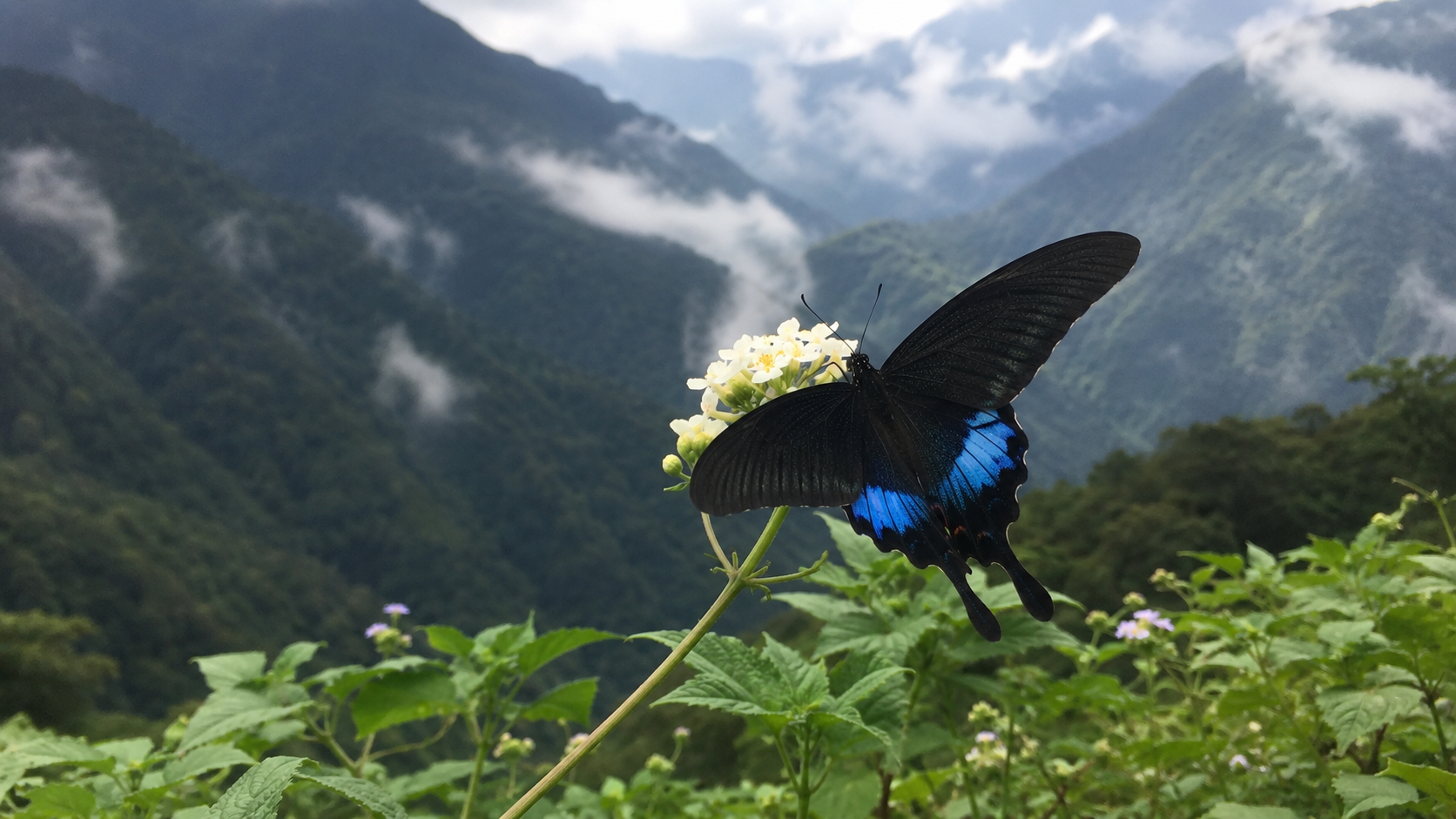
Taiwan is a high island in the western Pacific, separated from the Chinese mainland by the 180 km Taiwan Strait. Its Central Mountain Range runs the length of the island like a spine, with 268 peaks above 3,000 m and the summit of Jade Mountain (Yushan) reaching 3,952 m — the highest point in northeast Asia outside the Himalayas.
This vertical relief compresses tropical lowland forest in the south, subtropical and warm-temperate forest at middle elevations, cool-temperate forest above 2,000 m, and subalpine scrub and alpine meadow above 3,000 m into a narrow band that can be crossed in an hour's drive. The result is one of the highest butterfly diversities per unit area of any island in the world: approximately 400 species, including 57 endemic species and hundreds of endemic subspecies.
Endemics and special species
Swallowtails — Taiwan's crown jewels
Taiwan has 35 swallowtail species, of which several are strict endemics:
- Papilio maraho (Maraho swallowtail) — montane forest, protected as a natural monument; larvae on Sassafras randaiense
- Graphium chironides — local cliff-face and rocky gorge swallowtail of the south
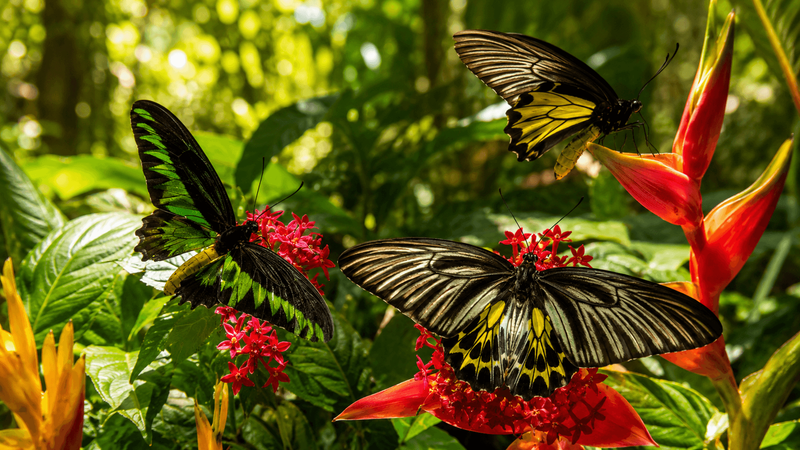
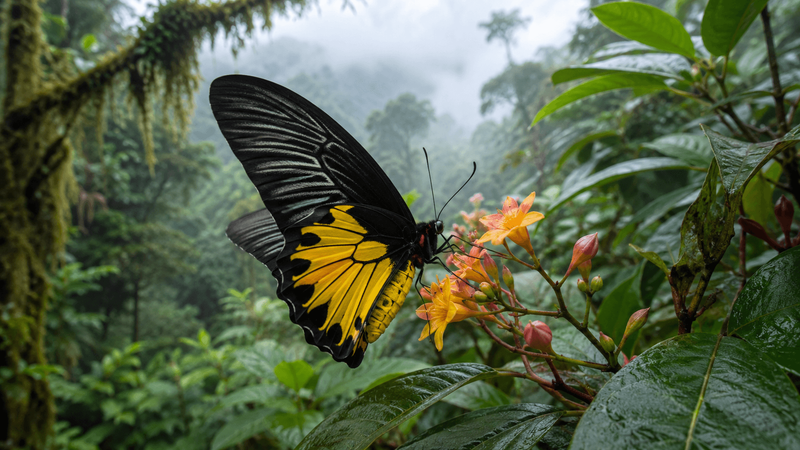
- Troides aeacus kaguya — the Taiwanese subspecies of the Golden birdwing, with exceptionally large females; fully protected
- Byasa impediens febanus — a crimson-patched windmill restricted to Taiwan
Blues and hairstreaks — high endemism
The Lycaenidae of Taiwan include numerous narrow-range endemics, particularly in the high-mountain zone above 2,000 m:
- Shijimia moorei and related high-mountain blues restricted to the Central Mountain Range
- Chrysozephyrus hairstreaks — a diverse complex of oak-associated hairstreaks, many endemic to Taiwan
- Arhopala species — multiple forest blues in lowland and submontane forest
Key regions and sites
Maolin — Purple Butterfly Valley
The Maolin district in Kaohsiung, in the warm southern lowlands, hosts Taiwan's most famous butterfly spectacle. From November to March, hundreds of thousands of Euploea crow butterflies (principally Euploea core and E. mulciber) overwinter in the sheltered valleys, clustering on vegetation in aggregations of tens of thousands. This "Purple Butterfly Valley" is one of only two known large butterfly overwintering sites in the world (the other being the Monarch wintering grounds in Michoacán, Mexico) and is a major eco-tourism destination. Maolin also holds excellent lowland forest butterflies year-round.
Taroko Gorge — Hualien
The dramatic marble gorge of Taroko National Park on the eastern coast offers outstanding butterfly watching at multiple elevations. The gorge road passes from subtropical forest at sea level through montane forest to the ridge at 3,000 m. Lycaenidae diversity is particularly high; several endemic hairstreaks are most reliably found here. The exposed rock faces and river beaches provide mud-puddling sites for swallowtails, Charaxes relatives, and Pieridae.
Alishan — Central Mountain forests
The Alishan mountain area (1,400–2,700 m), accessible by the famous narrow-gauge railway from Chiayi, is the classic site for Taiwanese montane butterflies. Cool-temperate forest with Chamaecyparis cypress, oak, and Sassafras supports endemics including Papilio maraho and numerous endemic hairstreaks. April to June is the peak season at this elevation.
Kenting National Park — southern tip
The tropical lowlands and coral coast of Kenting, Taiwan's southernmost point, hold the island's most purely tropical butterfly fauna — species shared with the Philippines and southeastern China. Open coastal scrub, tropical dry forest, and mangrove margins support the widest range of Pieridae, Lycaenidae, and Danaidae on the island.
Seasonal migrations
Taiwan witnesses two spectacular seasonal butterfly migrations:
Autumn Parantica migration (October–November): Several hundred thousand Parantica sitalces (Chestnut tiger) and P. aglea (Glassy tiger), large orange-and-brown milkweed glassywings, converge from across the island and funnel through the Bagua Mountain ridge and Caoling area, heading south to overwintering sites. The concentration at ridge-top mountain passes produces extraordinary aggregations visible from a few metres.
Spring Pieridae migration (March–April): Northward movement of emigrants (Catopsilia pomona, C. pyranthe), jezebels (Delias species), and common tigers (Danaus genutia) through the lowland corridors of western Taiwan marks the beginning of the butterfly season. Large numbers pause to nectar at flowering trees and shrubs.
Conservation
Taiwan has a well-developed butterfly conservation culture and a strong network of protected areas. Papilio maraho, the Troides birdwings, and several other endemic swallowtails are protected under the Wildlife Conservation Act; collection and trade are prohibited. The Butterfly Conservation Society of Taiwan runs monitoring programs across the island and manages the Purple Butterfly Valley tourism infrastructure.
The main threats to Taiwanese butterfly diversity are habitat conversion in the lowland fringe zone (urban expansion, agricultural intensification), road construction through mountain forests, and the effects of climate warming on high-altitude endemic species whose ranges are limited to a narrow altitudinal band and have nowhere higher to go.