Butterflies of Nepal
Nepal compresses an 8,700-metre altitudinal range into a narrow strip — from Terai plains to the highest peaks — producing around 650 butterfly species.
From jungle to snowline
Nepal is one of the world's most dramatic examples of ecological compression. In a horizontal distance of 150–250 km, the country rises from the subtropical Terai plains on the Indian border — barely 60–100 m above sea level — through a succession of ecological zones to the crest of the Himalaya at over 8,848 m (Mount Everest). No other country of comparable area contains such an extreme and complete altitudinal sequence.
For butterflies, this gradient means that a single country encompasses the tropical species of the Indian plains, the temperate forest species of the Himalayan foothills, the subalpine and alpine species of the high mountains, and the cold desert species of the trans-Himalayan rain shadow. Approximately 650 species have been recorded — roughly half the butterfly fauna of the entire Indian subcontinent, packed into a country one-twentieth of India's size.
The three ecological zones
The Terai: tropical lowlands
The Terai is a narrow strip of flat alluvial plain along Nepal's southern border, ecologically continuous with the Gangetic Plain of India. Once covered in dense subtropical and tropical moist deciduous forest (sal forest — Shorea robusta), much of the Terai has been converted to agriculture. The remaining forest blocks, protected as national parks, contain some of Nepal's richest butterfly communities.
Chitwan National Park (932 km²) is the most important butterfly site in the Terai and one of the best-known in Nepal. Its mix of sal forest, riverine forest, grassland, and wetland supports:
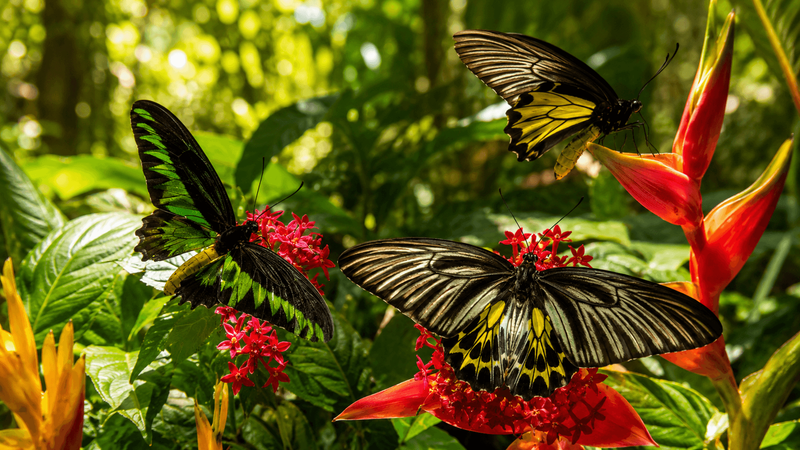
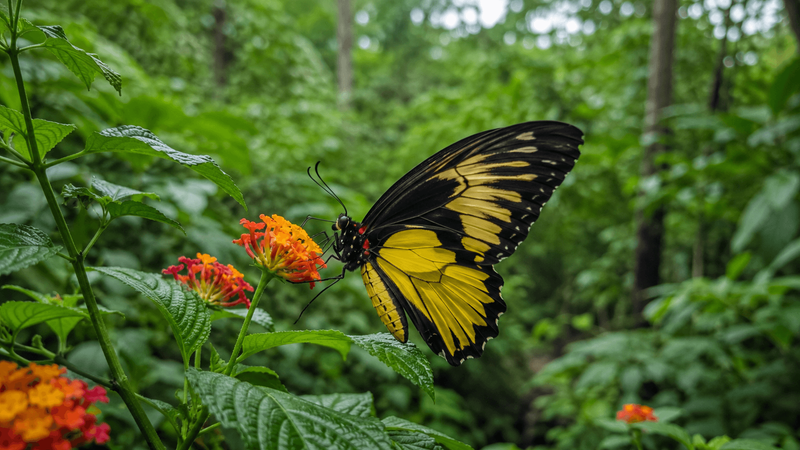
- Golden Birdwing (Troides aeacus) — Nepal's largest butterfly; males brilliant yellow and black; flies along forest rivers and at forest edge
- Common Mormon (Papilio polytes) and Blue Mormon (Papilio polymnestor) — large swallowtails abundant in the forest and at flowers
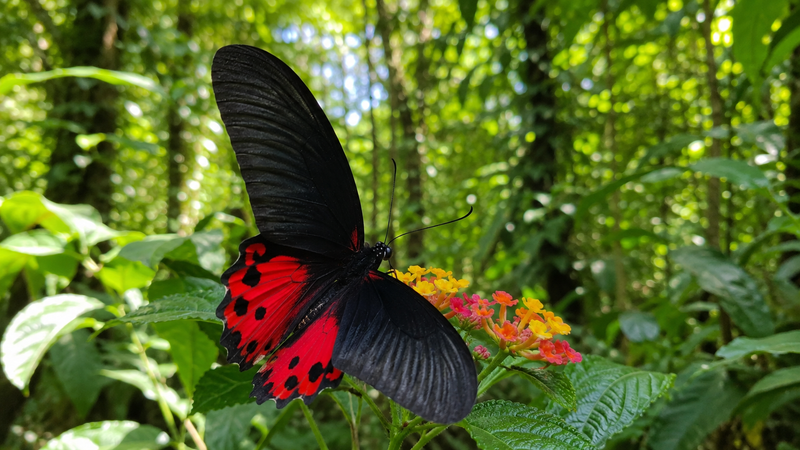
- Crimson Rose (Pachliopta hector) — vivid red-and-black swallowtail; characteristic of tropical forest edge
- Clipper (Parthenos sylvia) — large, fast-flying nymphalid with complex blue-black-and-white pattern; forest canopy
- Multiple Charaxes and Polyura emperors — powerful, fast-flying; attracted to fermenting fruit bait
- Rich lycaenid and hesperiid communities in the forest understorey
Bardia National Park in western Nepal is less visited but equally rich, with additional species at the western limit of their Terai range.
The Middle Hills: temperate diversity
The Middle Hills (broadly 500–3,000 m) — the zone of Nepal's traditional settlement, terraced agriculture, and rhododendron-oak forest — represent the greatest total species richness. Here the tropical lowland fauna overlaps with temperate elements, and the density of microclimates produced by deep river valleys, ridges, and aspect variation creates exceptional local diversity.
Langtang National Park (north of Kathmandu, 1,710–7,234 m) spans the full range from temperate forest to alpine zone and is accessible from Kathmandu, making it a popular butterfly destination. The trail from Dhunche to Langtang village passes through prime middle-altitude habitat (rhododendron and oak forest at 2,000–3,500 m) where species richness peaks in April–May:
- Common Jezebel (Delias eucharis) — vivid yellow-red-black pierid; forest canopy
- Kaiser-i-Hind (Teinopalpus imperialis) — one of Asia's most sought swallowtails; iridescent green; temperate forest; elusive
- Multiple Neptis sailers, Lethe and Mycalesis browns in shaded forest
- Tawny Rajah (Charaxes bernardus) and related species at forest edges
- High numbers of Parnassius above 3,000 m in summer
The Kathmandu Valley retains good butterfly diversity in its remnant natural areas despite urbanisation — particularly in the Shivapuri-Nagarjun watershed above the city.
The High Himalaya: alpine specialists
Above the tree line (generally 3,800–4,200 m depending on aspect), the butterfly fauna thins dramatically in species count but gains in biogeographic significance. The high Himalayan and trans-Himalayan zones are dominated by:
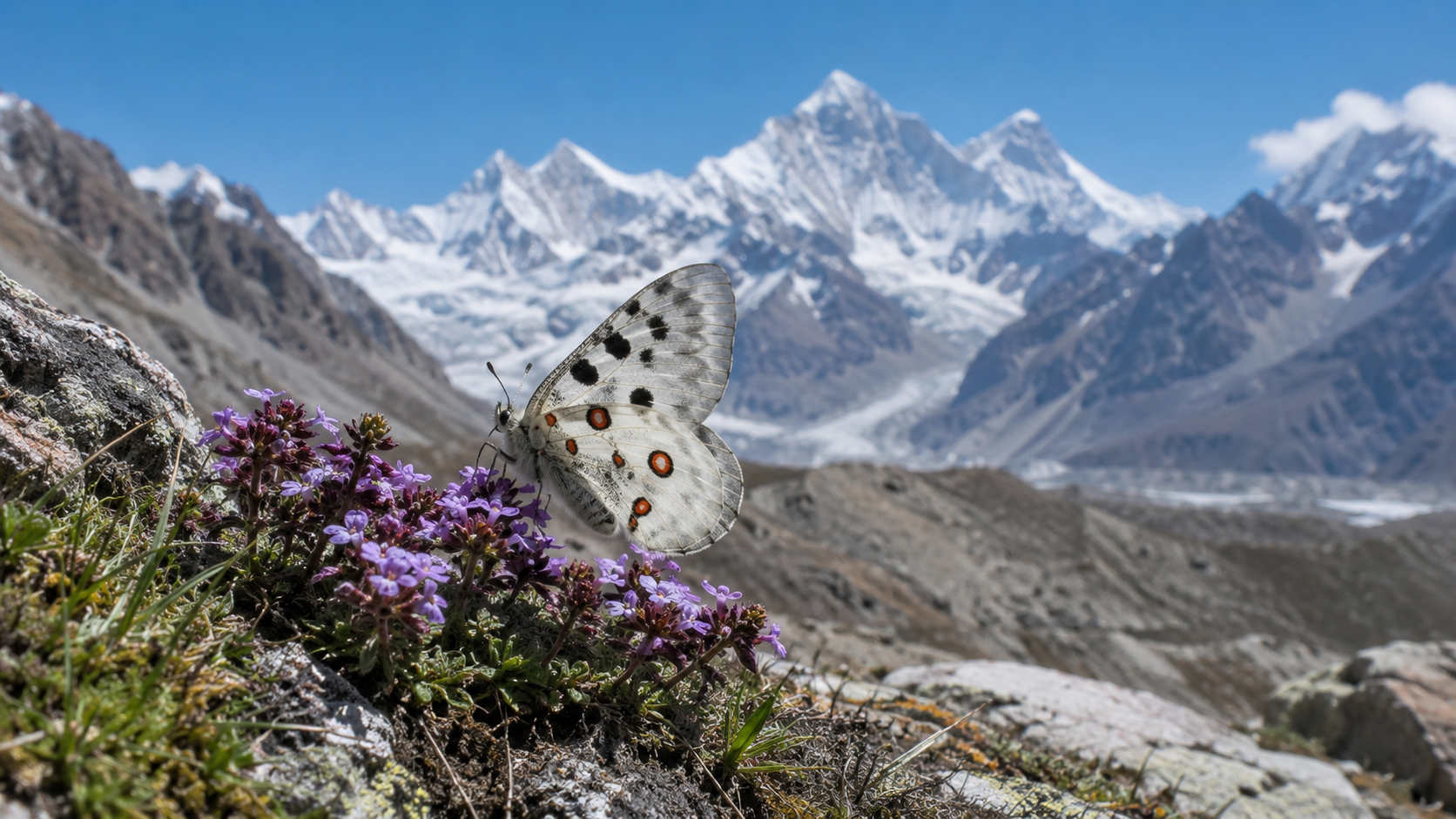
Apollo butterflies (Parnassius spp.) — the most characteristic high-altitude genus. Several species occur in Nepal's alpine zone, some restricted to specific valleys or massifs. Parnassius epaphus, Parnassius hardwickii, and Parnassius charltonius are among the most sought. These large, white or cream-coloured butterflies with red eyespots fly in the thin air of glacial valleys and alpine meadows.
High-altitude Blues (Plebejus, Polyommatus) — small but often intensely coloured; associated with alpine cushion plants and sedges above 4,000 m.
Himalayan Satyrs — several Erebia, Hipparchia, and related genera adapted to the cold and wind of the alpine zone.
In the Sagarmatha (Everest) region, butterflies have been recorded at extraordinary altitudes — occasional wanderers above 5,000 m, with reliable breeding populations documented above 4,500 m. The small lycaenid Plebejus sp. holds the record for one of the highest recorded butterfly populations in the world.
Iconic species
Kaiser-i-Hind (Teinopalpus imperialis) — arguably the most coveted swallowtail in South Asia; males brilliant metallic green with yellow patches; inhabits steep forested hillsides at 2,000–3,500 m; rare and elusive, noted for hilltop-soaring behaviour.
Golden Birdwing (Troides aeacus) — Nepal's largest butterfly; canopy glider; CITES Appendix II; Terai and lower foothills.
Common Nawab (Polyura athamas) — powerful nymphalid with rapid flight; common in the Terai; males mud-puddle at stream margins.
Parnassius hardwickii (Hardwick's Apollo) — large, cream-white with distinctive markings; sub-alpine meadows; named after British naturalist Charles Hardwick who collected in Nepal in the early 19th century.
Clipper (Parthenos sylvia) — large, dramatically patterned nymphalid; fast, soaring flight in the Terai forest canopy; multiple colour forms in South and Southeast Asia.
Observation seasonality
| Season | Best zones | Notes |
|---|---|---|
| March–May (pre-monsoon) | Middle Hills, subalpine | Rhododendron bloom; high species numbers; most accessible high routes |
| June–August (monsoon) | Terai, lower hills (with caution) | Heavy rain, leeches; Terai productive but humid; high country wet |
| September–November (post) | Terai, middle hills | Clear weather; high adult numbers after monsoon breeding season |
| December–February (winter) | Terai (Chitwan, Bardia) | Cold in hills; Terai butterflies still active on warm days |
Conservation
Nepal's butterfly fauna faces pressures from multiple directions:
- Deforestation: Middle Hills forests have been heavily cleared for agriculture; remaining forest is fragmented
- Agricultural intensification: conversion of Terai forest to rice paddies and sugarcane has eliminated lowland habitat over large areas
- Collection pressure: high-value species (Kaiser-i-Hind, Birdwings, Parnassius) attract collectors; Nepal has legal protections for certain species but enforcement is variable
- Climate change: the alpine zone is warming; Parnassius and other cold-adapted species face upward habitat compression
Nepal's national parks and conservation areas protect significant butterfly habitat, particularly in the Terai (Chitwan, Bardia, Koshi Tappu) and the Himalayan chain (Sagarmatha, Langtang, Annapurna). The Annapurna Conservation Area, covering 7,629 km² of middle and high mountain habitat, is one of the largest protected areas in South Asia and includes excellent butterfly habitat in the Marsyangdi and Modi river valleys.
Interesting facts
- The Kaiser-i-Hind (Teinopalpus imperialis) was so prized by Victorian collectors that specimens commanded enormous prices; early accounts describe local people being paid substantial sums to climb to hilltopping sites and capture males — the species remains one of the most sought after in Asian butterfly-watching
- Nepal's first systematic butterfly survey was conducted by British naturalist Brian Houghton Hodgson in the 1830s–1840s; many species first described from Nepal were collected during his long residency in Kathmandu and named by entomologists in London from his specimens
- The Terai Arc — a belt of protected forest along Nepal's southern border, connected by wildlife corridors — was originally designed for tigers and elephants, but its protection also preserves one of the most intact tropical butterfly communities in the Indian subcontinent
- At least five butterfly species discovered in Nepal in the 20th century were subsequently found to be undescribed new species — the Himalayan foothills continue to yield taxonomic surprises as molecular techniques are applied to existing museum collections