Priam's Birdwing
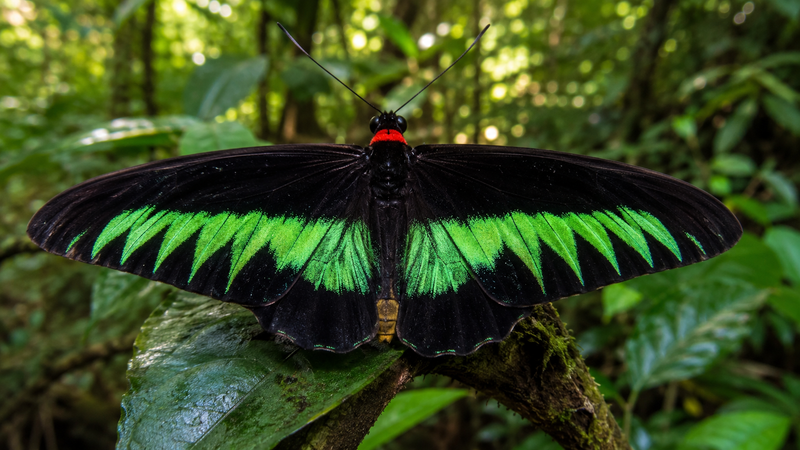
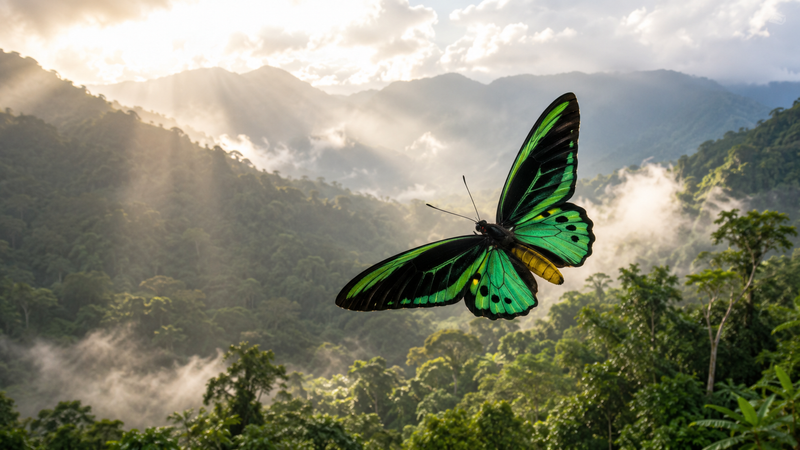
Priam's Birdwing is one of the largest, most spectacular butterflies. Males show iridescent green and black wings; larger females are brown and yellow.
Key facts
- Latin name
- Ornithoptera priamus
- Family
- Papilionidae
- Wingspan
- 130-200 mm
- Flight season
- Year-round
- Host plants
- Aristolochia tagala, Aristolochia acuminata, Aristolochia spp. (various)
- Conservation status
- LCLeast Concern
A giant of the rainforest
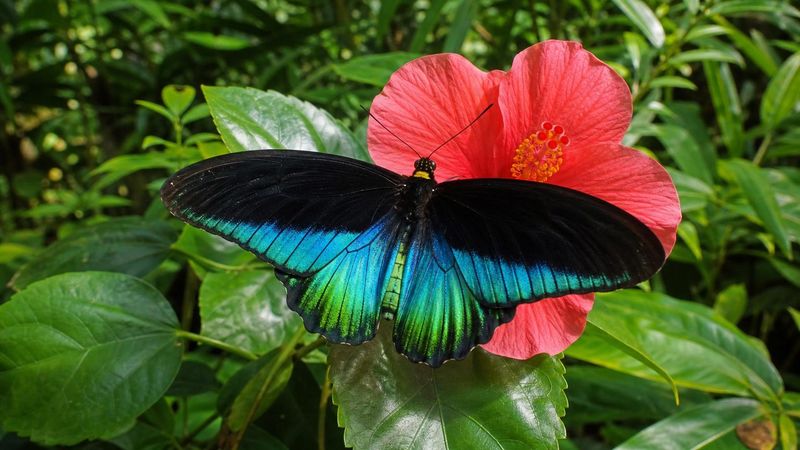
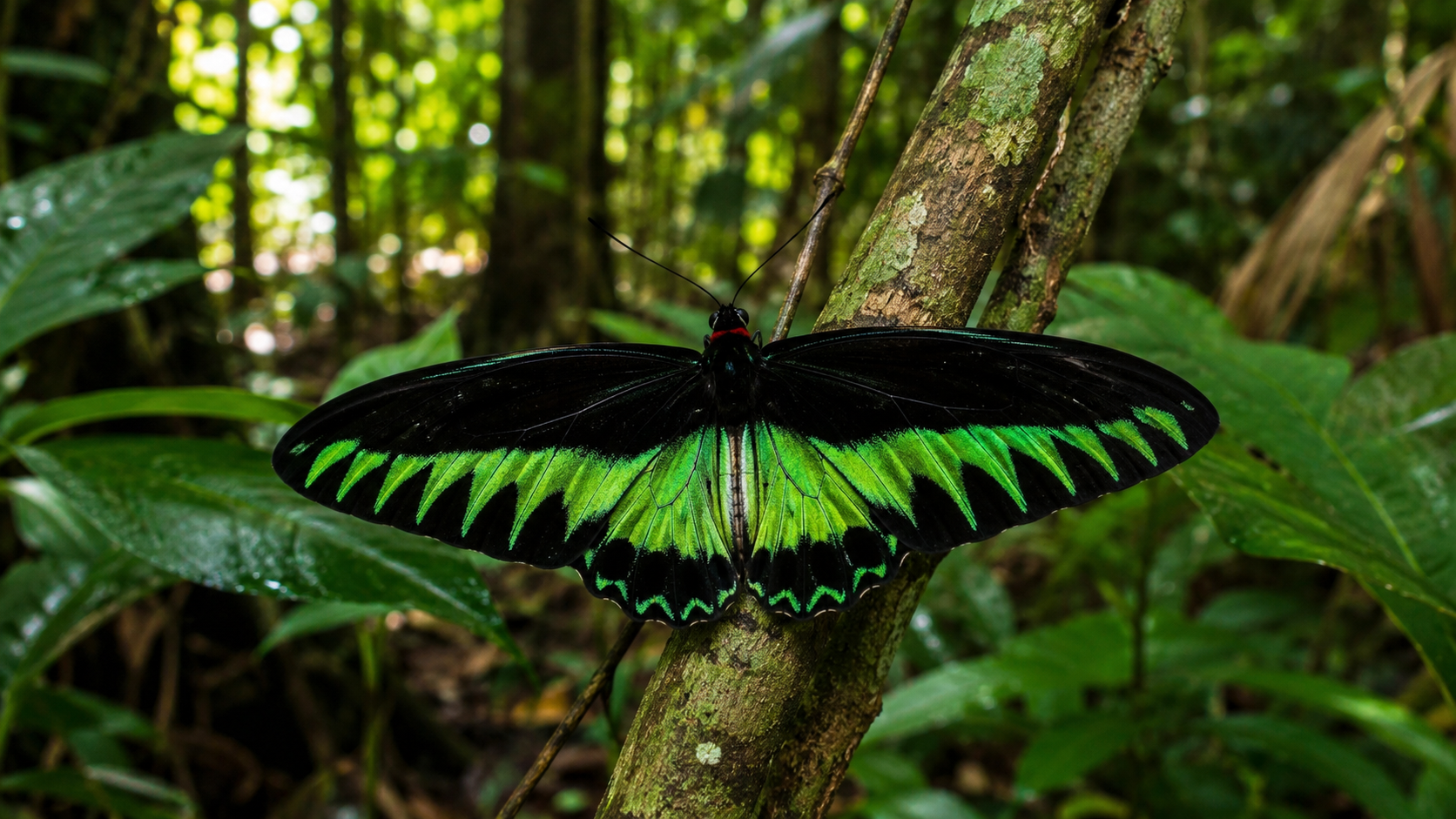
Ornithoptera priamus — Priam's Birdwing — combines extraordinary size with spectacular colour. The male's wings are black with brilliant iridescent green covering most of the forewing and hindwing; the abdomen is yellow. In sunlight the green shifts between turquoise, emerald, and gold depending on angle. The female is larger — sometimes dramatically so — patterned in brown, white, and yellow on a black background; she lacks the male's iridescence but is formidable in scale.
The genus name Ornithoptera means "bird-winged" — a reference to the size and speed of flight. In the field, a large female crosses a rainforest clearing with the wingbeat of a bird rather than an insect, and is sometimes briefly misidentified as one.
Taxonomy and subspecies
Ornithoptera priamus was formally described by Linnaeus in 1758 — among the first Australasian butterflies to enter the Linnaean system. It is the type species of the genus Ornithoptera and has given its name to the entire birdwing complex.
The species comprises numerous subspecies spread across a large geographic range:
| Subspecies | Range | Male notes |
|---|---|---|
| O. p. priamus | Seram, Ambon (Moluccas, Indonesia) | Nominate; vivid green |
| O. p. poseidon | Papua New Guinea, northeast Australia | Largest and most vivid subspecies |
| O. p. urvillianus | New Britain, Bougainville, Solomon Islands | Blue-green tone in some individuals |
| O. p. arruana | Aru Islands (Indonesia) | Greener, white hindwing patches |
The Australian populations all belong to subspecies poseidon. Taxonomy within the group remains debated; some authorities elevate poseidon and urvillianus to species rank.
The Aristolochia connection
All Ornithoptera birdwings depend on Aristolochia vines (birthworts) as larval host plants. The caterpillars sequester toxic aristolochic acids from the plants into their own tissues, making them unpalatable to predators — a defence that persists through metamorphosis into the adult, which is also distasteful.
The slow-growing, woody Aristolochia vines occur in rainforest understorey and edges. In Australia, the main species is Aristolochia tagala; in Papua New Guinea several species are used. Loss of Aristolochia through forest clearance directly limits birdwing populations, as females will not oviposit on alternative plants.
In gardens across northeast Queensland, planting Aristolochia tagala — sometimes called the Indian birthwort — reliably attracts breeding Priam's Birdwings. The vine is sold commercially in nurseries in Cairns and Townsville specifically for this purpose.
Lifecycle
Eggs and early instars
Females lay large, spherical pale eggs singly on young Aristolochia stems and leaves. The newly hatched caterpillar is brownish-red with fleshy tubercles along the body — conspicuous rather than cryptic, relying on its toxicity for defence. Early instars feed on leaf surfaces; later instars can consume entire leaves.
Late instars and pupa
Mature caterpillars are spectacular: large (up to 70 mm), with a pattern of dark reddish-brown and cream-yellow tubercles. The chrysalis is angular, brownish-green, and attached to a stem by a silk pad and girdle; it resembles a dried leaf or seed pod. The pupal period lasts approximately four to six weeks.
Adult
Adults emerge with wings fully formed after inflation from the pupal case. Males emerge before females and may wait near pupation sites for emerging females (a behaviour called "pupal mating"). Life span of the adult is several weeks; females live longer than males.
Flight and behaviour
Priam's Birdwings fly high and powerfully, often above the forest canopy. Males come lower to feed at flowers — particularly Lantana, Bauhinia, and Quisqualis (Rangoon creeper) are favoured garden nectar sources. Females descend to oviposit on Aristolochia and are less often observed at flowers.
Males are not territorial in the same way as Papilio swallowtails; multiple males can occur near the same Aristolochia patch. Puddling at wet soil, stream banks, and animal dung is common, particularly in Papua New Guinea where mineral sources are concentrated.
Papua New Guinea butterfly farming
Papua New Guinea operates one of the world's most successful legal butterfly farming programmes. Licensed village farmers breed birdwings and other large Papilionidae for legal export; each specimen carries documentation of captive origin.
For Ornithoptera priamus, PNG butterfly farming has:
- Provided an economic alternative to forest clearance for rural communities
- Created incentives to maintain Aristolochia vines and forest habitat around farms
- Supplied the international collector and display market sustainably, reducing poaching pressure on wild populations
The industry has been cited as a model for wildlife trade regulation: the economic value of a living, breeding birdwing exceeds the value of a wild-caught specimen, creating long-term conservation incentives. A legal certificate of origin from PNG allows legal international trade in farmed specimens under CITES Appendix II.
Distribution and habitat
The species spans a broad arc from the Moluccas (Seram, Ambon) through Papua New Guinea to the Solomon Islands and northeast Queensland. Within this range it is a lowland and lower montane species, most abundant in primary and lightly disturbed rainforest from sea level to about 1,200 m.
In Australia, populations are concentrated in the Wet Tropics World Heritage Area. The species is absent from dry forest and savannah zones and does not extend south of approximately Townsville.
Conservation
Despite CITES Appendix II protection, pressures on the species include:
- Deforestation: primary rainforest loss in Papua New Guinea (oil palm, logging) fragments populations
- Host plant loss: Aristolochia removal from gardens and forest edges
- Illegal collection: large perfect males still attract high prices from unscrupulous collectors; enforcement in remote PNG is difficult
The species is not immediately threatened at the global level but several island subspecies have restricted ranges and may be vulnerable to localised forest loss.
Interesting facts
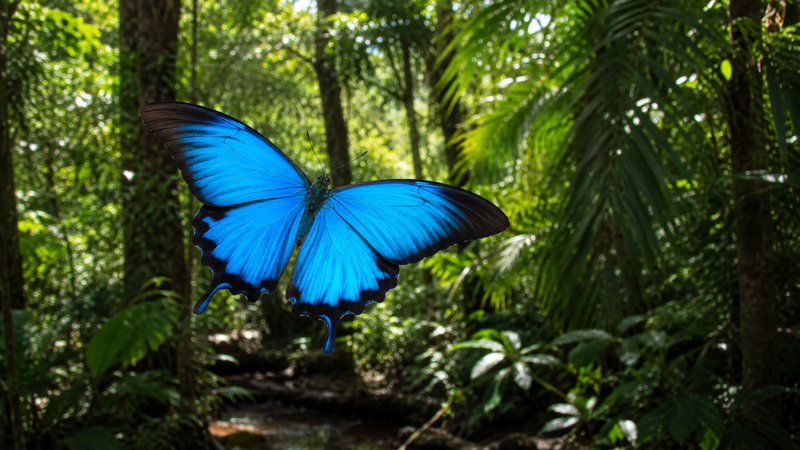
- Linnaeus named the species priamus after Priam, the king of Troy in the Iliad — giving this giant butterfly a name befitting its stature; the Ulysses Swallowtail (Papilio ulysses), found alongside it in Queensland, is named for the Greek hero who sacked Priam's city
- The related Queen Alexandra's Birdwing (Ornithoptera alexandrae), found only in a small area of Papua New Guinea, is the world's largest butterfly by wingspan; priamus poseidon females are the largest butterflies found in Australia
- In Papua New Guinea, birdwing butterflies feature in traditional ornamentation and headgear; their cultural significance has been noted as an additional argument for legal farming versus poaching
- Aristolochic acids from the larval food plants are among the most potent natural toxins known; they persist in the adult butterfly and are toxic to vertebrates — making birdwings genuinely unpalatable rather than merely warning-coloured mimics