Butterflies of Australia
Australia has about 420 butterfly species — modest globally but with high endemism. Queensland's tropical rainforests hold most of the diversity.
Australia: an isolated butterfly continent
Australia's long geographic isolation has shaped a butterfly fauna that is both limited in total species number and highly distinctive in composition. With approximately 420 species of day-flying butterflies, Australia falls far below tropical South America or Southeast Asia in raw numbers — but it compensates with extraordinary endemism and several uniquely Australian lineages.
The continent's butterfly geography follows its climate zones closely: the tropical north (Queensland, Northern Territory) holds most of the diversity; the temperate south and interior arid zones have far fewer species; and Tasmania and alpine areas of the Great Dividing Range host cold-adapted forms found nowhere else.
Queensland: the butterfly heartland
Wet Tropics
The narrow strip of tropical rainforest running along the northeast Queensland coast — designated a UNESCO World Heritage Area — is Australia's butterfly epicentre. The Daintree Rainforest, Cape Tribulation, and the Atherton Tablelands form a mosaic of lowland, montane, and riverine habitats that supports more than half of all Australian butterfly species.
The Cairns Birdwing (Ornithoptera euphorion) — Australia's largest butterfly — is the flagship species. Males patrol rainforest clearings with slow, powerful wingbeats, flashing their green-and-black wings in slanting morning light. The female, much larger at up to 160 mm wingspan, is more cryptic.
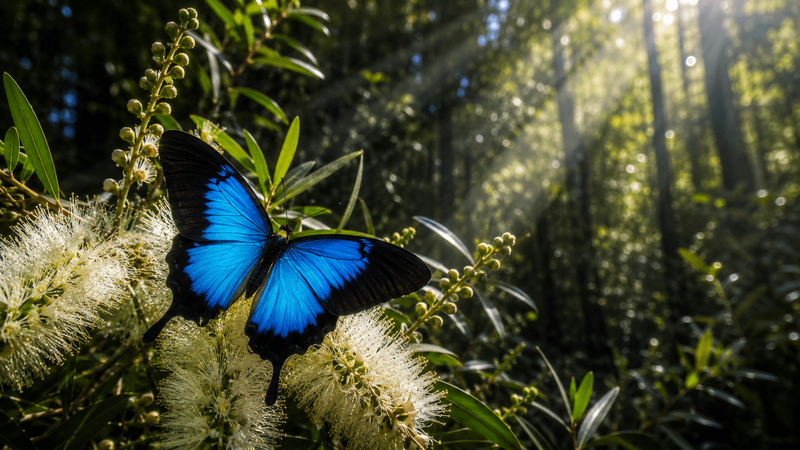
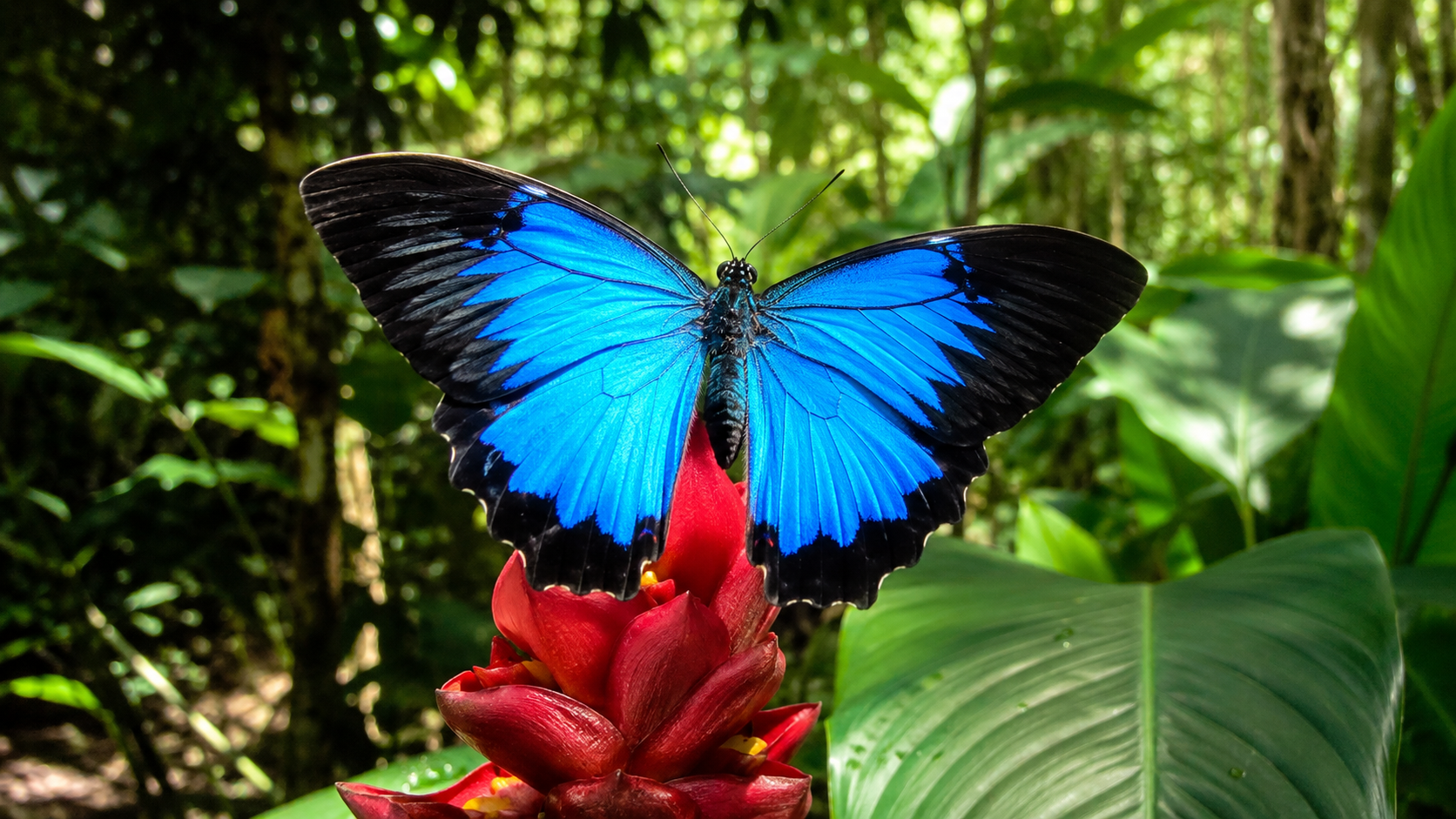
Equally stunning is the Ulysses butterfly (Papilio ulysses) — the tourism symbol of tropical Queensland. Its electric-blue wings (a structural colour, not pigment) are visible from tens of metres away. It is attracted to blue flowers and frequently descends to eye level along rainforest edges.
Cape York Peninsula
The Cape York Peninsula extending to the Torres Strait is the southernmost extension of a biological corridor connecting Australia with Papua New Guinea. Several species cross via the islands, making Cape York the entry point for Indo-Pacific species rarely found further south. The Blue Triangle (Graphium choredon) and various Jezebel butterflies (Delias spp.) are common here.
Southeast Australia
The temperate forests and heathlands of Victoria, New South Wales, and South Australia hold a different community dominated by browns, skippers, blues, and coppers. Notably endemic species include:
Fiery Jewel (Hypochrysops ignitus) — a small, brilliant orange lycaenid of coastal heathlands; one of the most vivid butterflies in southern Australia.
Imperial Blue (Jalmenus evagoras) — a lycaenid with a complex relationship with ants; larvae are tended by Iridomyrmex ants in return for secreted sugars, a classic example of myrmecophily.
Regent Skipper (Euschemon rafflesia) — the sole member of a primitive skipper subfamily (Euschemoninae) found only in Australia; a large, black-and-yellow species of Queensland rainforest.
Alpine species
The Australian Alps (Mount Kosciuszko area) and Tasmanian mountains support a small community of cold-adapted butterflies active only in the brief summer (December–February). The Bogong Moth (Agrotis infusa) is famous for its mass alpine migrations, but butterfly equivalents include mountain copper species and the Alpine Xenica (Oreixenica ptunarra) — a small grass-brown endemic to Tasmanian highland grasslands.
Iconic species
Cairns Birdwing (Ornithoptera euphorion) — Australia's largest butterfly; male metallic green and black, female brown and white, wingspan 120–160 mm. Endemic to north Queensland rainforest.
Ulysses Butterfly (Papilio ulysses) — electric blue swallowtail; the unofficial emblem of Cairns; common in rainforest edges and gardens.
Orchard Swallowtail (Papilio aegeus) — large black-and-white swallowtail of gardens and forest edges from Queensland to Victoria; one of Australia's most frequently seen large butterflies.
Monarch (Danaus plexippus) — the monarch is not native to Australia but has established a resident population, arriving from North America in the 19th century. It does not perform long-distance migrations in Australia as it does in the Americas.
Common Jezebel (Delias nigrina) — a colourful white-and-yellow nymphalid with vivid red underwing markings; visible in gardens and forest edges throughout eastern Australia.
Best observation sites
Daintree National Park and Cape Tribulation (north Queensland) — the classic Wet Tropics destination; easily reached from Cairns. Morning hours on rainforest roads produce birdwings, Ulysses, and dozens of smaller species.
Atherton Tablelands (north Queensland) — montane rainforest; cooler and with slightly different species assemblage including some upland endemics.
Australian Butterfly Sanctuary, Kuranda — the largest butterfly house in Australia; living collection of 1,500+ individuals; useful for identifying species before venturing into the field.
Tidbinbilla Nature Reserve (ACT, near Canberra) — excellent for temperate species; well-maintained trails through woodland and grassland.
Observation season
In tropical Queensland butterflies fly year-round, with peaks in the wet season (November–April) when host plants flush. The dry season (May–October) brings clearer skies and more comfortable walking conditions. Birdwings are most active in the mornings and less common at the height of the wet season.
In temperate southeast Australia the main season runs October–April (austral spring and summer). Alpine species emerge only in December–February.
Conservation
Australia's main butterfly conservation concern is habitat loss in the Wet Tropics and fragmentation of coastal heathlands. The Richmond Birdwing (Ornithoptera richmondia) — found only in a small area of rainforest in southeast Queensland and northeast New South Wales — is listed as vulnerable. Its decline is linked to the introduced Dutchman's Pipe vine (Aristolochia elegans), which attracts females to lay eggs but kills the larvae.
Community replanting programmes using native Pararistolochia host plants have helped stabilise some Richmond Birdwing populations.
Interesting facts
- The Regent Skipper (Euschemon rafflesia) is the only member of the subfamily Euschemoninae in the world — a lineage found nowhere outside Australia.
- The Cairns Birdwing is the world's largest butterfly restricted to a single country.
- Australian lycaenids (blues and coppers) show some of the most complex ant associations known in the family Lycaenidae — many larvae are parasitic on ant colonies rather than being merely tolerated by them.