Purple Emperor
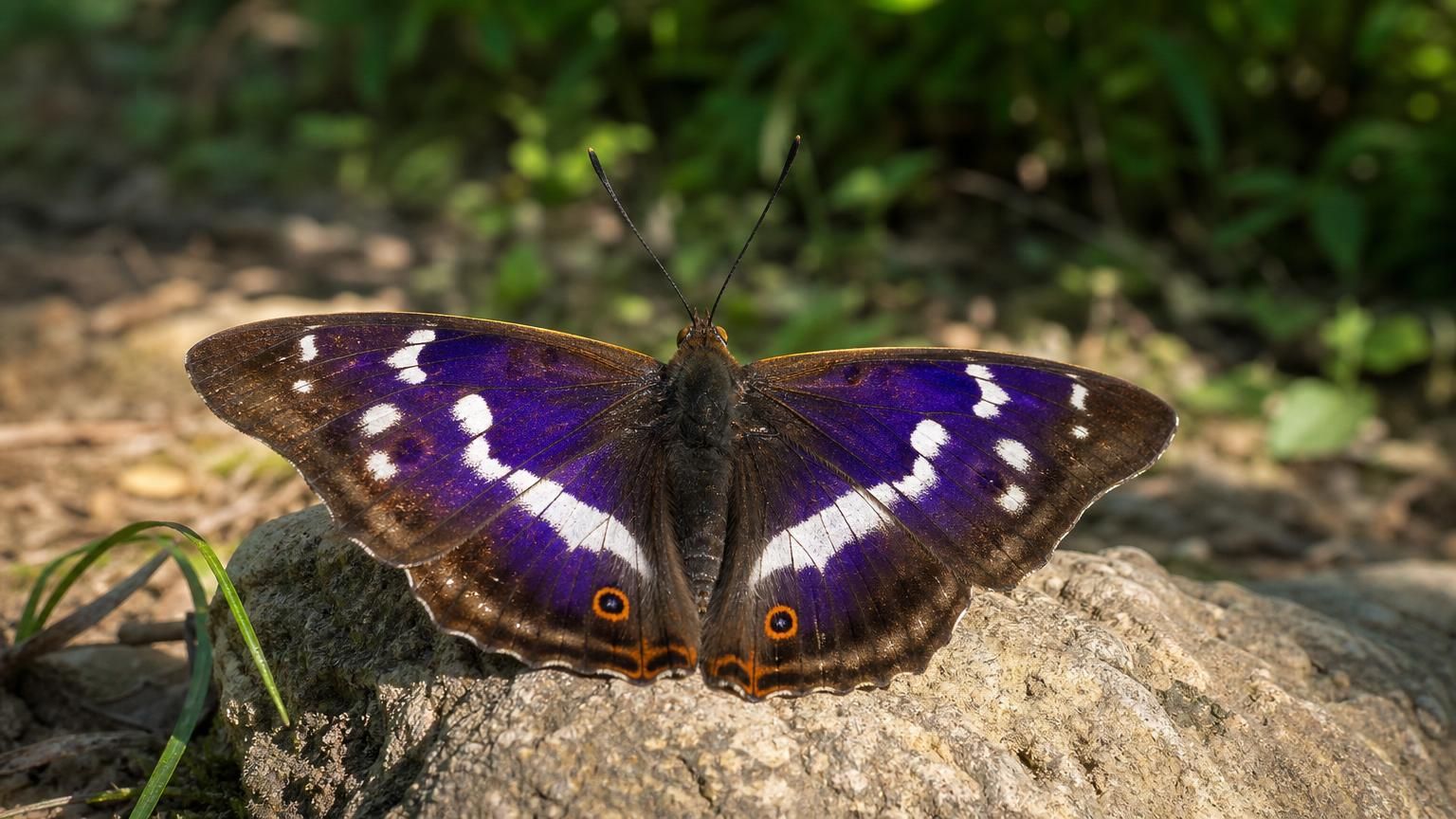
The purple emperor is one of the most beautiful butterflies in Europe. The male's wings shimmer with violet-blue iridescence in certain light.
Key facts
- Latin name
- Apatura iris
- Family
- Nymphalidae
- Wingspan
- 58-84 mm
- Flight season
- June — August
- Host plants
- Goat willow, Grey willow, Tea-leaved willow
- Conservation status
- LCLeast Concern
Appearance
The purple emperor (Apatura iris) is a large butterfly with a wingspan of 58–84 mm. In the male the upper side of the wings is dark brown with white spots and bands; in the right light the wings show a bright violet-blue metallic sheen. The female is similar but larger and without the violet sheen.
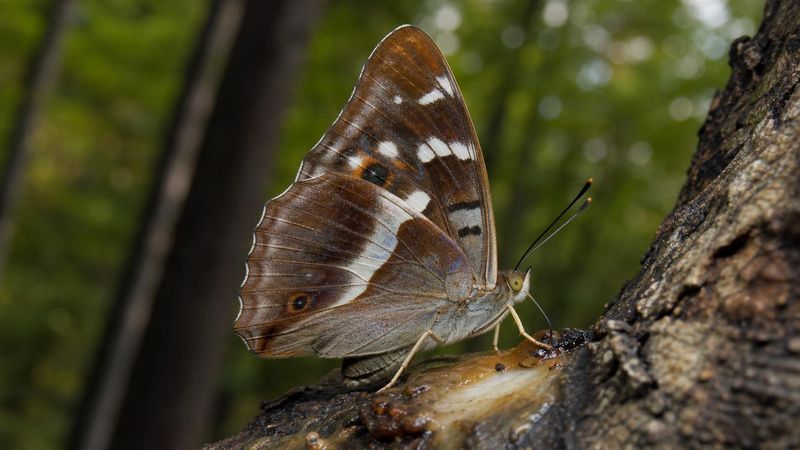
On the underside of the hindwings — a large orange 'eyespot' with a black dot. The underside is reddish with white spots and a faint lilac tint.
Range and Habitat
It is distributed in the forest zone of Europe and Asia to Japan. In Russia — in the European part and Siberia.
It lives in mixed and broad-leaved forests with willow. A high tree canopy is essential — males stay on tree tops.
Life Cycle
One generation per year. Flight from June through August. The caterpillar overwinters on willow branches.
Eggs are laid singly on the upper side of willow leaves. The caterpillar is bright green with two horns on the head — very decorative. It feeds on willow leaves. The pupa is green, angular, and hangs from a branch.
Iridescence
The male's blue sheen is an example of structural colour: the colour is created by light interference in ordered chitin nanostructures, not by pigments. A similar effect occurs on morpho wings, the Madagascar emerald pigeon, and many other animals.