Ulysses Swallowtail
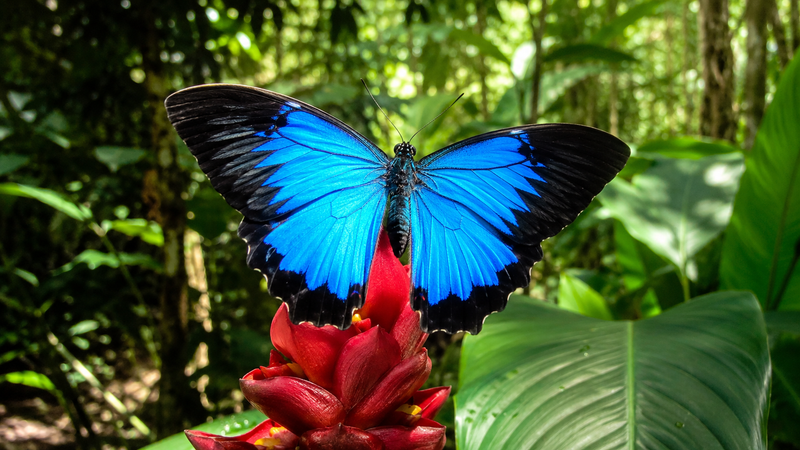
The Ulysses Swallowtail is a large rainforest swallowtail whose iridescent electric-blue wings flash through the canopy of Queensland and New Guinea.
Key facts
- Latin name
- Papilio ulysses
- Family
- Papilionidae
- Wingspan
- 100-130 mm
- Flight season
- Year-round (peak after wet season)
- Host plants
- Melicope elleryana (pink euodia), Euodia spp., Acronychia spp.
- Conservation status
- NENot Evaluated
A flash of electric blue
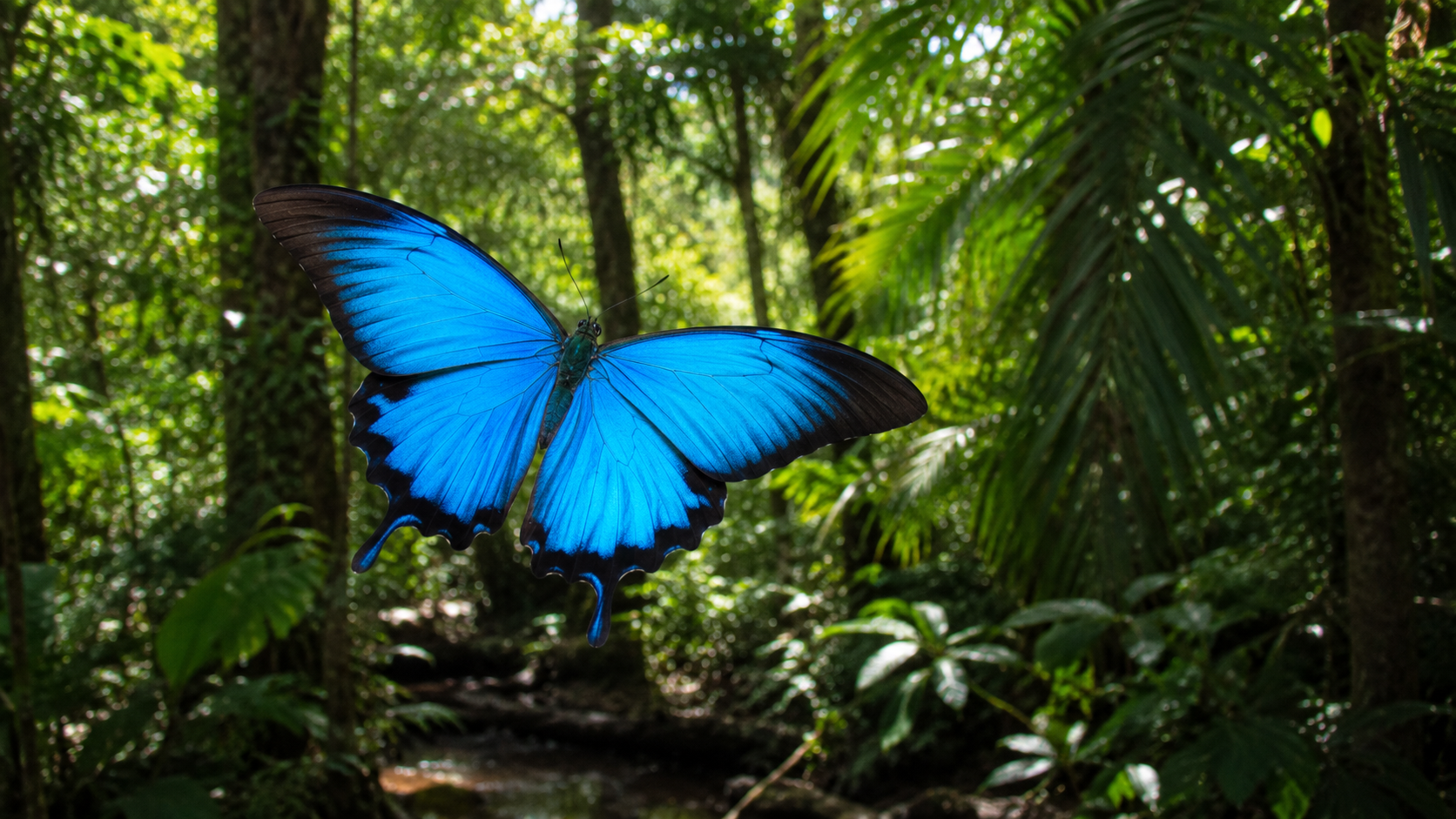
Few butterflies announce themselves as dramatically as the Ulysses Swallowtail. In flight through the rainforest, the wings catch sunlight and emit a pulse of iridescent blue visible from 50 metres or more — a quality so striking that it has been compared to a neon light flickering through the canopy. Up close, the wings reveal a complex pattern: vivid blue occupying most of the upper surface of both wings, bounded by a broad black border, with tailed hindwings that add to the swallowtail silhouette.
The underside is the opposite: almost entirely black-brown with minimal patterning. A resting Ulysses with wings closed disappears against tree bark or leaf litter — the transformation from brilliant to invisible is complete.
Taxonomy and distribution
Papilio ulysses belongs to the family Papilionidae (swallowtails) and is named after the Greek hero Odysseus (Ulysses in Latin). The species has numerous subspecies across its range:
- P. u. telegonus — the Australian subspecies, found in Queensland
- P. u. ulysses — Papua New Guinea and the Moluccas (the nominate subspecies)
- Additional subspecies in Vanuatu, Solomon Islands, and Seram
In Australia, the species is confined to the Wet Tropics — the narrow coastal rainforest belt of northeast Queensland. It does not occur in the drier forests of the interior and is absent from southern Queensland.
The structural colour
The blue of Papilio ulysses is produced by thin-film interference in the wing scale nanostructures — the same physics that creates colour in soap bubbles, beetle wing cases, and certain feathers. The scales are made of chitin arranged in layered gratings; when light strikes these layers, some wavelengths are reinforced through constructive interference while others cancel out.
The result is a colour that:
- Is extraordinarily saturated, far beyond any pigment
- Shifts slightly with angle
- Disappears entirely on the underside, which lacks the nanostructure
- Remains unfaded long after death (the scales retain their structure in pinned specimens)
This structural blue has attracted interest from materials scientists studying biologically inspired optical coatings.
Lifecycle
Eggs and larvae
Females lay single green eggs on the upper surface of young leaves of host plants, primarily Melicope elleryana (pink euodia, formerly Euodia elleryana) and related Rutaceae. The young caterpillar is brown with white saddle markings, resembling a bird dropping — an effective camouflage on a leaf surface. Older instars become brown and green with false eyespots on the thorax.
The larva feeds on the host plant at night and rests concealed during the day. Development through five instars takes approximately three weeks in tropical conditions.
Pupa and adult
The chrysalis is green, angled, and attached by a silk girdle and tail pad — typical swallowtail construction. In continuous tropical conditions the pupal stage lasts two to three weeks. Adults emerge throughout the year, with peaks in population following the wet season when host plant growth is most vigorous.
Behaviour
Flight
The Ulysses is a fast, powerful flier with a characteristic bouncing, looping flight path through forest edges and clearings. It is strongly attracted to blue objects and flowers — particularly Melicope elleryana blossoms, which are a key nectar source in Queensland gardens. The response to blue colour is sufficiently consistent that blue flags and traps have been used to attract males for study.
Males are territorial and will investigate any large blue intruder — including blue hats, clothing, or equipment of an observer — before departing. This behaviour makes the species relatively easy to observe once a display perch or nectar source is located.
Puddling
Males regularly puddle at damp ground, stream banks, and road surfaces to absorb dissolved salts. Puddling aggregations of several individuals can form at productive sites in the wet season.
Habitat and gardening
In Cairns and surrounding towns, the Ulysses is commonly seen in gardens where pink euodia (Melicope elleryana) has been planted. This single action — planting the larval host tree — reliably attracts breeding Ulysses Swallowtails to urban gardens within the species' range. The tree is fast-growing, produces small pink flowers, and is used horticulturally throughout tropical Queensland.
Edge habitats between rainforest and gardens are particularly productive. The species uses intact rainforest for shelter and dispersal but often breeds and feeds at sunny forest edges and in adjacent gardens.
Conservation
The Ulysses Swallowtail is not globally threatened — it remains widespread and locally common across its range. However, several factors warrant monitoring:
- Queensland population: dependent on the Wet Tropics rainforest system, which is World Heritage listed but under pressure from climate change (reduced rainfall reliability at higher elevations) and urban expansion around Cairns
- National protection: collecting in Australia requires a permit; Papua New Guinea permits sustainable collection under its butterfly farming industry. The species is not listed on CITES.
- Host plant availability: in urban areas, planting of Melicope elleryana directly influences local breeding populations
Interesting facts
- The Ulysses Swallowtail is the tourism symbol of Queensland, appearing widely in promotional material for the Cairns region and the Great Barrier Reef hinterland
- The species responds so reliably to blue that collectors historically used blue lures to attract males; modern researchers use the same approach for survey work
- In Papua New Guinea, Papilio ulysses is among the species legally farmed for export; large, perfect specimens command high prices from collectors worldwide
- The French entomologist Hippolyte Lucas formally described the species in 1857, naming it after Homer's wandering hero