Evolution of Butterflies: 150 Million Years
Butterflies are a young branch of Lepidoptera with ancient roots. From Jurassic moths to explosive diversity with flowers — their 150-million-year story.
The deep roots: Lepidoptera before butterflies
To understand butterfly evolution, we must begin with moths — because butterflies are moths.
The order Lepidoptera — the scale-winged insects — first appears in the fossil record approximately 200 million years ago in the early Jurassic. These first Lepidoptera were small, primitive moths, probably feeding on pollen or spore-bearing plants rather than the nectar of flowers (which did not yet exist). They already possessed the diagnostic feature of the order: tiny, flattened, overlapping scales covering the wing surface — visible today as the iridescent "dust" that rubs off butterfly wings on contact.
The fossil Archaeolepis mane from the early Jurassic of Dorset (c. 190 Ma) is the oldest confirmed Lepidoptera, identified by its characteristic wing scale structure. These earliest moths are thought to have been associated with Gymnosperm pollen — the order appears too early for any connection with flowering plants.
The angiosperm revolution
The most transformative event in butterfly evolutionary history was the radiation of angiosperms (flowering plants) beginning approximately 130–125 million years ago in the early Cretaceous. Within 30–40 million years, flowering plants came to dominate terrestrial vegetation globally — the most rapid major ecological transition in the history of land plants.
Flowers created a new resource: nectar — concentrated sugar solutions produced specifically to attract and reward animal pollinators. A long, coiled proboscis capable of extracting nectar from flowers is the key anatomical innovation of advanced Lepidoptera, including all butterflies. The proboscis evolved convergently in multiple insect lineages (flies, bees, moths) in response to the same resource — one of the clearest examples of evolutionary convergence in the animal kingdom.
Molecular clock studies place the divergence of the butterfly lineage from its moth sister-groups at approximately 98–100 million years ago, coinciding with the mid-Cretaceous phase of angiosperm diversification. This timing is not coincidental: butterflies as we know them are fundamentally creatures of the flowering-plant world.
Origins of the butterfly clade
Butterflies (formally: the clade Rhopalocera, plus the Hedylidae) form a single evolutionary lineage within the superfamily Papilionoidea. Their closest moth relatives differ among phylogenies: Geometroidea (geometer moths) is sometimes recovered as sister group, but Kawahara, Espeland and colleagues do not treat that as settled.
The basal divergence within butterflies — the split that produced the earliest branching lineages — is placed by most analyses at approximately 98 Ma. The Hesperiidae (skippers) diverged first, followed by the Papilionidae (swallowtails and birdwings), and then the remaining three major families (Pieridae, Lycaenidae, Nymphalidae) in rapid succession.
| Lineage | Approximate divergence | Approx. species today |
|---|---|---|
| Hedylidae | ~100 Ma | 36 |
| Hesperiidae | ~98 Ma | ~4,000 |
| Papilionidae | ~90 Ma | ~600 |
| Pieridae | ~85 Ma | ~1,100 |
| Lycaenidae | ~80 Ma | ~6,000 |
| Nymphalidae | ~80 Ma | ~6,000 |
These dates are from molecular clock analyses; the fossil record of early butterflies is sparse, reflecting both the fragility of insect wings and the relative rarity of suitable fossil preservation environments.
The fossil record
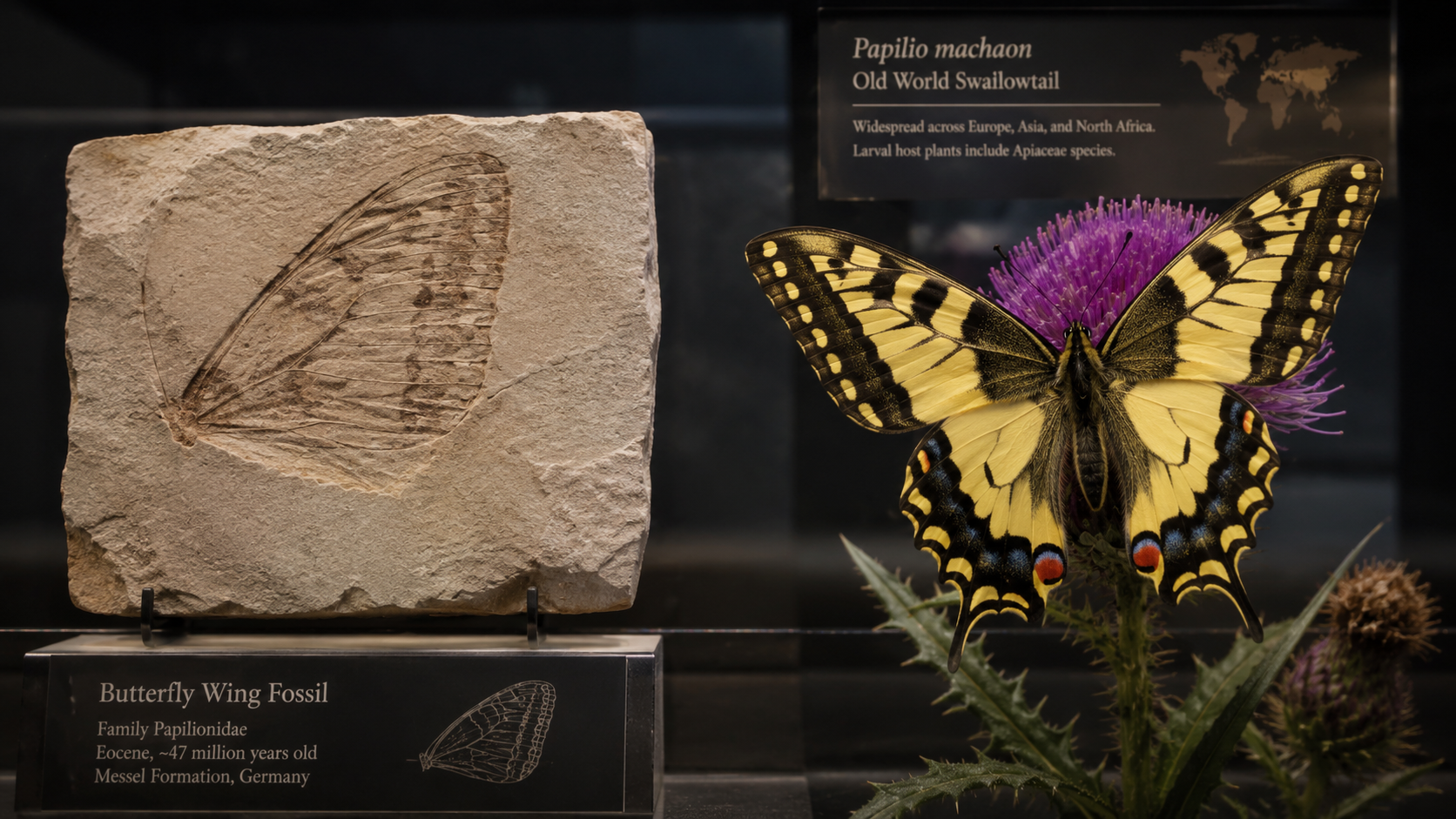
The oldest unambiguous butterfly fossils date to the Eocene epoch (56–34 Ma):
- Prodryas persephone (Florissant Formation, Colorado, c. 34 Ma): exquisitely preserved with visible wing venation, scale impressions, and even faint colour patterning. Its wing plan is recognisably nymphalid.
- Lethe corbieri (Baltic amber, c. 40–44 Ma): a satyrine nymphalid preserved in amber with three-dimensional surface detail intact.
- Various lycaenid fragments from Eocene Baltic and Rovno amber show that blues and hairstreaks were already diverse by 40–45 Ma.
The gap between the molecular divergence date (~100 Ma) and the oldest fossils (~40–45 Ma) reflects preservation bias: the Cretaceous terrestrial fossil record is fragmentary globally, and soft-bodied or delicate insects are rarely preserved. Amber from the mid-Cretaceous (Burmese amber, c. 99 Ma) contains abundant Lepidoptera, but these are small moths; unambiguous butterfly-lineage material from this period remains elusive.
Key evolutionary innovations
Complete metamorphosis (holometaboly)
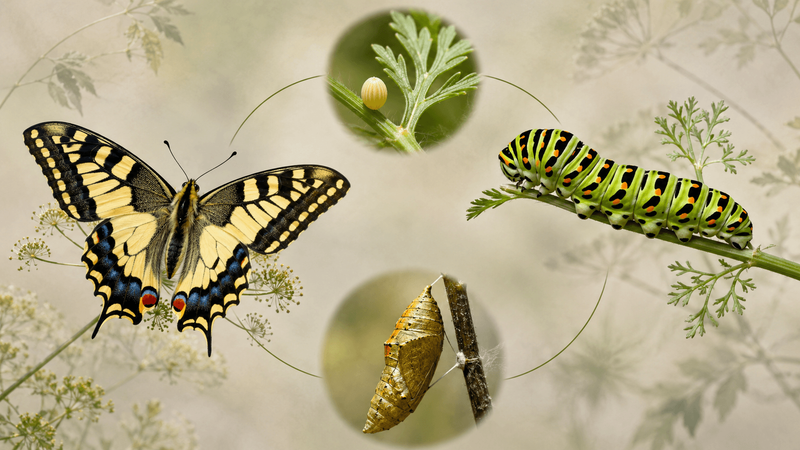
All Lepidoptera, including butterflies, undergo complete metamorphosis: egg → larva (caterpillar) → pupa (chrysalis) → adult. This developmental strategy, shared with beetles, flies, wasps, and bees, allows the larva and adult to exploit entirely different resources and occupy different ecological niches — the caterpillar as a leaf-eating growth machine, the adult as a mobile, flying pollinator and mate-seeker.
The pupa — the apparently inactive "resting stage" — is in fact a period of radical reorganisation, during which most larval tissues are broken down and rebuilt into adult structures. The butterfly chrysalis is the most visible manifestation of this process; its angular, sculptured form and sometimes metallic surface are among the most beautiful objects produced by evolution.
Colour vision and wing colour
Butterflies have among the most sophisticated visual systems of any insect. Most species are tetrachromatic — they have four types of colour receptor (compared to three in humans), including ultraviolet-sensitive receptors, allowing them to perceive colour patterns invisible to the human eye. UV-reflective patterns on wings, invisible to us but vivid to other butterflies, are used in species recognition and mate selection.
Wing colouration serves multiple functions whose evolutionary drivers have been studied intensively:
- Camouflage: bark-mimicking undersides (Charaxinae, Kallima), leaf-mimicking (Indian leaf butterfly), eyespot startle displays
- Aposematism: warning coloration in toxic species (Heliconius, Danaus)
- Müllerian mimicry: two or more toxic species sharing the same warning pattern, reinforcing avoidance learning in predators
- Batesian mimicry: a palatable species evolving to resemble a toxic species
Mimicry — evolution in real time
Heliconius butterflies of the Neotropics provided some of the first and clearest evidence of natural selection operating over human-observable timescales. Different populations of the same species (Heliconius melpomene, H. erato) carry dramatically different colour patterns in different parts of their range — but wherever they co-occur, they share the same pattern, driven by selection against being eaten by birds that have learned to avoid the local warning signal. The genetics of this mimicry have been dissected in detail: a small number of loci with large effect switch entire colour pattern modules, allowing rapid evolution of new mimicry forms.
Host plant specialisation and coevolution
The coevolution between butterflies and their larval host plants is a second, independent co-evolutionary arms race. Plants evolve chemical defences (alkaloids, glucosinolates, cardiac glycosides) to deter herbivores; butterfly lineages evolve tolerance or sequestration of these compounds, often converting plant toxins into their own defences. The Pieridae's specialisation on Brassicaceae (cabbage family), which produce glucosinolates, exemplifies this: pierid larvae evolved glucosinolate-hydrolysing enzymes; Brassicaceae subsequently evolved "nitrile-specifier proteins" that redirect glucosinolate breakdown away from the toxic compounds that deter most insects. The arms race continues.
Continental drift and biogeography
The distribution of butterfly lineages across continents reflects the history of plate tectonics as much as ecology. The Papilionidae, which diverged early, have a global distribution consistent with origin on a proto-Gondwana continent; their deep lineages (Parnassiinae, Baroniinae) are relictual in high mountain areas of the northern hemisphere. The Nymphalidae show a complex Gondwana-Laurasia history, with major lineages distributed asymmetrically between the Old and New Worlds in ways that reflect vicariance (continental separation) rather than dispersal.
The birdwings (Troides, Ornithoptera), largest of all butterflies, are confined to the Australasian region — their distribution tracks the collision of the Australian and Asian plates, which created the island arc of what is now the Indo-Malaysian archipelago, the precise region where birdwings achieve maximum diversity.
Butterfly evolution today
Evolution did not stop with the Pleistocene. Documented evolutionary change in butterfly populations is now measurable over decades:
- Wing melanisation in response to industrial pollution (Aglais urticae in parts of Europe became darker in the 20th century)
- Phenological shifts — earlier emergence dates driven by warmer springs, heritable and tracked over 40+ years in UK monitoring data
- Range expansion and host plant shifts — comma (Polygonia c-album) shifted its larval host plant from hop to nettles in the 20th century in parts of Europe, enabling northward range expansion
The history of butterfly evolution, from primitive Jurassic moths to the 20,000 species alive today, is a story of continuous change driven by the same forces that have always shaped life: selection, mutation, drift, and the endlessly shifting landscape of species interactions.