History of Butterfly Research: From Aristotle to the Genomic Era
The study of butterflies spans two thousand years, from Aristotle to DNA classification. A history of lepidopterology's explorers and scientists.
Ancient beginnings
The observation of butterflies is as old as natural history itself. Aristotle (384–322 BC) described the metamorphosis of Lepidoptera in his Historia Animalium with accuracy that remained unsurpassed for nearly two thousand years: he noted the four-stage progression from egg through larva and chrysalis to adult, and correctly identified that the chrysalis is not dead but in a state of transformation. He called the adult butterfly psyche — the Greek word for soul — a name that reflected the culturally loaded significance of the butterfly's emergence as a metaphor for the soul leaving the body. The same word gave us the genus Psyche and the family Psychidae (bagworm moths).
Greek and Roman scholars after Aristotle added little. The encyclopaedic natural histories of Pliny the Elder (23–79 AD) in his Naturalis Historia compiled existing knowledge but introduced no new observations. For more than a millennium after the fall of Rome, European natural history writing consisted largely of compiling, translating, and moralising from classical sources, with minimal direct observation of insects.
The Renaissance breakthrough: Merian
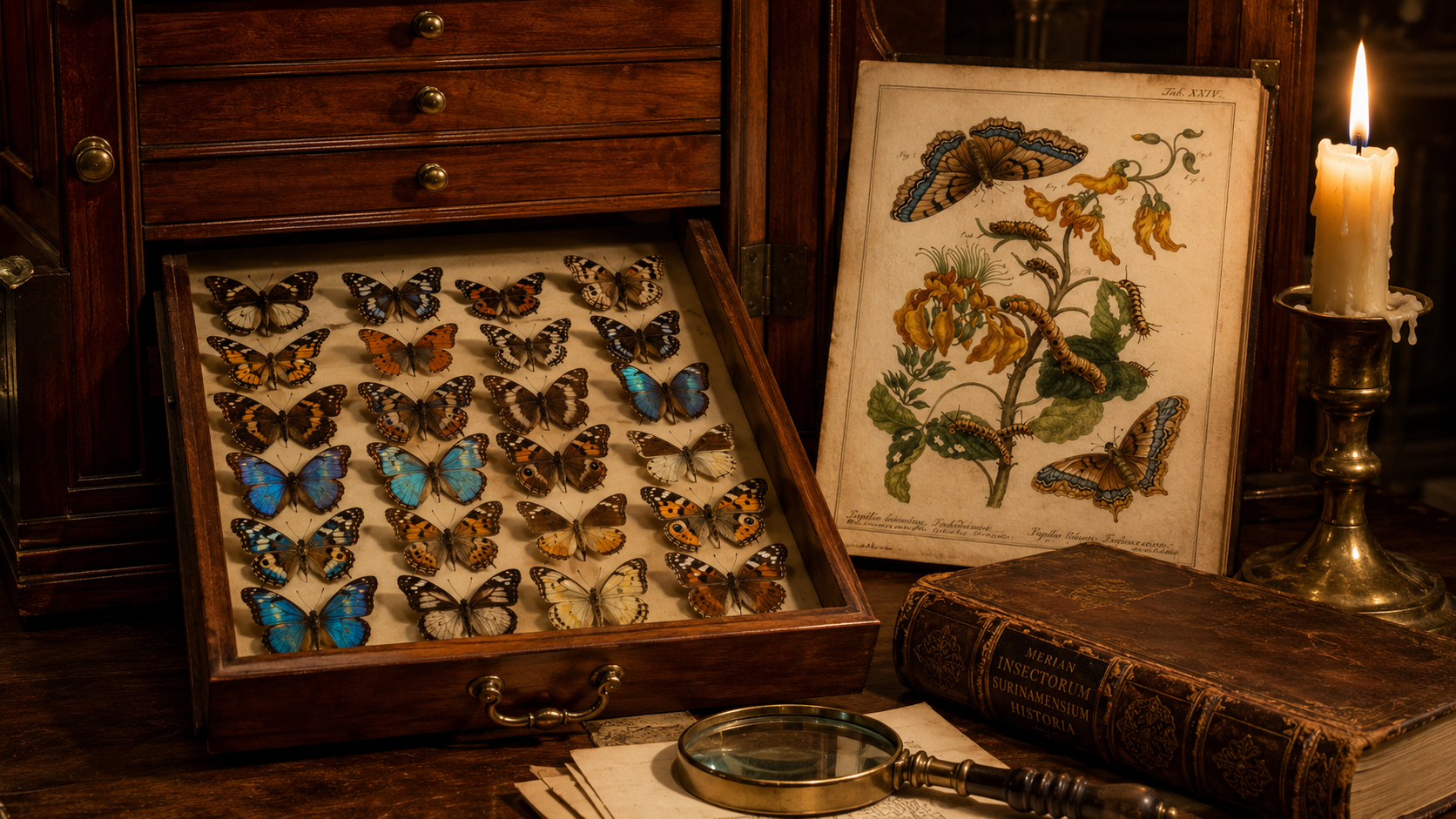
The most transformative figure in the early history of butterfly science was a woman: Maria Sibylla Merian (1647–1717). A German-Dutch artist and naturalist, Merian spent two years in Suriname (1699–1701) — an extraordinary expedition for any European at the time, let alone a woman in her fifties — observing and illustrating the complete life histories of tropical insects in their natural setting.
Her masterwork, Metamorphosis Insectorum Surinamensium (1705), presented 60 large folio plates of butterflies and moths alongside their caterpillars and the specific plants on which the larvae fed — the first systematic attempt to document host-plant relationships. The illustrations were accurate, scientifically informative, and artistically magnificent. Linnaeus drew on Merian's plates when naming many tropical species in his Systema Naturae, and several species were first formally described from her illustrations.
Merian established the intellectual framework that would drive lepidopterology for the next two centuries: the life history — egg, caterpillar, pupa, adult — as the unit of study, not just the adult specimen.
Linnaeus and the naming revolution
Carl Linnaeus (1707–1778) built the scaffolding on which all subsequent biology rests. His Systema Naturae, 10th edition (1758), established binomial nomenclature — the two-part Latin name (genus + species) — as the universal system for naming organisms. This work described 192 butterfly species and many more moths, assigning formal names still valid today: Papilio machaon, Vanessa atalanta, Pieris brassicae, and dozens of others received their scientific names in 1758 and have been called by them ever since.
Linnaeus worked primarily from museum specimens, supplemented by published illustrations. The resulting taxonomy had strengths — precision, stability, universality — and a significant weakness: without life history information or ecological context, species were defined entirely by adult morphology, and closely related species were sometimes lumped together while unrelated lookalikes were placed in the same genus. These problems would take two centuries to fully correct.
His principal successor in Lepidoptera classification was Johan Christian Fabricius (1745–1808), a Danish entomologist who described hundreds of additional species and began refining the Linnaean higher classification. Pieter Cramer (1721–1776) and Caspar Stoll produced the De Uitlandsche Kapellen (Foreign Butterflies, 1775–1782), a four-volume illustrated work on exotic species that served as a key reference for tropical Lepidoptera for generations.
The Victorian golden age of exploration
The 19th century was the great age of biological exploration and collection. Driven by global empires, the proliferation of steamship travel, and the demand of European natural history institutions for overseas material, thousands of collectors — professional and amateur, European and locally recruited — spread across Africa, Asia, Australia, and the Americas collecting insects.
The volume of new species described accelerated dramatically. Edward Doubleday and John O. Westwood produced the Genera of Diurnal Lepidoptera (1846–1852), the first comprehensive attempt to classify all known butterfly genera. William Chapman Hewitson described hundreds of new Neotropical species in his Exotic Butterflies series (1851–1876). Arthur Gardiner Butler and Herbert Druce worked through the vast collections arriving at the Natural History Museum in London.
But the two figures who most fundamentally changed the science were field naturalists, not museum workers.
Henry Walter Bates and mimicry
Henry Walter Bates (1825–1892) spent eleven years in the Amazon (1848–1859), the most productive single expedition in the history of entomology. He collected over 14,000 species, some 8,000 new to science. His analysis of Amazonian butterfly communities led to the discovery of what is now called Batesian mimicry: the phenomenon by which a palatable species evolves to closely resemble a toxic or unpalatable species, thereby gaining protection from predators without paying the metabolic cost of chemical defence.
Bates's 1861 paper "Contributions to an Insect Fauna of the Amazon Valley" presented this discovery with meticulous documentation — dozens of cases in which a harmless butterfly species, in each part of the Amazon where it occurred, bore a striking resemblance to the dominant toxic species of that region. He proposed that this was the result of natural selection, providing Darwin — to whom he sent the paper in manuscript — with one of the first documented examples of natural selection producing complex adaptive results. Darwin called it "the most remarkable and beautiful paper I have ever read in my life."
Alfred Russel Wallace and biogeography
Alfred Russel Wallace (1823–1913) co-discovered natural selection with Darwin but is also the founder of biogeography — the study of how species are distributed across the Earth. His eight years in the Malay Archipelago (1854–1862) produced the observation that a sharp boundary separated the Asian fauna (including Asian butterflies) from the Australian fauna — the line now called Wallace's Line, running between Bali and Lombok and between Borneo and Sulawesi.
Wallace used butterfly distributions, among other evidence, to draw this line and to argue that distribution patterns reflect ancient geographical and geological history. His book The Malay Archipelago (1869) remains a classic of scientific travel writing and one of the founding texts of biogeography.
Fritz Müller and Müllerian mimicry
Fritz Müller (1821–1897), a German naturalist who settled in Brazil, extended Bates's work with a crucial theoretical refinement. Bates had explained mimicry as a one-way deception: a harmless species mimics a toxic one. But Müller showed that two toxic species could mimic each other to mutual benefit — each species gains because predators learn the shared warning pattern from either species, reducing the per-species predation cost of being educational. This Müllerian mimicry explained the convergence of warning patterns across unrelated toxic butterfly groups in the same region — most famously in the Heliconius and Mechanitis complexes of the Neotropics.
The 20th century: specialisation and synthesis
Staudinger, Seitz, and the great catalogues
The early 20th century produced several definitive reference works. Otto Staudinger and Hans Rebel's Catalogue of the Lepidoptera of the Palearctic Faunal Area (1901) systematised Eurasian species knowledge. Adalbert Seitz's Macrolepidoptera of the World (completed 1914–1925) attempted a global synthesis — still consulted as a historical reference. These works created standardised lists that allowed the first global assessments of diversity.
Nabokov and systematic entomology as literature
Vladimir Nabokov (1899–1977), more famous as the author of Lolita and other novels, was also a serious professional lepidopterist who spent years curating the butterfly collections at Harvard's Museum of Comparative Zoology. His taxonomic work on the Polyommatine blues (Lycaenidae) — particularly the Neotropical Polyommatus relatives he called the "Blues of the New World" — was technically meticulous and long underrated. DNA analysis in the 2010s confirmed that Nabokov's morphology-based phylogeny of these groups was correct in almost all its details, a posthumous vindication of his systematic method.
His essays on butterfly collecting — notably those in Speak, Memory — remain among the finest literary descriptions of the naturalist's experience.
Ecological and conservation lepidopterology
The second half of the 20th century saw a fundamental shift in the questions lepidopterists asked. As species diversity became better documented and museum collections stabilised, the field moved from description to ecology and conservation:
- E. B. Ford's Butterflies (1945) and Moths (1955) synthesised population genetics and evolutionary biology with lepidopteran natural history, establishing the theoretical framework for ecological genetics
- Paul Ehrlich and Peter Raven's 1964 paper "Butterflies and Plants: A Study in Coevolution" launched the modern study of plant-herbivore coevolution using Lepidoptera as the model system
- The Butterfly Monitoring Scheme (UK, from 1976) established the template for long-term population monitoring of butterflies — now replicated across Europe and beyond — and provided some of the first quantitative data on butterfly population trends and their response to climate change
The genomic era
The polymerase chain reaction (PCR), developed in the late 1980s, and subsequent advances in DNA sequencing technology transformed systematics from a morphological to a molecular discipline. For butterflies, the impacts were profound:
- Cryptic species — visually identical populations with distinct evolutionary histories — were identified throughout Europe, Asia, and North America; the total species count has increased substantially through molecular studies
- Phylogenetic placement of anomalous groups was resolved: the Hedylidae, long classified as moths, were confirmed as the sister group to all butterflies
- Adaptive evolution was studied in real time: the Heliconius genome (published 2012) revealed the precise genetic basis of mimicry colour pattern switching, identifying "supergene" loci that control whole pattern modules and allow rapid evolution of new mimicry forms
- Population genomics now allows the history of butterfly populations — their expansion, contraction, and connectivity — to be reconstructed from genome sequences of museum specimens collected as far back as the 19th century
The first complete butterfly genome was published in 2008 (Melitaea cinxia, the Glanville fritillary); by 2025, hundreds of butterfly and moth genomes were available in public databases.
Citizen science and the current era
The 21st century has added a new dimension to butterfly research: mass citizen observation. Platforms such as iNaturalist, the UK Butterfly Monitoring Scheme, and national recording schemes across Europe, North America, and increasingly Africa and Asia have recruited tens of thousands of amateur recorders, producing datasets on species distribution and abundance that no professional research programme could replicate.
Smartphone photography has transformed species identification in the field — a record that would have required an expert to verify from a pinned specimen in 1970 can now be submitted as a photograph and verified by online community consensus within hours. The result is a global accumulation of occurrence data that is changing our understanding of butterfly range dynamics in real time, providing an unprecedented window onto how species are responding to climate change at continental scales.
The history of butterfly science is, in this sense, still being written — and for the first time, it is being written by millions of contributors rather than hundreds.