How to Attract Butterflies to Your Garden
A butterfly-friendly garden needs the right nectar and host plants, sunny sheltered spots, and minimal pesticide use to support butterflies year-round.
Why garden butterflies are declining
Over the past 50 years many once-common butterfly species have declined sharply in agricultural landscapes — driven by the loss of wildflower meadows, increased pesticide use, and the destruction of hedgerows and rough ground. Gardens have become increasingly important refuges. A well-planned butterfly garden in a suburban street contributes meaningfully to local butterfly populations, particularly for species that can move between garden habitats.
The key insight is that a butterfly-friendly garden must serve two completely different needs: nectar for adult butterflies and food for caterpillars. Most ornamental gardens provide some nectar plants but almost no larval host plants — this feeds passing adults but supports no breeding.
Nectar plants for adult butterflies
Spring (March–May)
Early-flying butterflies — brimstone, small tortoiseshell, peacock, comma — emerge from hibernation before most garden plants flower. Early nectar sources are critical:
- Aubretia (Aubrieta deltoidea) — one of the best early nectar plants; cascading purple flowers in March–April
- Primrose (Primula vulgaris) and polyanthus — valuable in March
- Honesty (Lunaria annua) — April–May; doubles as a larval host for orange tip
- Forget-me-not (Myosotis) — low-maintenance mass planting; visited by many early blues
- Bluebell (Hyacinthoides non-scripta) — important for the first bees and early butterflies in April
Summer (June–August)
This is the main butterfly season. A large range of species will visit a well-planted garden:
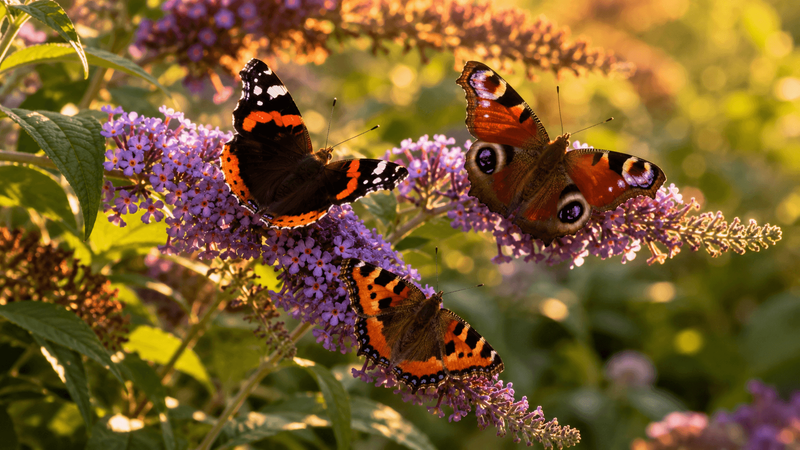
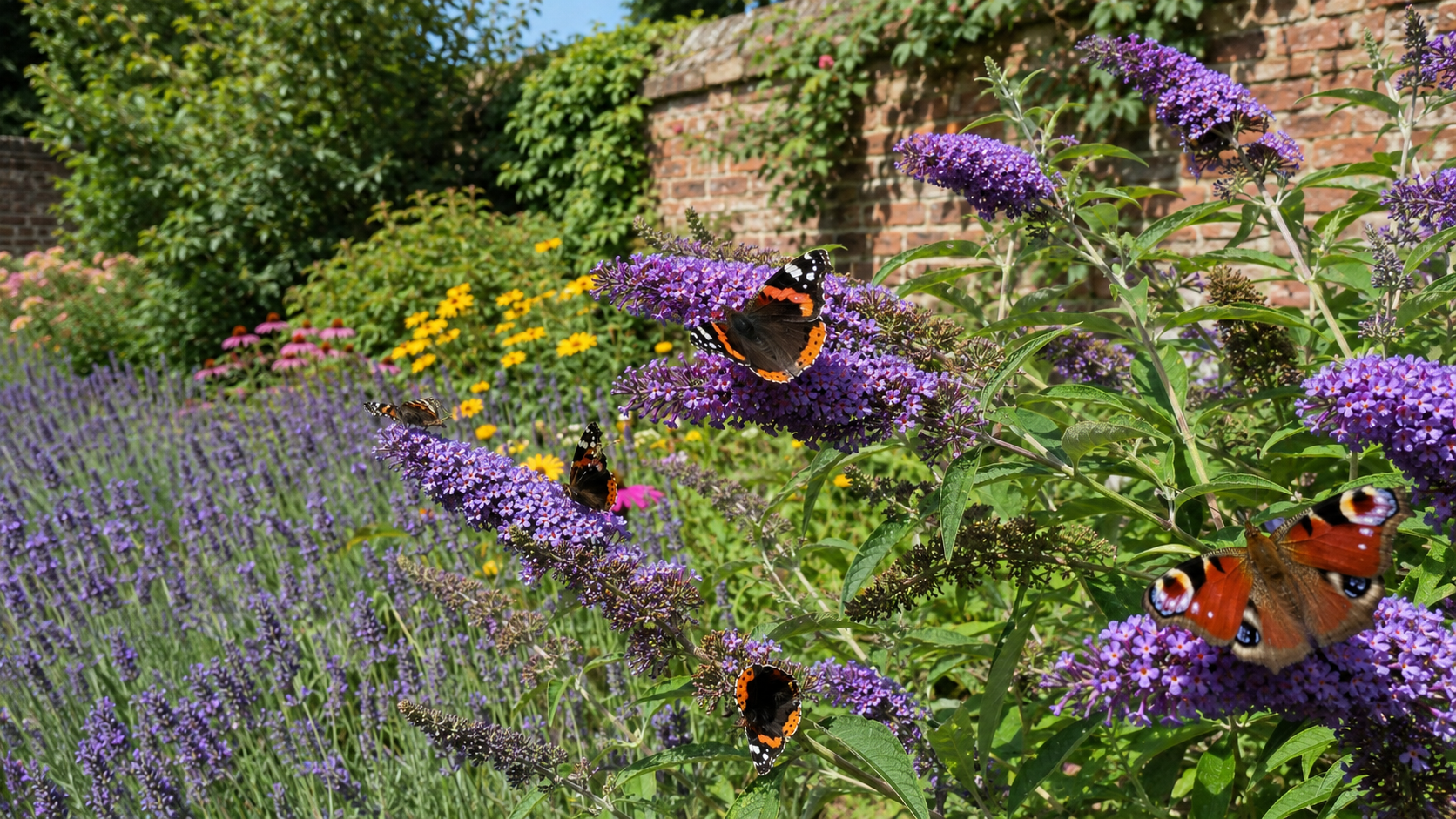
- Buddleia (Buddleja davidii) — the most powerful butterfly attractor; deadhead regularly to extend flowering; can attract 10+ species simultaneously
- Lavender (Lavandula) — excellent for small blues, browns, and skippers; drought-tolerant
- Marjoram / wild oregano (Origanum vulgare) — one of the best native nectar plants; small tortoiseshell, meadow brown, ringlet, and many blues use it heavily
- Knapweed (Centaurea nigra / C. scabiosa) — outstanding native; particularly good for fritillaries, admirals, and large whites
- Thistles (Cirsium) — painted ladies and red admirals favour thistles where available; leaving one or two to flower is worth it
- Scabious (Scabiosa, Knautia) — excellent for a wide range of species
- Verbena bonariensis — tall, airy; flowers over a very long season; attractive to many species
Late summer and autumn (August–October)
Second-brood and migratory butterflies need late nectar before winter:
- Ice plant (Hylotelephium spectabile, syn. Sedum spectabile) — one of the best late-season plants; covered in painted ladies, red admirals, and small tortoiseshells through September–October
- Hemp agrimony (Eupatorium cannabinum) — tall native plant; enormous attraction for many species; particularly good for silver-washed fritillaries and white admirals near woodland
- Michaelmas daisy (Aster / Symphyotrichum) — reliable autumn nectar into October
- Ivy (Hedera helix) — flowers September–October; critical late nectar for red admirals and commas before hibernation
Larval host plants
Without host plants for caterpillars, your garden feeds passing butterflies but supports no breeding. Each butterfly species uses a specific set of plants:
| Butterfly | Larval host plants |
|---|---|
| Red admiral, peacock, small tortoiseshell, comma | Stinging nettle (Urtica dioica) |
| Orange tip | Honesty, garlic mustard, cuckooflower |
| Large white, small white | Cabbage, nasturtium, honesty, rocket |
| Green-veined white | Cuckooflower, garlic mustard, watercress |
| Small copper | Common sorrel, sheep's sorrel (Rumex) |
| Common blue | Bird's-foot trefoil (Lotus corniculatus), clover |
| Brimstone | Buckthorn (Rhamnus cathartica), alder buckthorn |
| Meadow brown, ringlet, skippers | Fine grasses (fescues, bent grasses, meadow grasses) |
| Holly blue | Holly (spring brood), ivy (autumn brood) |
Habitat features
Plants are necessary but not sufficient. Butterflies also need:
Sun and shelter
Butterflies are cold-blooded and require warmth to fly. A south-facing wall or fence creates a sun-trap microclimate several degrees warmer than the open garden — ideal for basking. Tortoiseshells and peacocks habitually overwinter in such spots and emerge from hibernation in sheltered south-facing positions. A garden without sunny, sheltered corners will attract far fewer butterflies than a sheltered one, regardless of planting.
Water and minerals
Butterflies drink from shallow puddles, damp sand, and wet mud, absorbing water and dissolved minerals (a behaviour called puddling). A shallow dish of damp sand or a small patch of bare, damp soil in a sunny spot will attract mud-puddling species, particularly whites, coppers, and blues.
Rough grass and leaf litter
Many butterflies overwinter or pupate in rough grass, leaf litter, or dense low vegetation. A patch of unmown grass — even a narrow strip along a fence — provides overwintering habitat for meadow browns, skippers, and others. Hollow stems and dead plant material in a "bug hotel" can provide shelter for overwintering adults of some species.
Log piles and tree bark
Purple emperors, white admirals, and several other forest-edge species are attracted to rotting material (sap runs, dung, carrion). In woodland-edge gardens, a log pile in dappled shade can attract these less expected species.
Gardening practices
Reduce or eliminate pesticides
Insecticides kill caterpillars and other butterfly larvae indiscriminately. Systemic pesticides persist in nectar and pollen. Even "bee-friendly" products marketed as safe for pollinators may harm butterfly larvae. The single most impactful change for a butterfly garden is eliminating pesticide use entirely.
Delay tidying
The impulse to cut back dead stems and remove leaf litter in autumn removes overwintering sites. Leave cutting back until March — after hibernating adults have emerged and before ground-nesting insects become active. Holly blue pupae, brimstone adults, and many other species depend on undisturbed garden structure through winter.
Let some plants bolt and set seed
Honesty, teasel, and thistle left to seed provide structure and food for seed-eating birds that in turn reduce aphid pressure. Allowing a few ornamentals to bolt also reveals which self-seed freely — these can be managed as a low-maintenance wildflower element.
Maintain a nettle patch
Designate a permanent nettle patch in a sunny, sheltered corner — north-facing or deeply shaded nettles are largely ignored by butterflies. Cut one-third of the patch back in June to generate fresh young growth, which is more attractive to egg-laying females than old, tough leaves. Leave the rest uncut through summer to allow caterpillars to complete development.
What to expect
A well-planted butterfly garden in a temperate European or Russian climate can realistically attract:
- 15–25 species passing through or feeding if located near woodland or grassland
- 5–10 breeding species if larval host plants are present
- Regular visitors: red admiral, peacock, small tortoiseshell, comma, large white, small white, green-veined white, brimstone, holly blue, small copper, meadow brown
- Occasional visitors near suitable habitats: orange tip, painted lady, common blue, various skippers
The best butterfly gardens combine abundance of a few key species — nettles for the vanessids, buddleia for summer adults, ivy and sedum for autumn — with variety of supporting plants that serve less common species as they pass through.
Gardens and conservation
Urban and suburban gardens cover a large combined area — in Britain alone, around 400,000 hectares, more than all national nature reserves combined. A network of butterfly-friendly gardens can act as stepping stones between fragmented natural habitats, allowing species to move through the landscape and maintain connected populations. Individual gardens matter more than their small size suggests.