Butterfly Observer's Equipment
You need very little to start watching butterflies — good binoculars and a field guide take you most of the way. This covers essential and optional gear.
What you actually need
Butterfly watching requires remarkably little equipment compared to other natural history pursuits. The minimum kit that transforms a walk into a productive observation session is:
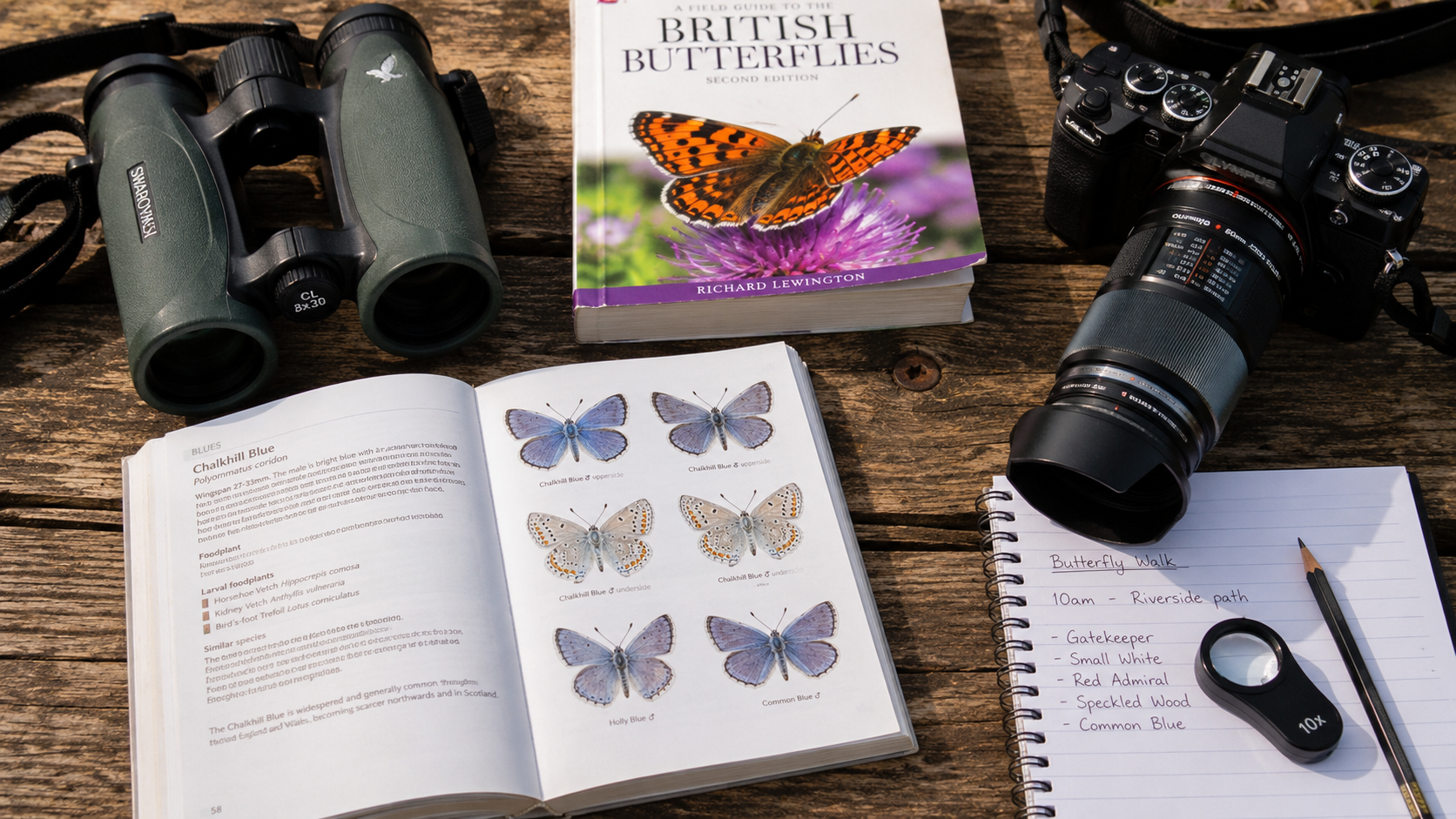
- Close-focus binoculars — the single most transformative piece of kit
- A field guide — either a book or a smartphone app
- A notebook — or a recording app on your phone
Everything else is optional and adds capability rather than enabling the activity. A beginner with these three items can identify most butterflies they encounter and contribute meaningful records to citizen science databases.
Binoculars
Why close focus matters
Standard binoculars designed for birdwatching focus at a minimum of 3–5 metres. At that distance a butterfly the size of a small copper appears as a barely discernible orange speck. Butterfly binoculars must focus at 1.5–2 metres — at that range a small copper fills a large fraction of the field of view, and you can see the black spots, the metallic sheen, and the forewing border clearly enough for confident identification.
This close-focus requirement eliminates most standard binoculars from consideration regardless of their optical quality.
Recommended specifications
- Magnification: 8× is the standard. 10× gives more detail but a smaller, shakier field of view — less useful for quick acquisition of moving subjects. 8×42 or 8×32 are the most widely used combinations.
- Minimum focus distance: 1.5 m or less. This is the critical specification — check it before purchasing.
- Field of view: wider is better for finding fast-moving subjects. Look for 120 m/1000 m (about 7°) or wider.
- Eye relief: 15 mm or more if you wear glasses.
Recommended models
Budget (under £100 / $120): Opticron Traveller 8×32 BGA or Celestron TrailSeeker 8×42 — both focus to under 2 metres and have adequate optics for field use.
Mid-range (£150–350): Nikon Prostaff P7 8×42, Vortex Diamondback HD 8×42 — noticeably better glass and close focus around 1.5–2 m.
Premium (£500+): Swarovski CL Pocket 8×25 (focus to 1.5 m, exceptional optics, compact), Zeiss Victory SF 8×42 — the best available, with close focus to 1.5 m and extraordinary low-light performance.
Field guides
Books
A physical field guide in the pocket or bag is still the most reliable reference in the field — no battery, no connectivity issues, and the ability to compare adjacent plates directly.
Pan-European guides:
- Butterflies of Britain and Europe — Tolman & Lewington (Collins). The standard reference for 440+ species. Illustrated with paintings showing flight positions, both sexes, both wing surfaces. Dense but comprehensive.
- Field Guide to the Butterflies of Britain and Europe — Higgins & Riley (Collins). An older classic; shows distribution maps alongside illustrations; well-organised for comparative identification.
Regional guides: For Russia: the regional guides published by regional editions (Приморье, Кавказ, Урал) are often more useful than all-Russia volumes for local fieldwork. Check for recent editions as taxonomy changes frequently.
Smartphone apps
Apps have transformed beginner butterfly identification. The best combine photo identification (AI-assisted) with distribution maps and flight season calendars:
- iNaturalist (free, iOS/Android) — not purely butterflies but the most powerful photo-ID system available; connected to a global naturalist community; submits observations directly to scientific databases. Identification suggestions use a neural network trained on millions of photos.
- Butterfly Conservation apps (UK-specific) — produced by Butterfly Conservation UK; excellent for British species with flight season, habitat, and status information.
- ObsIdentify / Observation.org — strong in Europe; AI photo identification; good for submitting records.
- Seek (iNaturalist's simpler companion) — instant camera identification without needing to submit records; useful for quick field checks.
AI photo identification has improved dramatically — for common, well-photographed species it is now reliable enough for field use. For confusing pairs (e.g. various Polyommatus blues) a human expert via iNaturalist community identification remains more reliable than AI alone.
Camera and photography equipment
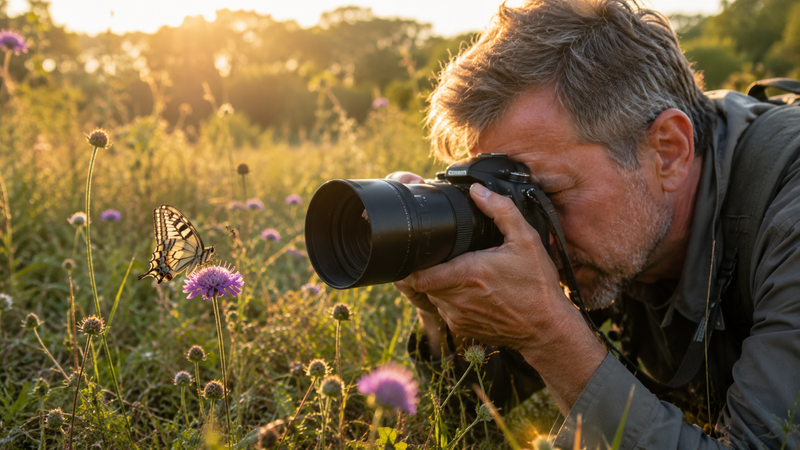
Photography serves a dual purpose for butterfly observers: it creates a visual record that can be checked later for identification, and it provides evidence for rare species records submitted to recording schemes.
For identification records: a modern smartphone is sufficient. The camera does not need to be exceptional — a clear, recognisable image of a perched butterfly is all a recording scheme needs to accept an unusual record.
For serious field documentation: a mirrorless camera with a 90–105 mm macro lens is the standard. See the butterfly photography guide for detailed equipment and technique advice.
For combination observation and photography: some observers use a digiscoping adapter to attach a smartphone to their binoculars — this allows handheld distance shots at moderate magnification without carrying a camera separately.
Hand lens (loupe)
A 10× hand lens is invaluable for examining details that even close-focus binoculars cannot resolve: antennal club shape, leg structure, and wing venation. This becomes important when separating similar species of skippers, blues, or whites. A jeweller's loupe of 10× magnification costs very little and weighs almost nothing; include one in any serious field kit.
Nets and handling equipment
Butterfly net
A butterfly net is used to catch individuals for close examination and then release them. The standard field net has:
- A lightweight aluminium or fibreglass handle, 60–90 cm long
- A round or D-shaped frame, 30–38 cm in diameter
- A fine mesh bag of white or cream netting, long enough (45–60 cm) to fold over the frame and prevent escape
When to use: for blues and skippers that cannot be safely identified at arm's length; for fresh-condition specimens where wear pattern helps age estimation; in scientific survey work.
Legal note: collecting and netting butterflies is regulated in many countries and in virtually all protected areas. In the UK, all butterfly species are protected under Schedule 5 of the Wildlife and Countryside Act — netting for examination is permitted but killing or taking specimens requires a licence. Check local regulations before using a net.
Handling
If you do briefly handle a butterfly for examination, hold the wings gently together above the body — never grip the wings open, as this tears the wing membrane and scales. Examine, note details, photograph if possible, then release on the same plant or spot where it was found.
Recording equipment
Notebook
A waterproof notebook (Rite in the Rain or similar) and a pencil (works when wet, unlike pens) allow notes in any weather. Record: date, time, location (grid reference or GPS coordinates), species, number of individuals, sex if known, behaviour, and habitat notes. A simple tally notebook works; a pre-printed recording sheet speeds up fieldwork.
GPS and mapping
Smartphone GPS is adequate for most recording. For systematic transect work, a dedicated GPS unit (Garmin eTrex or similar) is more reliable and has much better battery life. Recording GPS coordinates to 6-figure grid reference accuracy is the standard requirement for most national recording schemes.
Recording apps
iRecord (UK) — the standard national recording platform; accepts records with or without photos; linked to the UK Butterfly Monitoring Scheme.
iNaturalist — global; automatically generates a GPS-tagged observation record with every photo submitted.
ButterflyCount (Butterfly Conservation UK) — specifically designed for the Big Butterfly Count annual citizen science survey.
Clothing and field accessories
Butterfly watching is low-impact fieldwork that requires only comfortable field clothing:
- Dull, neutral colours (green, brown, grey, khaki) for approach — avoid white, which some species respond to as a rival
- Sun protection — butterflies are most active in full sun; bring hat and sunscreen for long field sessions
- Waterproofs — many productive butterfly days start wet and clear by midday; a packable waterproof allows you to stay out through the transition
- Walking footwear appropriate for the terrain — meadow walking needs no more than trail shoes; moorland or mountain work may need ankle support
Beginner starter kit summary
| Item | Budget option | Cost (approx.) |
|---|---|---|
| Close-focus binoculars | Opticron Traveller 8×32 | £60–80 |
| Field guide | Regional guide or iNaturalist | Free–£20 |
| Notebook and pencil | Any waterproof notebook | £5–10 |
| Hand lens | 10× jeweller's loupe | £5–15 |
Total minimum investment: under £100. This kit enables confident identification of the large majority of species encountered and proper record submission to citizen science databases. Add a camera when the interest deepens.