Butterflies of Tropical Forests
Tropical forests cover less than 7% of Earth's land, but harbour over half of all butterfly species, spread across forest layers and under growing threat.
The butterfly diversity paradox
Less than 7% of Earth's land surface is covered by tropical forest — yet these forests harbour well over half of all known butterfly species. A single hectare of Amazonian rainforest may support more butterfly species than the entire country of France. A list of butterflies from one Peruvian research station frequently exceeds 1,000 species; the total butterfly fauna of North America north of Mexico is around 750 species.
This extraordinary concentration of diversity is not random — it reflects a specific combination of ecological conditions that tropical forests uniquely provide. Understanding why tropical forests are so rich in butterflies helps explain what is lost when they are destroyed.
The three great tropical forest regions
Tropical forest butterfly diversity is concentrated in three major regions, each with its characteristic fauna and ecological character.
Amazonia and the Neotropics
The Amazon Basin and the broader Neotropical forest region (including Central America, the Orinoco, the Atlantic Forest of Brazil, and the forests of the Guiana Shield) contain the richest butterfly fauna on Earth.
Key characteristics:
- Morpho butterflies (Morpho spp., 30+ species) — large, iridescent blue nymphalids; canopy gliders; iconic of Amazonian forests
- Heliconiidae — Heliconius longwings and their kin; toxic, mimetic, long-lived; the dominant model species in the Neotropical mimicry networks
- Ithomiidae (clearwing butterflies) — highly toxic, semi-transparent wings; the most speciose family in Amazonia with 400+ species; central to understorey mimicry rings
- Charaxinae — powerful, fast-flying emperors; especially the genus Prepona and Archaeoprepona; attracted to fermenting fruit and carrion
The western Amazon — Peru, Ecuador, Colombia — holds the global record for local butterfly richness. The Manu Biosphere Reserve in Peru and the Yasuní National Park in Ecuador are among the most species-rich sites ever documented anywhere on Earth for butterflies.
The Congo Basin and Afrotropical forests
The Congo Basin contains the world's second-largest tropical forest (approximately 1.8 million km²) and supports a butterfly fauna second only to Amazonia in overall diversity.
Key characteristics:
- Cymothoe (forest glories) — the most speciose Afrotropical butterfly genus; males with vivid structural colour; among the most diverse at Korup (Cameroon) and in the Congo forest core
- Charaxes — richly diverse genus of powerful nymphalids; highest diversity in the world in the Congo Basin
- Euphaedra (forest nymphs) — large, complex genus of medium-sized nymphalids; understory species
- Acraea (Telchinia) — numerous toxic orange-and-black species; dominant in the forest-savannah mosaic
The Congolese forest in the Democratic Republic of Congo is the centrepiece. Poorly surveyed compared to Amazonia, it continues to yield new species records; its total diversity is certainly still underestimated.
Southeast Asian and Indo-Pacific forests
The forests of Borneo, Sumatra, the Philippines, New Guinea, and the Malay Peninsula form the third great tropical forest butterfly region. While less diverse than Amazonia or the Congo at the broadest scale, several sub-regions have extraordinary local richness.
Key characteristics:
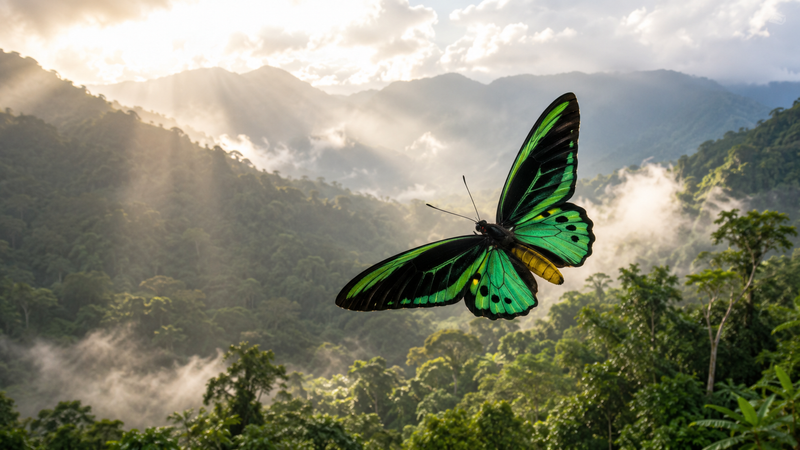
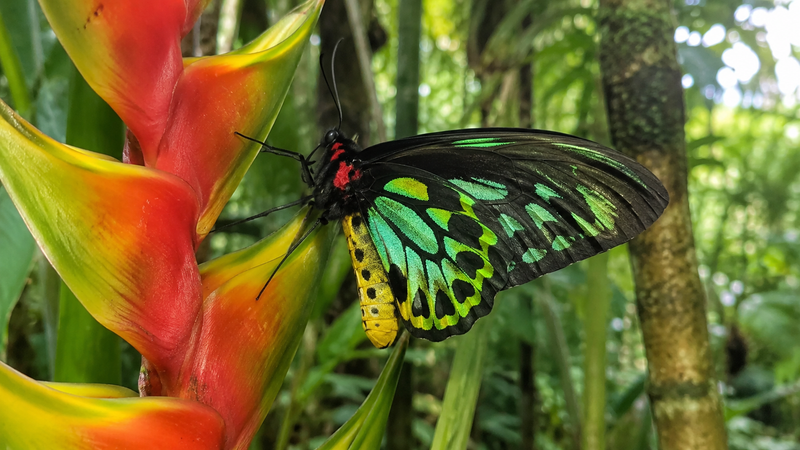
- Birdwings (Ornithoptera, Troides, Trogonoptera) — the world's largest butterflies; restricted to the Indo-Pacific region; CITES protected
- Rajah Brooke's Birdwing (Trogonoptera brookiana) — national butterfly of Malaysia; males brilliant red and iridescent green-black
- Tree Nymphs (Idea spp.) — large, paper-white; slow-gliding; characteristic of Southeast Asian forest
- Catopsilia migrations — mass seasonal movements of yellow and white pierids across island Southeast Asia
Borneo — the world's third-largest island, divided among Malaysia, Indonesia, and Brunei — has one of the highest butterfly diversities in Asia, with over 900 species recorded.
Vertical stratification: floors to canopy
One of the defining features of tropical forest butterfly ecology is vertical stratification — the strong partitioning of species between different height layers of the forest.
Forest floor and stream margins
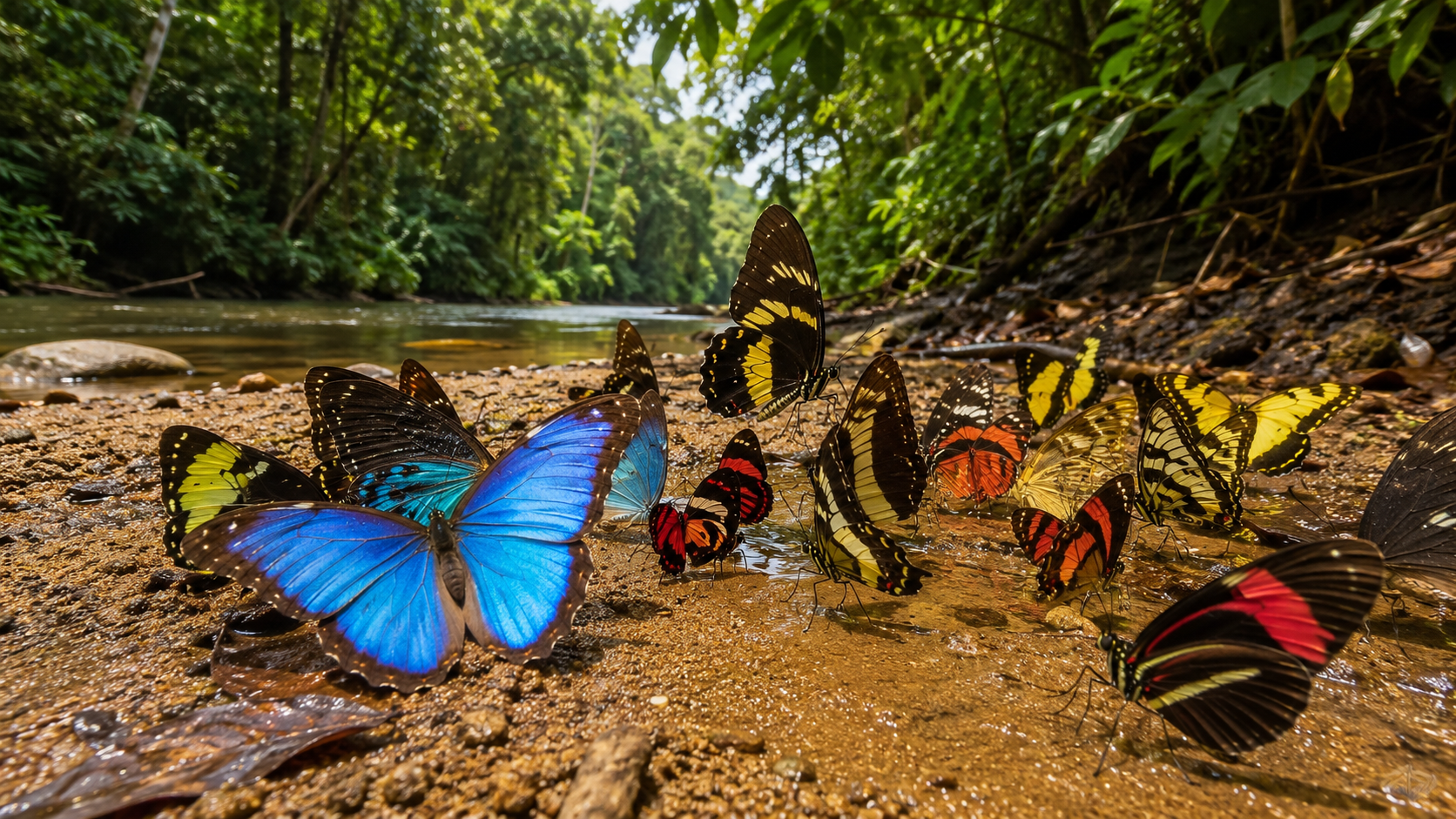
The forest floor and the banks of forest streams are critical for mud-puddling — aggregations of male butterflies absorbing sodium, amino acids, and other minerals from wet soil, dung, carrion, and urine. These aggregations, sometimes involving dozens of species simultaneously, are among the most spectacular wildlife spectacles in tropical forests and are a primary survey technique for entomologists. Large Morpho, multiple swallowtail species, and pierids concentrate at sandy river banks, while smaller hesperiids and lycaenids take the margins.
Understorey (1–5 m)
The shaded understorey is the zone of ithomiids (clearwings) in the Neotropics and their Afrotropical and Asian counterparts. These slow-flying, chemically defended species form the core of tropical understorey mimicry rings — communities of toxic and non-toxic species that converge on shared warning patterns, deterring a wide range of predators collectively. In Amazonia, a single understorey mimicry ring may contain 20–40 species from multiple families.
Shade-adapted satyrs and browns (Satyrinae) are characteristic understorey species across all three tropical forest regions, flying in the permanent twilight of the lower forest layers.
Subcanopy (5–15 m)
The subcanopy layer supports sailer butterflies (Neptis, Aldania) gliding between shaded branches, and numerous Papilio swallowtails that use subcanopy flight paths between feeding and oviposition sites.
Canopy (15–40 m)
The sunlit upper canopy is the realm of Morpho in Amazonia and Charaxes in Africa — powerful, fast-flying nymphalids that use thermals and wind currents to travel between tall trees. The canopy is also where Ornithoptera birdwings soar — males patrol long circuits through the forest crown. Conventional survey methods (ground-level netting) dramatically undersample canopy species; canopy fogging, trap-netting at height, and flight interception traps have shown that true canopy diversity is substantially higher than previously estimated.
Mimicry in tropical forests
Tropical forests are the principal arena for the evolution of butterfly mimicry — the resemblance of one species to another for mutual advantage or for protection.
Müllerian mimicry (mutual mimicry between species both of which are unpalatable) is most highly developed in the Neotropical forests, where ithomiid clearwings, Heliconius longwings, and numerous other toxic species converge on shared warning patterns. A single geographical area of Amazonia may have multiple distinct mimicry rings — groups of unpalatable species sharing a pattern — with the ring composition changing gradually over hundreds of kilometres as the local abundance of different model species varies.
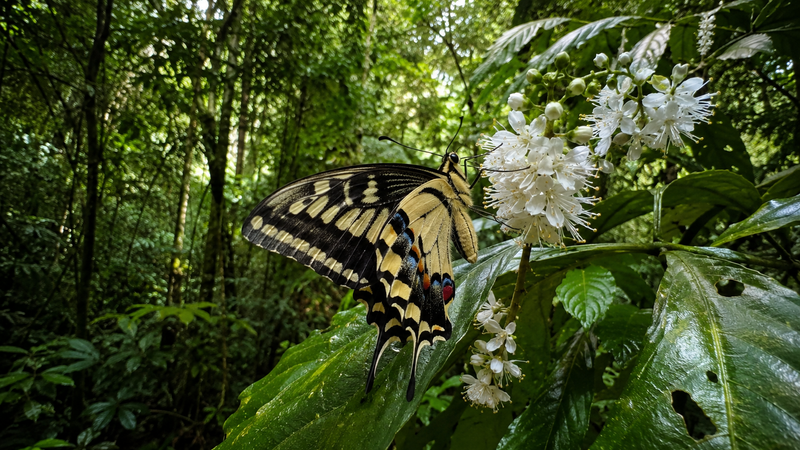
Batesian mimicry (palatable species mimicking unpalatable models) is also widespread: many Papilio females in Southeast Asia and Africa mimic toxic models (Troides, Amauris, Danaus) with remarkable precision. Some mimicry is so accurate that only genital examination distinguishes the mimic from the model.
Light gaps: the engine of tropical butterfly diversity
A crucial, often overlooked feature of tropical forest butterfly ecology is the role of light gaps — areas where a fallen tree or landslide has opened the canopy to full sunlight. In the permanent shade of an intact tropical forest, many butterfly species cannot complete their lifecycle — their host plants require at least some direct light.
Light gaps act as hotspots of diversity: a single gap of a few hundred square metres may support dozens of species absent from the surrounding closed forest. Light-gap butterflies include many pierids, a range of nymphalids, and numerous fruit-feeding species attracted to fermenting fallen fruit in the gap. Survey teams working in tropical forests systematically target light gaps, forest edges, and stream corridors — the richest sampling localities in the landscape.
The threat of deforestation
Tropical forests are being lost at alarming rates — the global estimate is approximately 10 million hectares per year, with the highest losses in the Amazon, the Congo Basin fringe, and Southeast Asia.
For butterflies, the consequences are severe:
- Species with restricted ranges (many tropical endemics are found only within a few tens of km² of forest) are eliminated when that forest patch is cleared
- Connectivity loss isolates populations that cannot disperse across even short stretches of agricultural land
- Selective logging — even without complete clearance — removes the tall emergent trees used by canopy species and damages the understorey structure needed by shade-adapted species
- Edge effects penetrate 1–2 km into forest interiors, degrading the interior forest microclimate over a wide band around cleared areas
Critically, the number of butterfly species lost to tropical deforestation exceeds our capacity to document them: many species in poorly surveyed regions — particularly in the Congo Basin and interior Borneo — will certainly be lost before they are formally described.
Conservation measures that benefit tropical forest butterflies include:
- Maintaining large, connected protected areas with minimal internal road infrastructure
- Preventing illegal logging within existing reserves
- Restoring forest corridors between fragmented patches
- Community-based forest management that provides economic incentives for forest maintenance
Interesting facts
- The highest concentration of butterfly species ever recorded at a single location is at the Los Amigos Conservation Concession in Amazonian Peru: over 1,300 species from a 1,000-hectare area — roughly one new species every 0.8 hectares of tropical forest
- Butterflies pollinate fewer tropical forest plants than bees, flies, and beetles, but play an important role in long-distance pollen transfer for certain plant families, including some Rubiaceae and Gentianaceae
- Ithomiid clearwing butterflies in the Neotropics spend their adult lives at Heliotropium flowers, absorbing pyrrolizidine alkaloids that male ithomiids use as pheromone precursors in courtship — a system that ties the entire mimicry ring to the availability of specific weedy plants at forest edges
- The Amazon butterfly fauna is estimated at 7,500–10,000 species when all records are combined — a figure that continues to grow as molecular methods reveal that many "single species" in museum collections actually represent multiple genetically distinct taxa