Monarch Butterfly Migration — One of Nature's Greatest Journeys
Every autumn, monarch butterflies travel up to 4,500km from Canada to Mexican mountain forests — navigation and multigenerational memory puzzle science.
The phenomenon
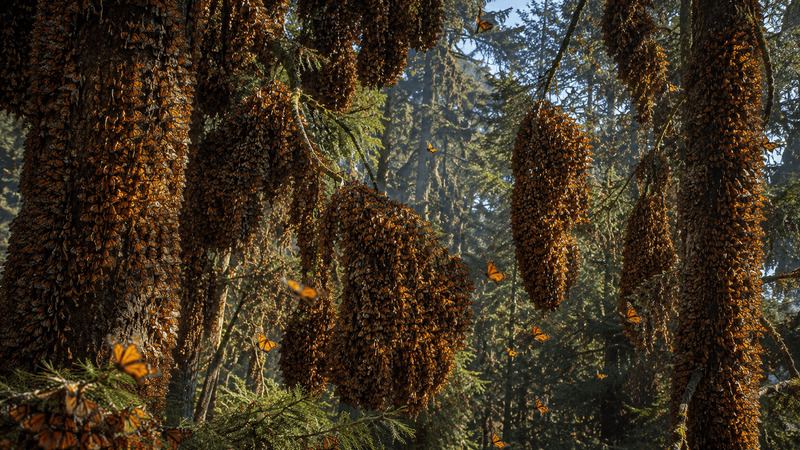
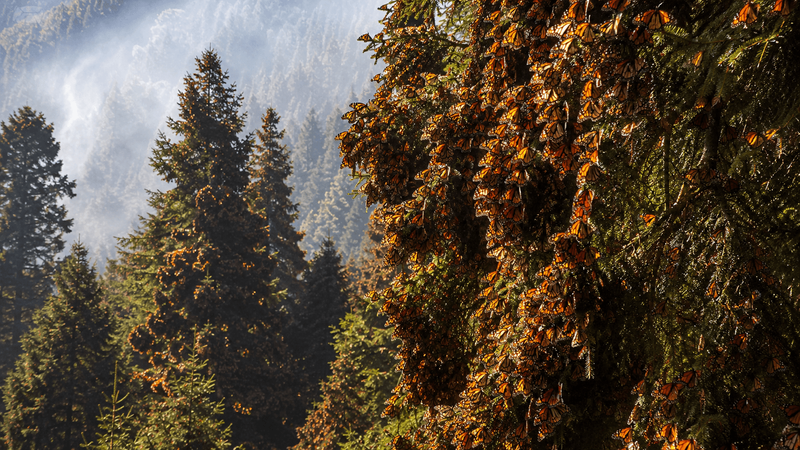
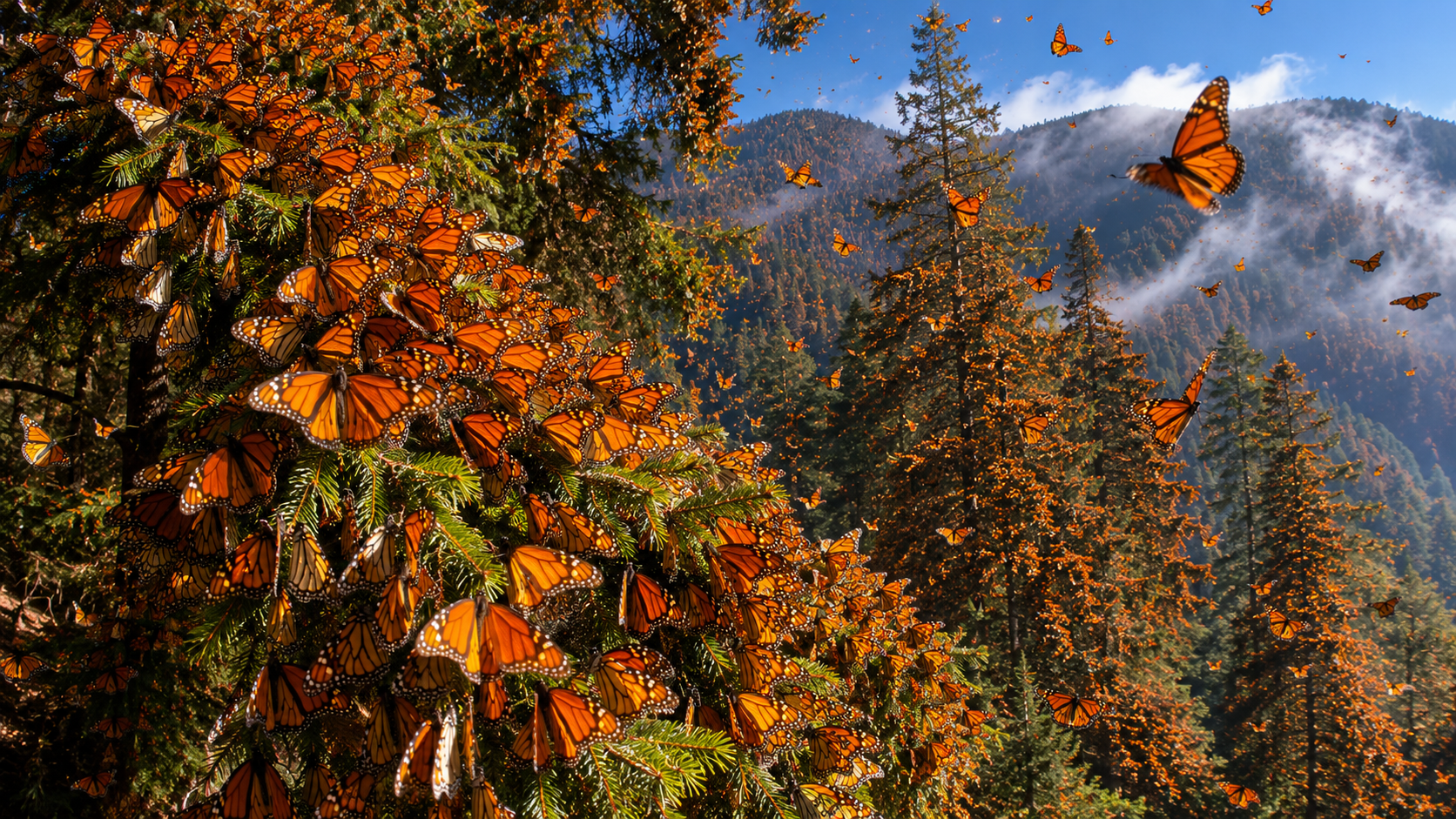
Each autumn, eastern North America witnesses one of the most dramatic animal migrations on Earth. Hundreds of millions of monarch butterflies (Danaus plexippus) leave their summer breeding grounds across Canada and the northern United States and funnel south and southwest, converging on a pinpoint destination: a cluster of Oyamel fir forest at 2,400–3,600 m in the Sierra Madre of Michoacán, Mexico. There, at roughly twelve overwintering sites typically covering 1–20 ha each, the entire eastern population clusters on trees so densely that branches bend under their weight.
No individual monarch has made this journey before. No individual monarch will make the return journey in spring. The butterflies that reach Mexico are the fourth or fifth generation of the year — descendants of those that left Mexico the previous spring. Yet they navigate unerringly to the same forest patches their ancestors used, on a route no living butterfly has ever flown.
The four-generation cycle
A monarch's normal adult lifespan in summer is two to six weeks. The annual cycle of the eastern population involves four or five distinct generations:
Generation 1 (March–April): The overwintering monarchs in Mexico begin to stir as days lengthen. They mate and begin moving north, reaching the southern United States (Texas, Oklahoma, Florida). Females lay eggs on the first milkweed of the year. These adults die in Mexico or shortly after reaching the US.
Generations 2 and 3 (May–July): Successive short-lived summer generations breed northward through the continent, following the emergence of milkweed. Each generation lives two to six weeks. By midsummer, monarchs are breeding in southern Canada.
Generation 4 — the migrant (late July–October): Something changes in the last summer generation. Instead of maturing sexually within weeks, these adults enter reproductive diapause — their gonads remain undeveloped, their metabolism slows, and their lifespan extends to seven or eight months. They are the ones that will fly to Mexico, overwinter, mate in spring, and begin the northward movement again. This generation is sometimes called the Methuselah generation for its extraordinary longevity compared to summer adults.
Navigation mechanisms
The sun compass
Monarchs maintain a consistent heading using a time-compensated sun compass housed in the antennae and brain. The circadian clock in the antenna adjusts for the sun's apparent movement across the sky, allowing the butterfly to hold a constant south-southwest course regardless of the time of day. Remove the antennae, and the butterfly loses directional ability. Keep it in constant light (disrupting the clock), and it flies in random directions.
The compass is calibrated: monarchs from different parts of the breeding range all converge on the same destination, implying that the inherited heading is not a fixed angle but is adjusted based on position.
Magnetic sensing
Several experiments have provided evidence that monarchs also detect the Earth's magnetic field. Exposing migrants to a shifted magnetic field causes predictable changes in heading. The sensory mechanism is not yet identified — iron-containing magnetite crystals have been found in the abdomen, but whether these are the primary magnetic sensor is uncertain.
Skylight polarisation
Monarchs can detect the pattern of polarised light in the sky — useful for orientation when the sun is obscured by cloud or near the horizon. This may extend the sun compass into twilight conditions.
Landscape and instinct
On a large scale, the migration follows landscape features: the Rocky Mountains funnel western migrants toward California; the Appalachians and coastline shape eastern routes. Local funnelling points — coastal capes, ridges, lakeshore peninsulas — can concentrate thousands of migrants. These landscape-level cues interact with the inherited directional tendency to guide the butterflies to their destination.
The overwintering sites
The Monarch Butterfly Biosphere Reserve in Michoacán, Mexico, protects the core overwintering sites. These are Oyamel fir (Abies religiosa) forests at high elevation, where the cool temperatures keep monarchs in a semi-dormant state that conserves energy through winter. The dense clustering provides microclimate stability — a single butterfly would freeze on a cold night; millions clustered together maintain enough warmth to survive.
The reserve was inscribed as a UNESCO World Heritage Site in 2008. Before protection, logging — both legal and illegal — had severely reduced the old-growth Oyamel forest. Since the reserve's establishment, forest cover has partially recovered, though illegal logging continues to be a problem.
In a warm winter, monarchs become active and consume fat reserves too quickly; in an unusually cold snap, mass mortality can occur. The overwintering sites are monitored annually: population is measured by the area of forest covered (hectares) rather than individual count, as individual counting is impossible. Peak populations in the late 1990s exceeded 18 hectares; recent years have seen as few as 2 hectares, with some recovery to 4–7 hectares after conservation efforts.
The milkweed crisis
Monarchs breed exclusively on milkweed (Asclepias spp.) — the only plants their caterpillars can eat. Adult monarchs also sequester cardenolide toxins from milkweed into their tissues, making them unpalatable to most birds (the blue jay famously learns to avoid monarchs through trial and error).
The loss of milkweed from the agricultural landscape of the midwestern United States is widely considered the primary driver of monarch decline. The adoption of herbicide-tolerant (Roundup-Ready) crops in the 1990s–2000s allowed widespread application of glyphosate across corn and soybean fields. Milkweed — previously common as a weed in field margins and between rows — was eliminated from the most productive agricultural areas of the migration corridor.
Conservative estimates suggest common milkweed (Asclepias syriaca) declined by more than a billion plants from the US Midwest between 1995 and 2013. This agricultural milkweed was an enormous breeding resource that has not been replaced by roadsides and gardens alone.
The western population
A separate, smaller western population overwinters along the California coast, primarily at Pacific Grove and Pismo Beach on the central California coast. These monarchs breed west of the Rocky Mountains and travel a shorter distance — typically 1,000–1,500 km. The California overwintering population has declined even more steeply than the eastern population, with counts dropping from over a million individuals in the 1980s to fewer than 30,000 in some recent winters, though numbers have partially recovered.
Other migratory butterflies
The monarch's migration is the most famous but not unique. Other notable migratory Lepidoptera:
- Painted Lady (Vanessa cardui): makes a multigenerational migration between sub-Saharan Africa and northern Europe, covering up to 15,000 km in total across generations — recently confirmed as the world's longest butterfly migration
- Red Admiral (Vanessa atalanta): partially migratory in Europe; autumn southward movement confirmed by radar tracking
- Cloudless Sulphur (Phoebis sennae): visible autumn migration along the eastern US coast, though shorter than monarch migration
- Common Jezebel (Delias nigrina): altitudinal migrant in eastern Australia
None of these approaches the monarch's combination of distance, directionality, and population size.
Conservation
The monarch is currently listed as Endangered on the IUCN Red List (assessed 2022), reflecting the steep population declines since the 1990s. Key conservation measures include:
- Milkweed restoration: citizen science programmes (e.g. Monarch Watch, Journey North) promote milkweed planting in gardens and on conservation land across the breeding range
- Monarch Butterfly Biosphere Reserve: continued protection and restoration of Oyamel forest in Mexico
- Agricultural partnerships: some US farmers have enrolled field margins in conservation programmes that maintain milkweed corridors
- Waystation network: certified monarch waystations — gardens and public spaces with milkweed and nectar plants — number over 35,000 across North America
The monarch has become the most prominent symbol of pollinator conservation in North America and attracts substantial public engagement. Several US states have designated the monarch as their state insect or state butterfly.
Interesting facts
- The Oyamel fir forests used by monarchs are the same forests used by their ancestors for at least tens of thousands of years — the site fidelity is encoded in the species' genome, not learned behaviour
- Monarchs can fly up to 80–100 km per day during autumn migration, using thermal air columns to soar and glide, minimising energy expenditure
- The monarch's orange-and-black warning pattern is mimicked by the Viceroy butterfly (Limenitis archippus), which was long believed to be non-toxic but is now known to be slightly unpalatable itself — making the relationship Müllerian mimicry (mutual benefit) rather than Batesian (bluff)
- During overwintering, the clustering monarchs occasionally burst into flight in a thermal event — millions of orange wings against the Mexican mountain sky — one of the most spectacular natural sights in the Americas