Red Data Book Butterflies of Russia
Russia's Red Data Book 2020 list: categories 0–5 and which day-flying butterflies are actually listed. What that means for observers.
What is the Red Data Book?
The Red Data Book of the Russian Federation (Красная книга Российской Федерации) is the official state list of threatened animal, plant, and fungal species. It is maintained by the Russian Ministry of Natural Resources and Environment and is periodically updated — the current animal list was approved in 2020 (Order No. 162).
Species listed in the federal Red Book receive legal protection under Russian law. Deliberate collection, killing, trade, or disturbance of a listed species and its habitat is a criminal offence with fines and, in serious cases, custodial sentences.
The Red Book is not simply a list — each species entry includes:
- A conservation status category (0–5 under the Russian method, not IUCN codes)
- A description of the species' range and population in Russia
- An assessment of the main threats
- Conservation measures recommended or already implemented
Conservation status categories
Russia's Red Data Book uses six categories (0–5) with Russian legal names. These are not IUCN codes (EX/CR/EN):
| Category | Meaning |
|---|---|
| 0 | Extinct in Russia |
| 1 | Endangered (under threat of extinction) |
| 2 | Declining |
| 3 | Rare |
| 4 | Status uncertain |
| 5 | Recovering |
Butterfly species in Russia's Red Book
The federal list was approved by Ministry of Natural Resources Order No. 162 of 24 March 2020. It includes fewer than 20 Rhopalocera taxa, counting some subspecies.
Papilionidae (Swallowtails)
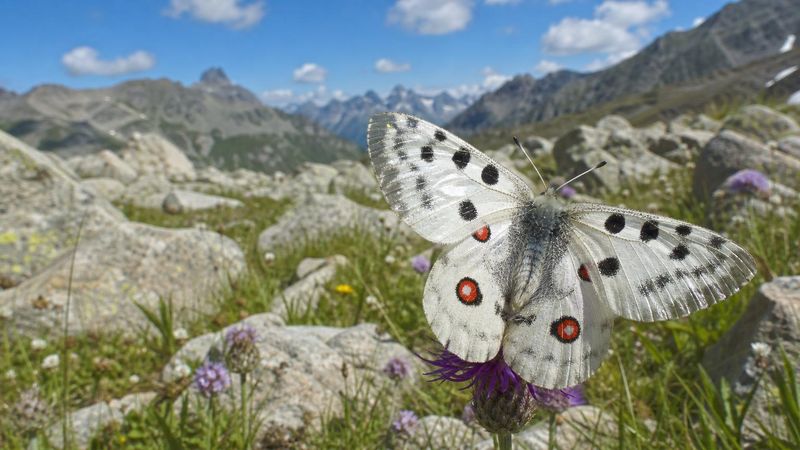
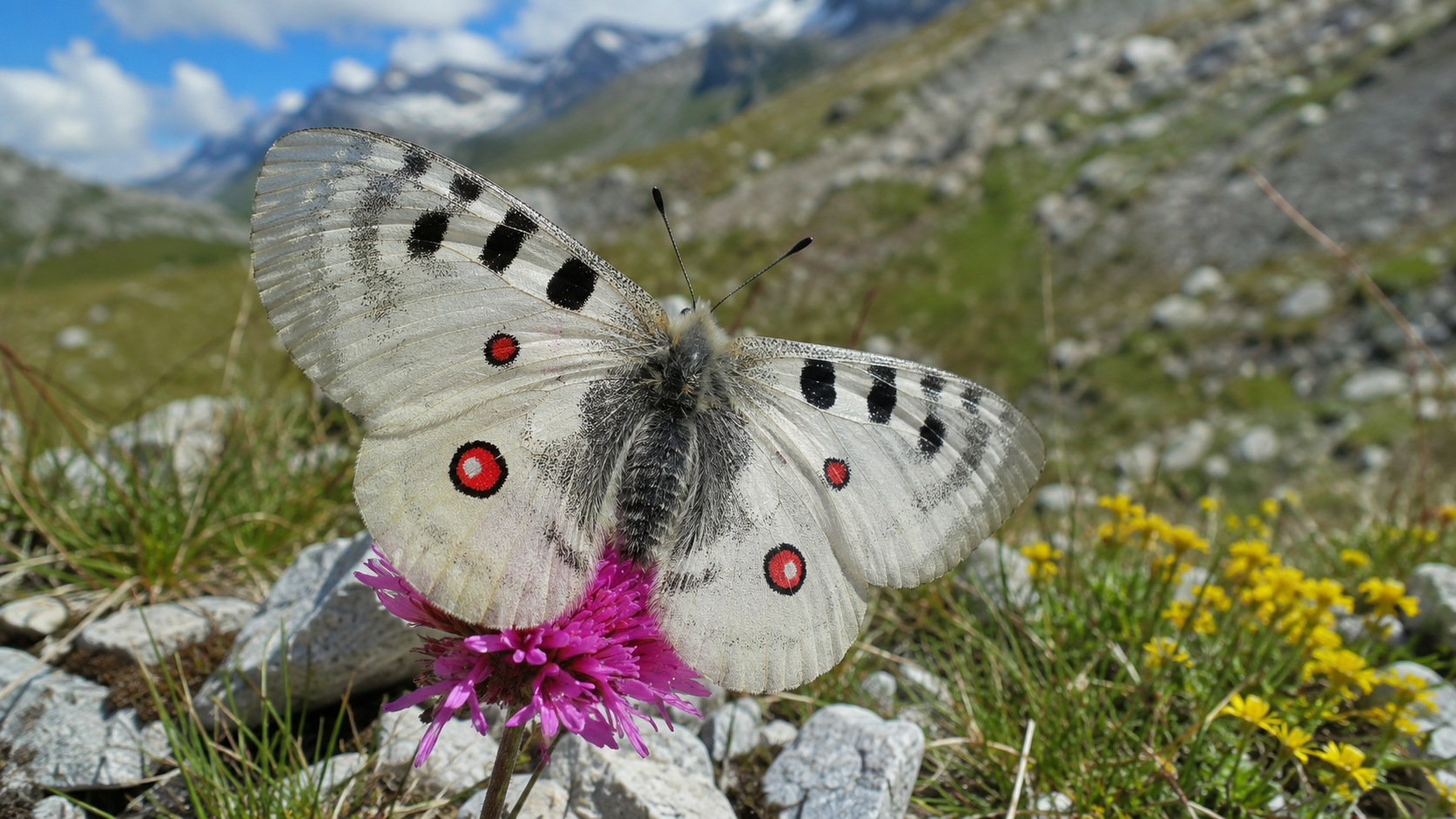
Apollo (Parnassius apollo) — Category 2 (declining). One of Russia's most recognisable protected butterflies. White wings with red-ringed black eyespots. Inhabits mountain and upland meadows in the Urals, southern Siberia (Altai, Sayan), and the Far East. Threatened by habitat change, tourism pressure on alpine sites, and collecting. Also CITES Appendix II.
Felder's Apollo (Parnassius felderi) — Category 1. A range-restricted Far Eastern parnassian.
Sericinus montela — Category 3. A Far Eastern swallowtail.
Goldia pacifica — a Far Eastern papilionid on the federal list.
Lycaenidae (Blues)
On the 2020 federal list: Celastrina oreas, Glaucopsyche argali, the subspecies Polyommatus damone pljushtchi, and Shijimiaeoides divina asahii. These are not the European Phengaris arion / alcon / nausithous.
Nymphalidae
Argynnis zenobia and Argynnis nerippe — Category 3. Also listed: Chalinga pratti, Pseudochazara euxina, Erebia kindermanni.
Not on the 2020 federal list (though often confused with it, and protected regionally or in Europe): mnemosyne, alexanor, the large blues Phengaris arion / alcon / nausithous, woodland brown (Lopinga achine). The false ringlet (Coenonympha oedippus) is a European Russia species, not Far Eastern; a global IUCN VU listing is not confirmed. Poplar admiral (Limenitis populi) and purple-edged copper (Lycaena hippothoe) appear in some regional Red Books, not on the 2020 federal list.
Regional Red Books
The federal Red Book covers species threatened at a national level — meaning rare or declining across Russia as a whole. But Russia's regional subjects (oblasts, republics, krays) also maintain their own regional Red Books covering species that may be common nationally but are rare or absent locally.
For a naturalist in Moscow, the Moscow Region Red Book is more directly relevant than the federal list: it covers over 60 butterfly species considered rare within the region, including many that are abundant elsewhere. A species need not be in the federal Red Book to be legally protected within the region where it is listed.
Regional Red Books where butterfly lists are particularly important:
- Moscow Region — high urbanisation, loss of meadow habitats
- Leningrad Region / St. Petersburg — many wetland species threatened by drainage
- Krasnodar Krai / Republic of Adygea — Caucasus endemics, alpine species
- Primorsky Krai (Far East) — East Asian species at the edge of their ranges in Russia
Why are Russian butterflies declining?
The same drivers affecting butterfly populations across Europe apply in Russia:
Habitat loss and change:
- Abandonment of traditional meadow management (mowing, light grazing) allows shrub encroachment and grassland succession, eliminating open meadow species
- Drainage of wet meadows eliminates species dependent on marsh and fen habitats
- Afforestation of upland meadows and grasslands
- Loss of forest clearings and rides through changed forestry practices
Agricultural intensification:
- Pesticide use in agricultural landscapes kills caterpillars and eliminates host plants
- Fertilisation of meadows promotes rank grass growth at the expense of wildflowers
Urbanisation and infrastructure:
- Road building and housing development fragment habitat, isolating small populations
- Recreational pressure on sensitive alpine sites
Climate change:
- Montane species (Parnassius, alpine blues) face shrinking suitable altitudinal zones as lower limits warm and vegetation zones shift upward
- Phenological mismatch between butterfly emergence and host plant availability
Collecting:
- A significant historical pressure on spectacular species like Apollo, Parnassius, and large swallowtails; reduced by legal protection but not eliminated
What citizen scientists can do
Recording observations
Every observation of a Red Book butterfly submitted with location data and photographs contributes to the monitoring of threatened populations. The most valuable records:
- Include precise GPS coordinates or a clear location description
- Have at least one photograph showing diagnostic wing features
- Note date, time, number of individuals, and habitat type
iNaturalist is the most accessible platform for submitting observations globally; records automatically feed into scientific databases.
Argo (argo.ecobirds.ru) is Russia's national citizen science butterfly monitoring project — specifically designed for butterfly records in Russia, with a user interface in Russian and integration with regional monitoring programmes.
Habitat protection
Many butterfly species respond to simple habitat management measures: preventing scrub encroachment on grassland, maintaining flower-rich meadow edges, delaying mowing until after peak butterfly season (usually after mid-July). Working with local nature reserves or participating in conservation volunteer days can have measurable impact on local butterfly populations.
Raising awareness
Photography and citizen science records that demonstrate the presence of Red Book species at a specific site can trigger legal protection for that site or influence planning decisions. Several development projects in Russia have been modified or cancelled after surveys demonstrated the presence of protected species.
Useful resources
- Red Data Book of the Russian Federation (Animals) — the official publication; the 2020 list (Order No. 162) is available through the Ministry of Natural Resources website
- IUCN Red List (iucnredlist.org) — global conservation status for species occurring in Russia
- iNaturalist — citizen science observation platform; community identification; global database
- Argo citizen science — Russian butterfly monitoring programme
- Fauna of Russia — academic database of Russian biological records
Interesting facts
- Russia's federal Red Book has been published four times: 1978, 1983, 2001; the current animal list is 2020; each edition has expanded the butterfly list as populations have been better surveyed and declines confirmed
- The Apollo (Parnassius apollo) was the first European butterfly to receive international CITES protection, added to Appendix II in 1987, after evidence of widespread commercial collecting for the collector trade
- Some butterfly species that were in serious decline in European Russia have shown partial recovery in recent decades — the White Admiral (Limenitis camilla) and Purple Emperor (Apatura iris) have expanded following changes in forest management that created more suitable woodland structure
- Russia's Far East has a number of Asiatic butterfly species listed in regional Red Books that have no equivalent protection in neighbouring China or Japan, making the Russian boundary populations conservation priorities even though the species are not globally threatened