Butterfly vs. Moth: What Actually Separates Them
Butterflies and moths are not formally separate scientific groups — the popular distinction rests on a handful of unreliable rules of thumb rather than a single defining trait.
There is no formal dividing line
Despite how confidently the distinction is treated in everyday language, butterflies and moths are not separate scientific groups. Both belong to the single order Lepidoptera, and butterflies (technically the superfamily Papilionoidea, plus a couple of small related groups) are, in strict evolutionary terms, simply one specialized branch that evolved from within a much larger and older group of moths. There is no formal taxonomic rank called "moth" at all — it functions as a catch-all popular label for every Lepidoptera species that isn't a butterfly, spanning roughly 160,000 species of enormous diversity, compared to around 18,000 butterfly species.
The rules of thumb, and where each fails
Three popular rules are commonly used to sort a given specimen into "butterfly" or "moth," and each one works most of the time but fails on real species:
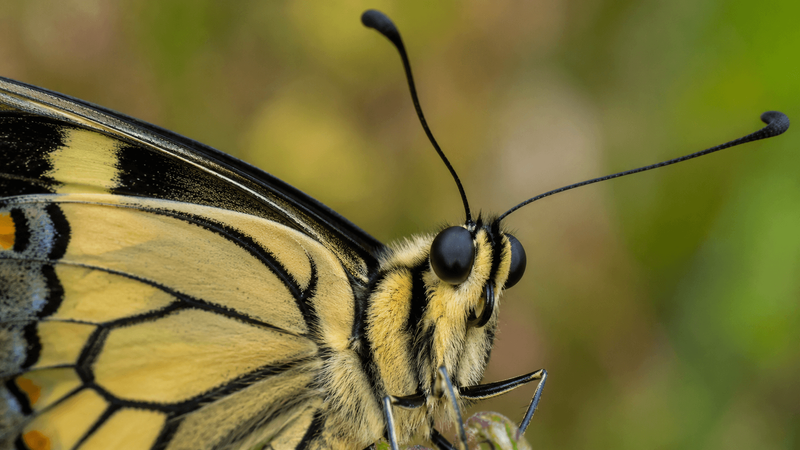
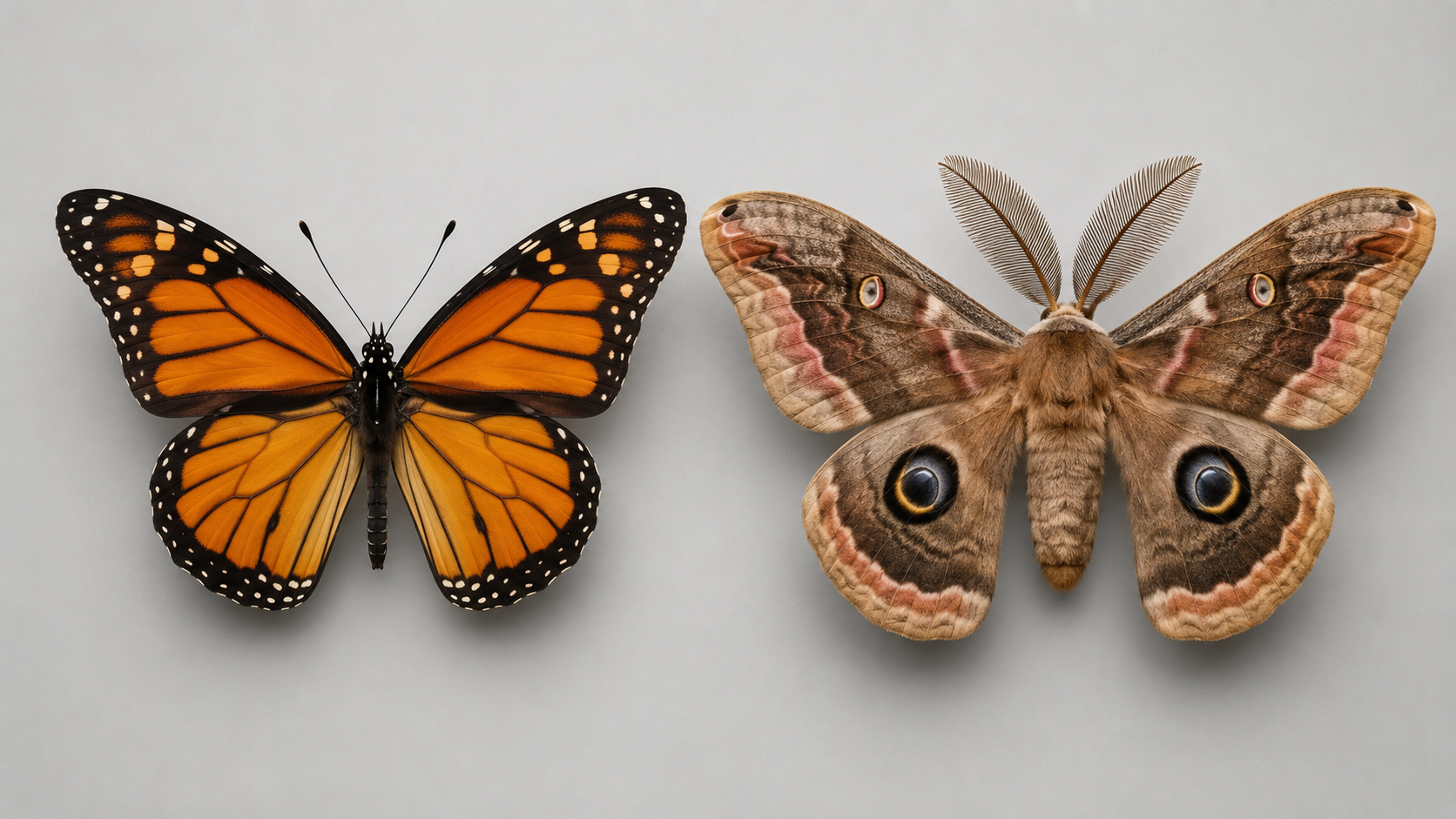
- Antennae shape. Most butterflies have slender antennae ending in a small club or knob; most moths have feathery, comb-like, or simple thread-like antennae without a club. But several moth families, including some day-flying burnet moths, have club-tipped antennae closely resembling a butterfly's.
- Time of activity. Most butterflies fly by day; most moths fly by night. But numerous moth species, including many burnets and some silk moths, are active in daylight, while a few butterflies are most active at dusk.
- Resting wing position. Butterflies typically fold their wings together vertically above the body at rest; moths typically hold wings flat or tented over the body. Skippers, generally classified with butterflies, often rest with wings in positions that don't match the typical butterfly pattern at all.
Each rule reflects a genuine statistical tendency across Lepidoptera as a whole, but none of them is a hard boundary, and a specimen that breaks two of the three rules is not unusual.
The atlas moth: large, colorful, and still a moth
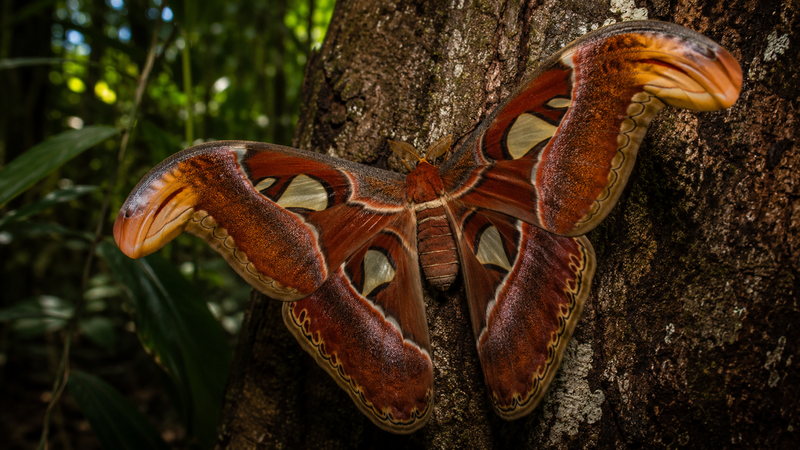
The atlas moth (Attacus atlas), the largest moth in the world by wing surface area, is a useful illustration of how far the popular stereotype can diverge from an individual species. Its enormous, intricately patterned wings — up to 30 cm across, with snake-head-shaped wingtips — look far more like the popular image of a spectacular butterfly than a plain nocturnal moth, yet by every formal classification criterion it is unambiguously a moth. Adult atlas moths don't even feed, living entirely on fat reserves stored during the caterpillar stage, a trait shared with several other giant silk moths but essentially unheard of among true butterflies.
See also: Lepidoptera, antenna.