Atlas Moth
The atlas moth (Attacus atlas) — the largest moth by wing area, up to 30cm, with snake-head wingtips. Adults don't feed, live on larval fat reserves.
Key facts
- Latin name
- Attacus atlas
- Family
- Saturniidae
- Wingspan
- 250–300 mm
- Flight season
- Year-round (varies by region)
- Host plants
- Cinnamon (Cinnamomum verum), Citrus species (Citrus spp.), Ailanthus (Ailanthus altissima), Privet (Ligustrum spp.), Tree of heaven and many other woody plants
- Conservation status
- NENot Evaluated
Appearance
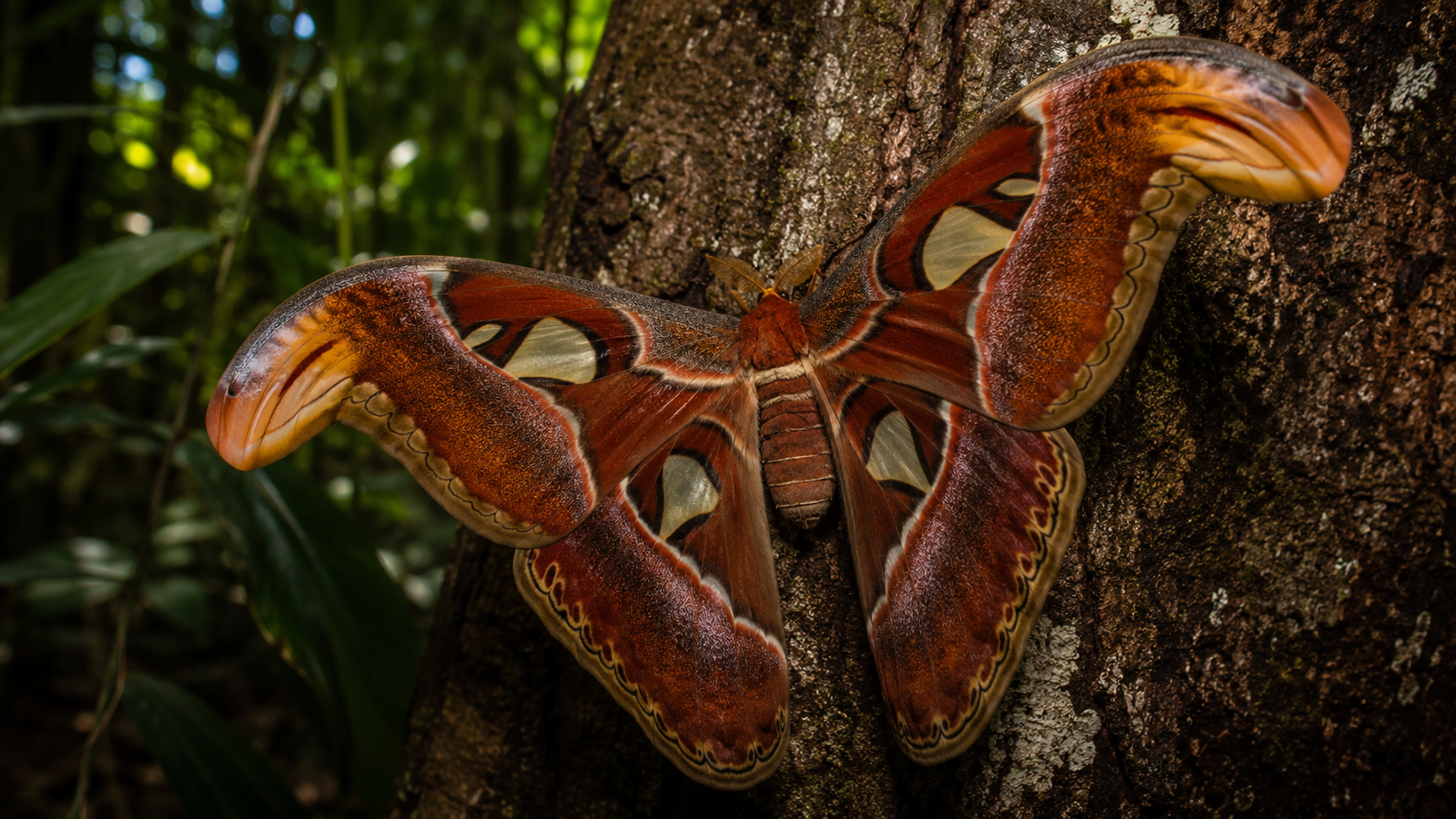
The atlas moth is an overwhelming insect. A large female with wings fully spread covers an area greater than a human hand — the wingspan reaches 250–300 mm (25–30 cm), and the wings themselves are broad and deeply lobed, maximising surface area. The total wing area can exceed 400 cm² in large individuals.
Colouration: The wings are a complex patchwork of warm chestnut-brown, russet, ochre, white, and deep maroon, arranged in geometric bands that flow across both forewings and hindwings continuously. The overall effect is rich and intricate rather than gaudy — patterned to suggest bark texture when the wings are folded slightly.
Translucent windows: Each wing carries a triangular translucent patch (the "window") near its centre — an area where the wing scales are absent and the wing membrane itself is clear, like glass. Four such windows, one per wing, catch and transmit light in a way that may disrupt the outline of the moth to predators. These windows are a signature feature of the atlas moth and several relatives in the Saturniidae.
Snake-head wing tips: The forewing apex is extended into a curved, hook-like lobe with a pattern that mimics a snake's head with remarkable fidelity — the curve suggests a jaw, brown-on-white scaling imitates snake skin texture, and a dark spot suggests an eye. Each of the four wing tips carries this pattern. At rest, the moth appears to be surrounded by four small snake heads; when disturbed, it waves its wings slowly, animating the illusion.
Sexual dimorphism: Females are substantially larger than males and have a larger, rounder abdomen packed with eggs. Males are immediately distinguished by their large, highly plumose (feathery) antennae, which are the sense organs for detecting female pheromones.
Range and habitat
The atlas moth is distributed across South and Southeast Asia:
- Indian subcontinent: peninsular India, Sri Lanka (common in lowland wet zone)
- China: Yunnan, Guangdong, Taiwan (where it is particularly well-known culturally)
- Southeast Asia: throughout Myanmar, Thailand, Laos, Vietnam, Cambodia, Malaysia, Indonesia (Sumatra, Java, Borneo, Sulawesi), the Philippines
The species is found primarily in tropical and subtropical forest from sea level to approximately 1,500 m. It favours areas with tall trees providing ample larval host plants and sheltered roosting sites for the large, unwieldy adults. It is also found in secondary forest, forest edge, and occasionally in gardens and parks in lowland urban areas when host plants are present.
Life cycle
Eggs and larvae
The female lays 200–400 eggs on the underside of leaves of the host plant over the course of her brief adult life. Eggs are spherical, pale, and slightly sticky, attached singly or in small groups. They hatch in approximately 2 weeks.
Caterpillars are large, pale blue-green when young, becoming progressively yellower and more robust through five instars. Fully grown fifth-instar caterpillars are massive — up to 10 cm long — and striking: a pale green body is coated with waxy white powder (pruinose) that gives a frosted appearance. Prominent tubercles (spike-like protuberances) line the back and sides. The caterpillar feeds voraciously on the leaves of a wide range of woody plants, including cinnamon, citrus, Ailanthus, privet, and many others; it is polyphagous across dozens of host plant families.
Larval development takes 2–3 months, during which the caterpillar accumulates all the reserves that will sustain it through its entire adult life.
Pupa and cocoon
The atlas moth produces a distinctive silk cocoon of considerable size — up to 10 cm long and shaped like a hanging teardrop or purse. The silk is brown or golden-brown and very strong. Uniquely, the cocoon is left partially open at the top — a hanging funnel or "sleeve" — which the adult moth can exit easily on emergence without being trapped.
In Taiwan, the tough, naturally open-ended cocoons have traditionally been used as small purses or coin pouches, taking advantage of the natural opening as a functional closure. The purse-making tradition using atlas moth cocoons is documented in Taiwan's Atayal indigenous culture.
The pupal stage lasts 3–4 weeks under warm conditions; in cooler or drier conditions, diapause can extend this period substantially.
Adults
Adults emerge, mate, and die within one to two weeks. They are primarily nocturnal, flying at night, but are commonly found resting during the day on tree trunks, walls, or foliage. Despite their enormous size, they are weak fliers relative to their wing area — they lack the powerful thoracic musculature of fast-flying moths — and are more given to gliding and slow, directional flight than to rapid manoeuvring.
Male pheromone detection: The male's exceptionally large, bipectinate (doubly-feathered) antennae carry thousands of chemoreceptor cells sensitive to the specific pheromone cocktail produced by the female. Males can detect a single female from distances of several kilometres in still air.
Snake-head mimicry
The wing-tip mimicry of the atlas moth has attracted considerable scientific attention. Experiments placing atlas moths in cages with potential avian predators showed that the snake-head presentation caused hesitation and avoidance behaviour in naive (previously inexperienced) birds, suggesting that the mimicry does not require prior experience of snakes to be effective — possibly because certain visual configurations (curved, patterned with a central dark spot) trigger innate predator-avoidance responses in birds.
When handled or disturbed at rest, the atlas moth characteristically drops to the ground, spreads its wings to their fullest extent, and performs slow rhythmic wing movements that further animate the four snake-head patterns. This is the classic "wing-waving" display documented in Saturniidae with mimetic wing tips.
Cultural significance
In Taiwan, the atlas moth (liugui tiancan in Mandarin) is one of the most recognisable and culturally significant insects. Its silk is collected for traditional crafts; its enormous size makes it a frequent subject of nature documentaries and science education programmes. The moth is also the origin of the vernacular Chinese name for the Atlas Mountains — the Chinese word atejisi used as a transliteration of "atlas" coincidentally resembles the Chinese name for the moth, creating an etymological curiosity.
In parts of rural India and Southeast Asia, large Saturniidae cocoons are collected for their silk (an alternative to mulberry silk), and the pupae are eaten as a protein-rich food. The atlas moth's large cocoon makes it particularly valued for both purposes.
Conservation
The atlas moth has no global IUCN assessment (NE). It is widespread and not generally considered threatened — it is widespread, occurs in multiple protected and unprotected forests throughout its range, and is not known to be in decline at a population level. Its polyphagous caterpillars and tolerance of secondary forest mean it persists in degraded habitats where obligate forest specialists have been lost.
Localised populations may face pressure from deforestation (reducing tall-forest roosting and larval host availability) and from collection for the live insect trade and display market — large, showy Saturniidae are among the most commercially traded Lepidoptera globally. However, the broad range and ecological flexibility of A. atlas mean these pressures do not currently constitute a species-level threat.