Peleides Blue Morpho
The Peleides blue morpho is one of the largest, brightest butterflies alive — its iridescent blue wings, up to 20 cm, come from light-scattering nanostructures.
Key facts
- Latin name
- Morpho peleides
- Family
- Nymphalidae
- Wingspan
- 95–200 mm
- Flight season
- Year-round (adults present all months)
- Host plants
- Mucuna (velvet bean, Fabaceae), Lonchocarpus (Fabaceae), Erythrina (coral tree, Fabaceae), Pterocarpus (Fabaceae)
- Conservation status
- NENot Evaluated
Appearance
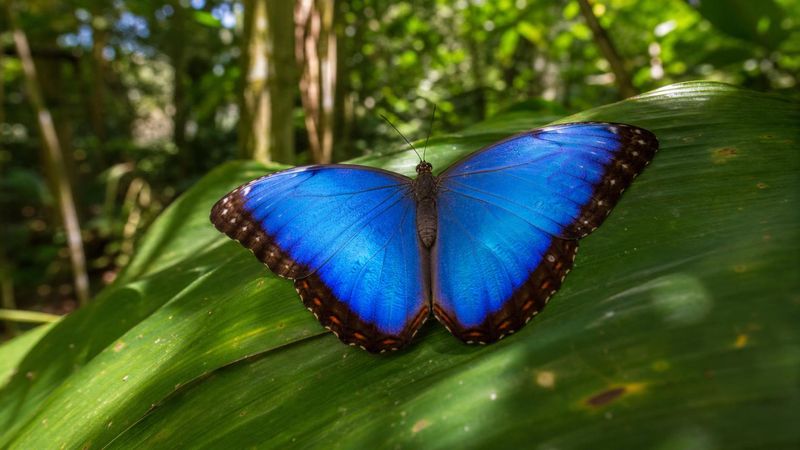
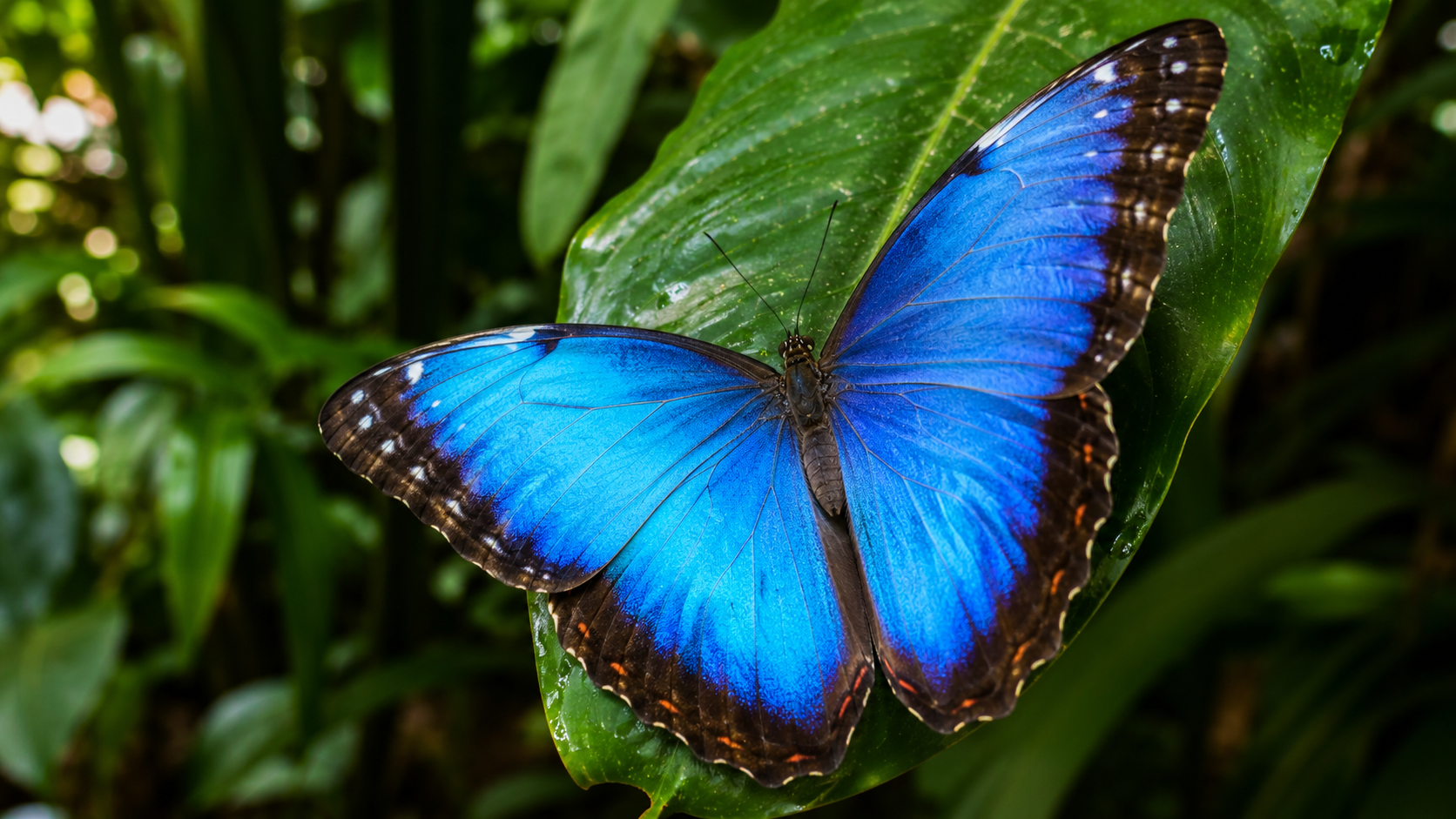
The Peleides blue morpho is one of the most visually striking insects on Earth. The male's wingspan reaches 120–200 mm (females are slightly larger but less intensely coloured); the entire upperwing surface is a blazing, reflective electric blue that shifts through cobalt, cyan, and violet depending on the angle of light. This iridescence is visible from 50–80 metres and makes the species unmistakable in flight.
The underside of both wings is completely different: cryptic dark brown with a pattern of large, ringed eyespots and pale buff patches that resembles dead leaves or bark. When a morpho lands and closes its wings, it disappears almost instantly. The transition from near-invisible resting state to brilliant blue flight flash is one of the most arresting sights in tropical natural history.
Females are less dramatically coloured: the upperwing is brown with a broad blue-to-blue-green iridescent band, and the underside eyespot pattern is more developed than in males.
Range and habitat
Morpho peleides is native to Central America and the northern half of South America, from Mexico south through Guatemala, Belize, Honduras, Costa Rica, and Panama, and into Colombia, Venezuela, Ecuador, and Trinidad.
The species inhabits tropical and subtropical moist broadleaf forest — primarily the understorey and edge zones of lowland and premontane rainforest up to about 1,400 m elevation. It is most visible in open forest clearings, river margins, and wide forest trails where males patrol exposed sunny routes. Dense primary forest interior is less frequented; morphos use the interior mainly for roosting at night and resting during the hottest midday hours.
Life cycle
Eggs and larvae
Females lay pale green, hemispherical eggs singly on the young leaves of leguminous host plants, particularly Mucuna, Lonchocarpus, and Erythrina. The caterpillar is strikingly patterned — bright green with red and white lateral markings — and feeds at night, resting motionless on a bare twig by day. When threatened, it rubs its abdomen against its thorax to produce a sound, and releases a secretion with a pungent, butter-like odour from glands near the head.
The larval stage lasts approximately 90 days through several instars. The pupa is green and hangs freely from a leaf stem or twig; it reflects incident light from its metallic gold-green surface — thought to function as camouflage by mimicking a glistening dew-covered leaf. The pupal stage lasts two to three weeks.
Adults
Adults are non-seasonal — fresh adults emerge throughout the year in the lowland tropics, though emergence peaks after the dry season. Lifespan is approximately 115 days.
Behaviour
Territory and flight
Males are strongly territorial. Each individual patrols a defined route along a forest path, stream margin, or clearing, flying at moderate height (0.5–3 m) in the characteristic morpho style: slow, bounding wingbeats with long glides, the wings alternately flashing blue and disappearing brown. Rival males engage in aerial spiral chases lasting several minutes before one retreats.
The flashing iridescence may serve as long-range male recognition signal. At distance, the alternating blue flash and dark invisibility creates a flickering strobe effect that is highly conspicuous to other morphos but may confuse predators — the actual position of the butterfly in space becomes very hard to track.
Feeding
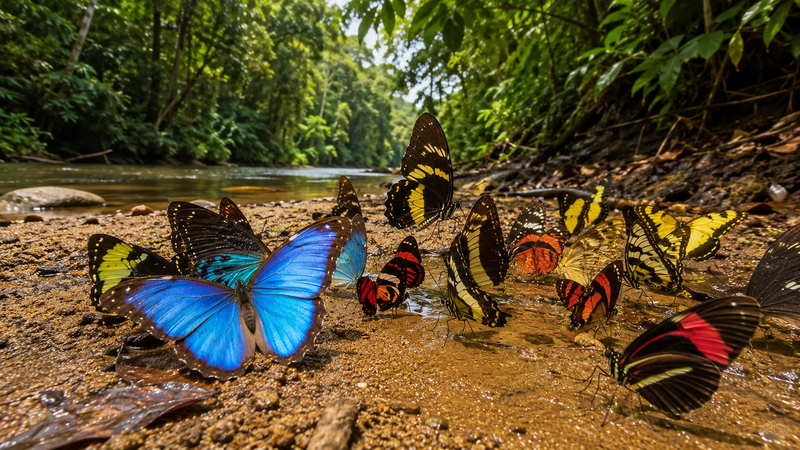
Adults feed on fermenting fruit — overripe mangoes, fallen figs, and rotting bananas. They locate food primarily by chemical detection, often gathering in small aggregations around a single fruit source. They do not visit flowers. Males also engage in mud-puddling at damp riverbanks, extracting mineral salts from wet sand.
Structural colour — how it works
The blue colour is produced by photonic nanostructure rather than pigment. Each wing scale carries a series of transparent cuticle ridges, each ridge being a stack of precisely spaced horizontal lamellae — thin transparent shelves separated by air gaps approximately 200 nm wide. When white light strikes this array, blue wavelengths (around 450 nm) are selectively reinforced by constructive interference while other wavelengths cancel out. The result is an exceptionally pure, saturated blue with high reflectance — far brighter than any achievable with chemical dyes.
This principle is now used as a model for engineering anti-counterfeiting features, structural-colour displays, and ultra-efficient solar cells.
Conservation
Morpho peleides has no global IUCN assessment (NE). It remains common in suitable forest habitat throughout its range and is the most widely bred butterfly in the world — hundreds of butterfly houses on every continent maintain captive colonies reared from eggs on legal farms in Costa Rica and Colombia.
The principal long-term threat is deforestation: morphos require intact or semi-intact forest and do not persist in degraded or agricultural landscapes. Population monitoring in areas of intensive logging and cattle ranching in Central America shows rapid decline wherever the forest canopy is removed.