Pearl Heath
The pearl heath (Coenonympha arcania) is a small satyr butterfly of Central and Southern Europe, with a white postdiscal stripe and silver-ringed eyespots.
Key facts
- Latin name
- Coenonympha arcania
- Family
- Nymphalidae
- Wingspan
- 33–40 mm
- Flight season
- June — July
- Host plants
- Upright brome (Brachypodium pinnatum), Wood millet (Milium effusum), Sheep's fescue (Festuca ovina), Wood melick (Melica uniflora)
- Conservation status
- LCLeast Concern
Appearance
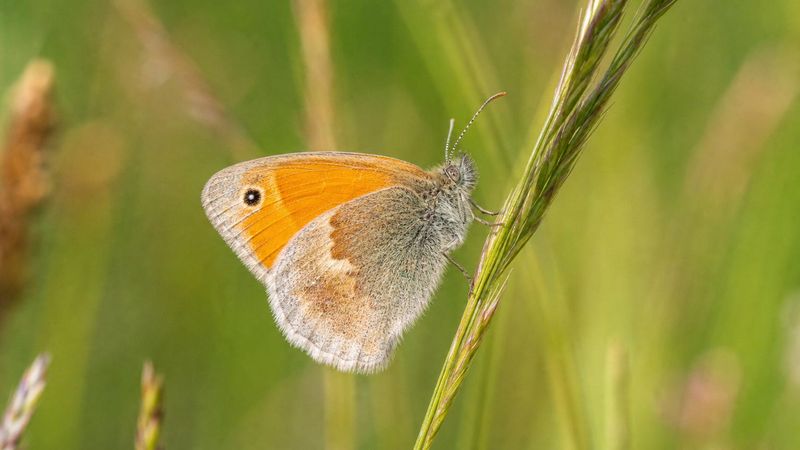
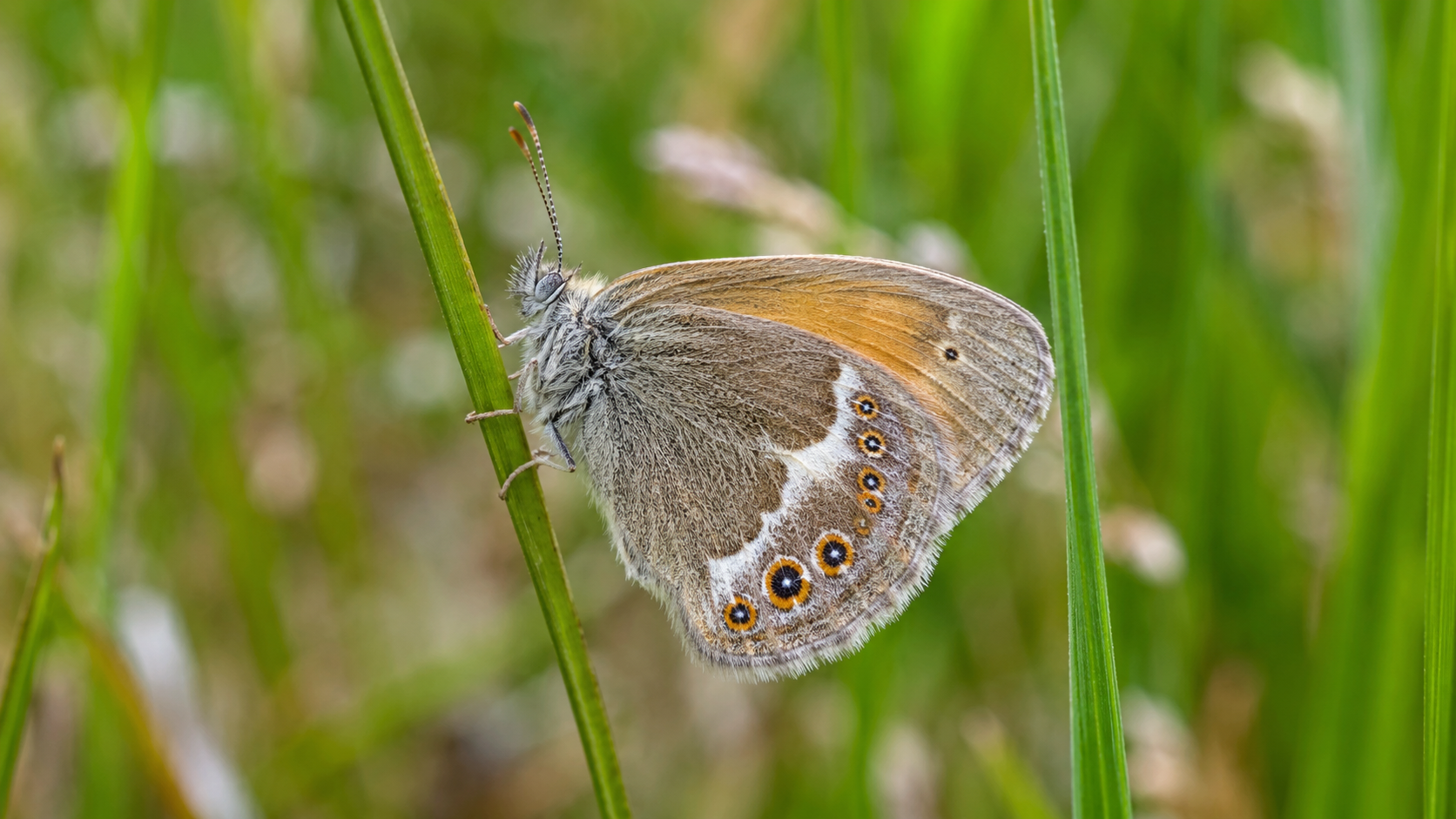
The pearl heath is a small to medium-sized butterfly with a wingspan of 33–40 mm. In resting posture — the wings invariably closed — the hindwing underside provides the clearest identification features:
- A broad white or pale cream postdiscal stripe running across the outer half of the hindwing
- Within the white band, a row of five to six black eyespots, each surrounded by an orange-yellow ring and tipped with a silver-white pupil
- The inner hindwing is grey-brown; the outer margin beyond the eyespots is grey, often with a faint violet sheen in fresh individuals
The upperwing is plain orange-tawny with a dark grey border, slightly darker in females. Unlike its close relative the small heath, there are no eyespots visible on the upperwing. The forewing underside is orange-buff with a small apical eyespot.
Males are somewhat brighter than females; worn individuals lose the silver pupils from the eyespots and the white band fades to pale buff.
Range and habitat
The pearl heath occurs from northern Spain and France east through the Alps, Apennines, Balkans, and Anatolia to the Caucasus and northern Iran. It is absent from the British Isles, the Netherlands, and Scandinavia; the northern range limit runs roughly through northern Germany and Poland.
The species is essentially a woodland-edge specialist. It thrives in:
- Sunny rides and glades in deciduous and mixed woodland, especially on calcareous soils
- Scrubby grasslands where bracken, bramble, or hazel provide partial shade at the margins
- Coppice woodland where the regular cutting cycle creates a shifting mosaic of open and shaded ground
- Wood pastures and traditionally managed forest edges in Central Europe
It avoids continuously shaded forest interiors and heavily grazed or fertilised grasslands. Warm, sheltered south-facing slopes with a mixture of grass and scrub are consistently the best sites.
Life cycle
The pearl heath is single-brooded, with adults flying from mid-June to late July (late May to June at lower elevations in southern parts of the range; July to early August in the Alps above 1,000 m).
Eggs are laid singly on grass blades, usually on shaded plants at the woodland margin. The caterpillar is green with a pale lateral stripe, cryptically matching the grass leaves on which it feeds. It overwinters when half-grown, typically among the leaf litter at the base of the host plant, and completes feeding in spring. Host grasses include upright brome (Brachypodium pinnatum), sheep's fescue (Festuca ovina), wood melick (Melica uniflora), and wood millet (Milium effusum).
The pupa forms at the base of a grass stem or in low vegetation in early June. The adult emerges after two to three weeks.
Behaviour
Adults are most active on sunny, calm days. Males perch prominently on grass stems, bracken fronds, or low shrub branches, making short sallying flights to intercept females or rival males. Both sexes feed avidly on nectar — bramble blossom, wild marjoram, and field scabious are especially favoured where they occur at woodland margins.
The pearl heath is a sedentary species. Most individuals remain within a patch of suitable habitat of a few hectares throughout their short adult life. This localisation makes populations in isolated fragments — a single woodland ride, a small calcareous meadow enclosed by arable land — very vulnerable: once lost, recolonisation rarely occurs without deliberate management to create connecting habitat.
Conservation
The species is listed Least Concern (LC) globally. In Central Europe it remains widespread, though regional trends show contraction at the northern and western edges of its range. The key management prescription is maintaining structured woodland edges: rides should be cut on a rotation so that at any point some sections are open and sun-drenched while others offer adjacent shade. Overgrown rides with complete canopy closure, and rides mown uniformly each year, both fail the species. Where calcareous grassland adjoins woodland, traditional low-intensity grazing or hay-cutting maintains the sward structure the caterpillars require.