Butterflies of Meadows and Steppes
Meadows and steppes support the richest butterfly communities in the temperate world, but face drastic losses across temperate Eurasia.
Grasslands as butterfly habitat
Open, unimproved grasslands — meadows managed by traditional mowing or grazing, and the natural steppes of the continental interior — are among the most important habitats for butterflies in the temperate world. The combination of abundant and diverse flowering plants, open sunny conditions, and minimal disturbance to the soil creates the conditions in which butterfly diversity reaches its temperate maximum.
A species-rich hay meadow in the forest-steppe zone of Russia may support 60–80 species of butterfly within a few hectares. The steppe proper, where natural grassland extends for hundreds of kilometres, hosts a fauna that has evolved over millions of years alongside the grassland ecosystem itself — a community of specialists found nowhere else.
Meadow habitats and their butterflies
Flood meadows and wet grasslands
Wet meadows along rivers, and seasonally flooded lowland grasslands, support a distinct community centred on moisture-demanding plants:
- Marsh fritillary (Euphydryas aurinia) — devil's-bit scabious meadows
- Purple-edged copper (Lycaena hippothoe) — damp grassland with sorrel and dock
- Scarce copper (Lycaena virgaureae) — meadow edges with goldenrod and sorrel
- Large skipper (Ochlodes sylvanus) — tall rank grassland with cocksfoot
The key management requirement is late mowing — cutting after mid-July allows most butterfly species to complete their flight and egg-laying cycles. Early silage cuts in May–June are particularly destructive.
Calcareous dry meadows
Chalk and limestone grasslands, where the thin, alkaline soil prevents rank vegetation from overwhelming low-growing plants, hold the highest butterfly diversity in the temperate zone:
- Adonis blue (Polyommatus bellargus) — horseshoe vetch on short turf
- Chalk-hill blue (Polyommatus coridon) — also horseshoe vetch
- Duke of Burgundy (Hamearis lucina) — cowslip and primrose
- Dark green fritillary (Speyeria aglaja) — violet-rich unimproved pasture
- Silver-spotted skipper (Hesperia comma) — very short, south-facing turf
Low-intensity grazing — particularly by sheep and cattle — is the traditional management that maintains the sward structure these species need. Moderate grazing pressure keeps the turf short enough for sun-loving species while preventing the invasion of coarse grasses and scrub.
Forest-edge and woodland meadows
In the forest zone of central Russia, the richest grassland butterfly sites are the clearings and margins between forest and open land — the opushka habitat:
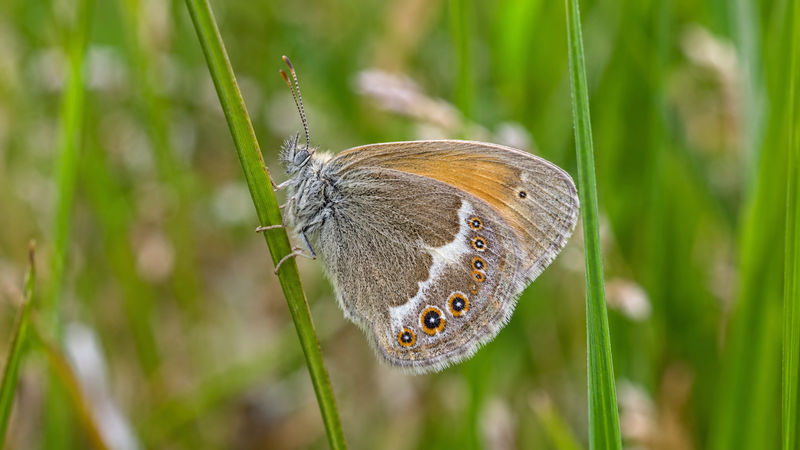
- Pearl heath (Coenonympha arcania) — warm woodland rides and scrubby margins
- Small pearl-bordered fritillary (Boloria selene) — moist clearings with violet
- White admiral (Limenitis camilla) — shaded rides with honeysuckle
- Silver-washed fritillary (Argynnis paphia) — oak and mixed woodland rides
Steppe habitats and their butterflies
Meadow steppe (луговая степь)
The transition zone between forest-steppe and true steppe, with a rich forb (wildflower) layer in a tall-grass matrix, is the most botanically diverse and butterfly-rich steppe type. Characteristic species include:
- Esper's marbled white (Melanargia russiae) — tall-grass steppe with fescues and bunchgrasses
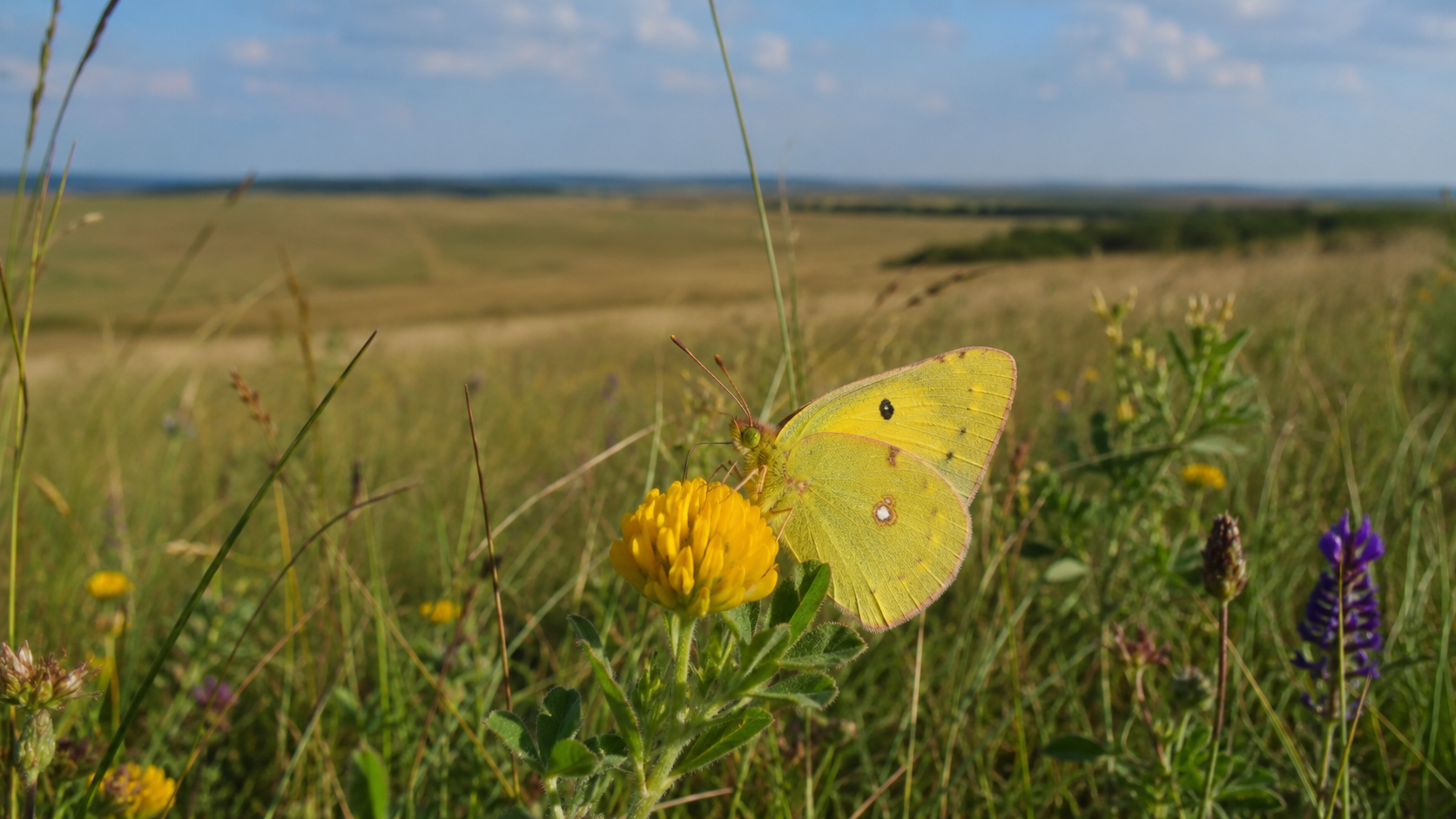
- Eastern clouded yellow (Colias erate) — legume-rich swards
- Little blue (Cupido minimus) — kidney vetch patches
- Damon blue (Polyommatus damon) — sainfoin (Onobrychis) on calcareous soils
Dry feather-grass steppe (типичная степь)
The classic open steppe of the Black Earth belt, dominated by feather-grasses (Stipa) and fescues, hosts more drought-tolerant specialists:
- Great sooty satyr (Satyrus ferula) — large, powerful brown satyrid of rocky and dry grass steppe
- The hermit (Chazara briseis) — bare and rocky steppe slopes
- Lattice brown (Kirinia roxelana) — tall grass at steppe margins, range reaches southern Russia
- Pale clouded yellow (Colias hyale) and Berger's clouded yellow (C. alfacariensis) — legume-rich steppe patches
| Steppe type | Characteristic butterflies |
|---|---|
| Meadow steppe | Esper's marbled white, eastern clouded yellow, Damon blue |
| Feather-grass steppe | Great sooty satyr, hermit, pale clouded yellow |
| Rocky (petrophytic) steppe | Chazara briseis, various Pseudophilotes blues, steppe skippers |
| Saline steppe | Damon blue, salt-flat specialist lycaenids, clouded yellows |
Threats to grassland butterflies
Ploughing of virgin steppe
The most catastrophic single event for the Russian steppe fauna was the Virgin Lands campaign of the 1950s–60s, which brought over 40 million hectares of natural steppe under the plough. This destroyed irreplaceable plant communities — some of them ancient since the Pleistocene — along with the entire butterfly faunas dependent on them. Recovery on ploughed steppe, even after decades of abandonment, is extremely slow: rare plant species and their associated butterflies may never return.
Agricultural intensification
On meadows retained in agricultural use, the shift from late hay-cutting to early, repeated silage cuts eliminates most butterfly species within a few years. Nitrogen fertilisation promotes aggressive grasses that crowd out the diverse low-growing flowers on which blues, fritillaries, and skippers depend. Herbicide drift from neighbouring arable fields further reduces the plant diversity that sustains grassland communities.
Abandonment and scrub encroachment
Paradoxically, the end of traditional grazing or mowing is equally destructive. Without management, rank grasses and scrub invade within a decade, shading out the low-growing plants and eliminating the warm, open microclimate that grassland butterflies need. Many former meadows in central Russia are now birch scrub or young forest — biologically unproductive for grassland species.
Climate change
Warming and increasing summer drought are shifting steppe-adapted species northward while compressing the range of meadow species dependent on cooler, moister conditions. Species with narrow host-plant requirements and limited dispersal ability — many blues and fritillaries — cannot track these shifts fast enough and face local extinction from sites where they have been recorded for centuries.
Conservation
The most effective conservation measure for grassland butterflies is the continuation or re-introduction of traditional management: late hay-cutting (after 15 July where possible), low-intensity grazing, and rotational management that ensures some areas are always at an early successional stage. Protected areas — zapovedniks and national parks — preserve remnant steppe and meadow communities, but connectivity between fragments is essential for long-term population viability.
Several Russian zapovedniks have world-class steppe butterfly faunas: Khopyor, Galichya Gora, and Belaya Gora in the Black Earth belt, and the Orenburg steppes in the southern Urals, all support communities of 80–100 species including species of conservation concern at European and global level.