Butterflies in Art and Culture
Butterflies have inspired art, mythology, and belief on every continent — from ancient Egypt to Nabokov's fiction, one of humanity's most resonant symbols.
The universal symbol
Of all insects, none has entered human culture as deeply as the butterfly. Its brief, brilliant adult life; its complete transformation from crawling larva to winged creature; its colours that rival precious stones — all made it an irresistible symbol long before the mechanisms of metamorphosis were understood. On every inhabited continent where butterflies occur, human cultures have given them meaning far beyond their ecological role.
Ancient world
Greece and Rome — Psyche, soul, and immortality
The most influential cultural use of the butterfly in the Western tradition begins in ancient Greek. The Greek word psyche (ψυχή) means both soul and butterfly — the same word, the same concept. In classical mythology, Psyche is a mortal woman so beautiful that she becomes the lover of Eros (Cupid), and after a series of trials achieves immortality. She is typically depicted in art with butterfly wings, signalling her transformation from mortal to divine, from earthbound to winged.
Greek funerary art from the 5th century BC onwards often shows the soul departing the dead body as a small winged figure — sometimes explicitly butterfly-winged. Roman sarcophagi, particularly those of children, frequently carry butterfly imagery as a symbol of the soul's release and survival after death.
Ancient Egypt
Egyptian art from the New Kingdom period (c. 1550–1070 BC) includes representations of butterflies among garden and marsh scenes, particularly in the painted tombs of nobles at Thebes. The painted butterfly species appear to be identifiable as African representatives of genera still found in Egypt today. While no specific mythology is attached to the butterfly in surviving texts, their inclusion alongside birds and flowers in paradise garden scenes suggests a positive symbolic association with life and the afterlife.
Asia
China — Zhuangzi's dream
The foundational Chinese text featuring a butterfly is one of philosophy's most celebrated thought experiments. In the Zhuangzi (c. 300 BC), the philosopher Zhuang Zhou describes dreaming that he is a butterfly, fluttering freely and unaware of being Zhuang Zhou. He then wakes as himself, but is left with an unsettling question: is he a man who dreamed of being a butterfly, or a butterfly now dreaming of being a man? The passage — only a few dozen words long — encapsulates Daoist ideas about the relativity of identity, the boundaries of consciousness, and the relationship between dream and waking reality. It has been continuously cited, illustrated, and reinterpreted for 2,300 years.
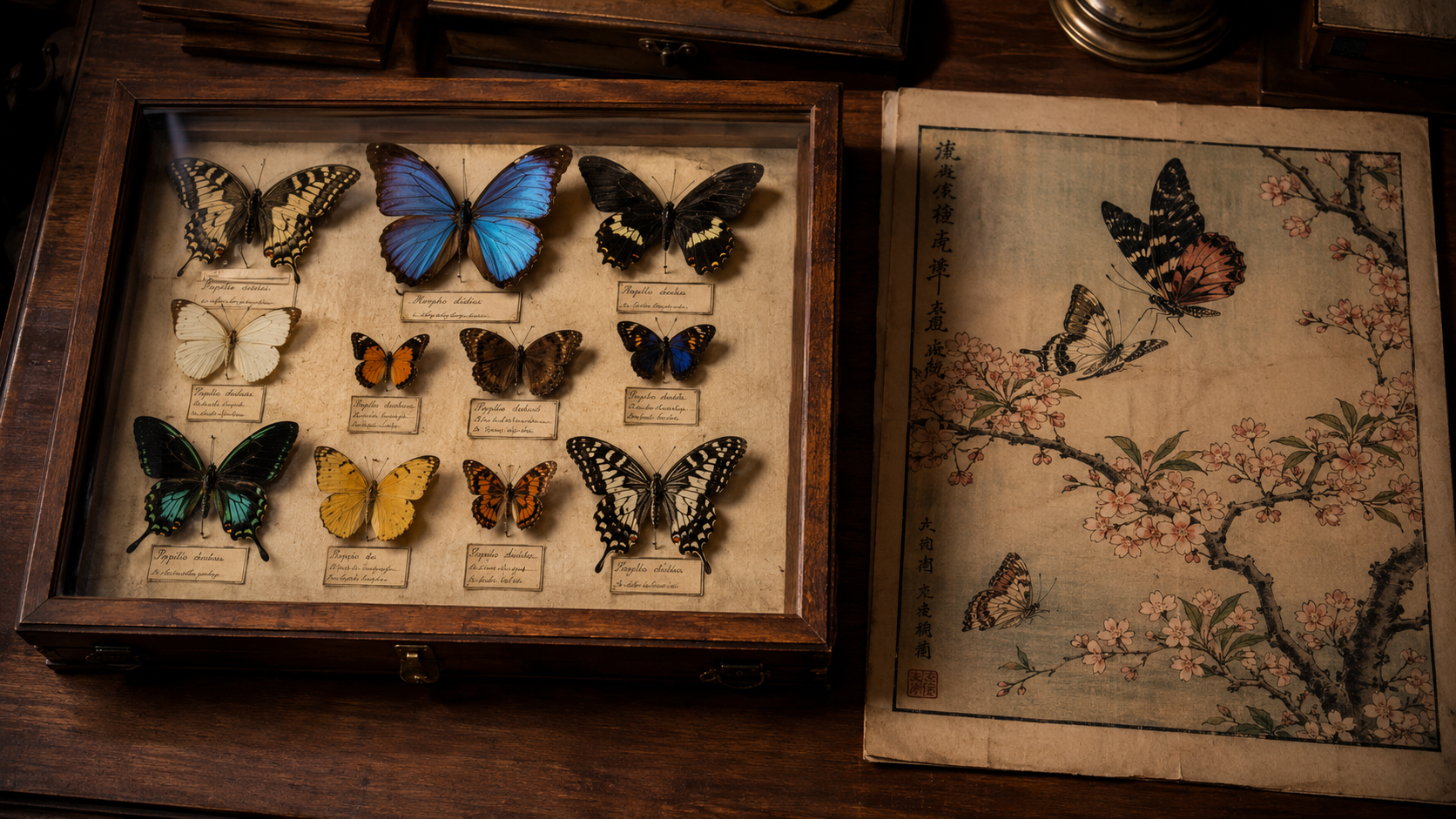
In Chinese decorative art, paired butterflies (shuangdie, 双蝶) are a traditional symbol of romantic love and marital happiness, equivalent to the Western use of doves. The butterfly also symbolises longevity when depicted with flowers in the baxian (eight immortals) tradition.
Japan — cho in poetry, art, and ceremony
Japan developed one of the world's richest cultural relationships with butterflies. In classical Japanese poetry (waka and haiku), the butterfly is a dominant seasonal image for spring and summer:
Napping on a butterflydreaming of flowers —temple bell — Matsuo Bashō (1686)
Beyond poetry, butterflies appear ubiquitously in:
- Kimono design — the butterfly (cho) is one of the most common motifs in silk dyeing (yuzen), appearing in a vast range of stylised forms
- Family crests (kamon) — numerous samurai families used butterfly-derived mon, including the Taira clan, whose ageha cho (swallowtail butterfly) crest became one of the most recognised in Japanese heraldry
- Wedding decoration — pairs of folded paper butterflies (cho) are placed on sake cups at traditional weddings, the male on the right, the female on the left
- Soul belief — a white butterfly entering a house is traditionally interpreted as the visiting soul of a recently deceased family member
Puccini's opera Madama Butterfly (1904) used Japanese butterfly symbolism explicitly: the title character is Cio-Cio-San (Butterfly), fragile, beautiful, and finally destroyed.
India — sacred and auspicious
In Hindu iconography, several deities are associated with transformation imagery that includes butterfly-like forms. In Indian folk art traditions, particularly in Madhubani painting from Bihar, butterflies appear in garden and nature scenes as symbols of joy and impermanence. The butterfly's brief life is used as a metaphor for the ephemeral nature of material existence (maya) in classical Sanskrit literature.
The Americas
Aztec and Mesoamerican culture
Mesoamerican butterfly symbolism is among the richest and most complex in the world. The Aztec goddess Itzpapalotl (Obsidian Butterfly) was a fearsome divine figure associated with sacrifice, stars, and the souls of women who died in childbirth — one of the most powerful deities in the Aztec pantheon. Her name derives from the butterfly's wings (papalotl) and obsidian blades, and she was depicted with butterfly wings edged with stone knives.
Quetzalpapalotl (Precious Butterfly, or Feathered Butterfly) was a more benign figure, associated with the stars of the night sky, and a great hall in the ceremonial complex of Teotihuacán is named in her honour.
The Monarch butterfly (Danaus plexippus) holds a unique contemporary significance in Mexican culture. The monarch's winter roosts coincide with the Day of the Dead festival (Día de los Muertos, early November), and many communities in Michoacán and the State of Mexico traditionally interpret the arrival of millions of monarchs as the returning souls of the dead visiting the living. The monarch is the state insect of Michoacán.
Native North American traditions
Several Native American nations gave butterfly ceremonial significance. The Hopi of the American Southwest perform the Butterfly Dance (Bulitikibi) as an annual ceremony, originally a prayer for rain, crops, and fertility. The butterfly is also a common motif in Hopi pottery and katsina (kachina) figures. In Blackfoot cosmology, a butterfly carries dreams; the traditional Blackfoot explanation for sleep is that Napii (Old Man) sends a butterfly who carries dreaming on its wings.
Europe — heraldry, literature, and science
Heraldry
Butterflies appear in European heraldry from the 12th century onward. In English, German, and Italian heraldic traditions they are depicted stylised with wings spread, typically called a "papillon" or "schmetterling." Numerous noble families across France, Italy, and the Holy Roman Empire used butterfly charges; the butterfly also appears on civic coats of arms, particularly in the Rhine Valley and southern Germany.
Literature and art
- Shakespeare refers to the butterfly in several plays as a symbol of beauty, frivolity, or the transient nature of honour (Coriolanus, A Midsummer Night's Dream)
- William Blake's poem "The Butterfly" (c. 1793) uses the butterfly as a figure for the awakened soul
- Romantic painting: the butterfly appears throughout 19th-century academic painting as a symbol of the soul, femininity, and nature's beauty (Odilon Redon, John William Waterhouse)
- Vladimir Nabokov — see FAQ — combined professional scientific lepidopterology with literary genius, leaving both a body of taxonomic science and a body of fiction deeply saturated with butterfly observation
Nabokov and the scientific gaze
Nabokov described the act of capturing and describing a new butterfly species as one of the greatest aesthetic experiences available to a human being — comparable to the creation of a poem. His published lepidopterological work, particularly on the genus Polyommatus (blues), was initially dismissed by some professionals as the hobby of a literary man, but has since been vindicated in detail by molecular phylogenetics. He represents the point where art and taxonomy converge: the same precise attention to pattern, form, and detail that makes a great naturalist makes, he argued, a great novelist.
Butterflies in science communication and conservation
In the modern era, butterflies function as flagship species for biodiversity conservation. Their sensitivity to habitat change, their visibility and beauty, and their broad public appeal make them effective symbols for communicating habitat loss, climate change, and the value of wildflower grasslands. Monitoring schemes in the UK (Butterfly Conservation), Germany (Tagfalter-Monitoring Deutschland), and Russia (Russian Butterfly Monitoring Network) use volunteer butterfly counts to track the health of ecosystems — data collected by thousands of enthusiasts with nets or cameras that would be impossible to gather any other way.
The butterfly remains, across cultures and centuries, the most compelling insect ambassador for the natural world.