Butterflies as Pollinators: Their Role in Ecosystems
Butterflies are the world's most visible pollinators — but how does their contribution compare to bees? Ecology of butterfly pollination and decline.
The pollinator community
Every flowering plant that requires animal pollination must attract, reward, and exploit an animal visitor to transfer pollen between flowers. The global pollinator community is dominated by bees (Hymenoptera: Apidae and related families), but includes flies, beetles, wasps, moths, butterflies, birds, and bats. Each group has different morphology, behaviour, and foraging preferences, meaning that different plants are specialised for different pollinator types.
Butterflies occupy a specific niche within this community: they are mobile, selective, and equipped with a long proboscis, allowing them to access floral resources unavailable to many other insects. Their role is not to replace bees as generalist pollinators of the majority of plants, but to service a subset of plants — particularly those with deep, narrow flowers and moderate to long corolla tubes — with greater effectiveness than bees.
How butterfly pollination works
The proboscis advantage
A butterfly's proboscis is a long, flexible tube formed from two modified mouthparts (galeae) zipped together — coiled tightly at rest and extended to probe flowers for nectar. Proboscis length varies significantly across species: short-tongued butterflies (many skippers, some blues) access open, flat flowers; long-tongued species (swallowtails, some fritillaries, many tropical Nymphalidae) can probe deep tubular corollas inaccessible to most bees.
When a butterfly probes a flower, pollen is passively deposited on the butterfly's body — particularly the head, thorax, and legs. Unlike bees, butterflies do not actively collect pollen (they carry no pollen baskets or scopae). Pollen adheres to the body surface and is incidentally transferred to the stigmas of subsequent flowers. This passive pollen transfer is less efficient per visit than a bee's active pollen collection, but what butterflies lack in per-visit efficiency they compensate for in inter-plant movement.
The outcrossing advantage
Butterflies typically travel longer distances between individual plants than bees during a foraging bout. While a bee may work methodically through an entire patch of the same plant species before moving on, a butterfly commonly moves between widely separated plants in the same nectar-foraging visit. This behaviour strongly promotes outcrossing — the transfer of pollen between genetically different individuals rather than between flowers of the same plant — which increases genetic diversity in plant populations and is generally advantageous for plant fitness.
Several studies of calcareous grassland plant communities have shown that plants visited primarily by butterflies have higher genetic diversity in their seed-set than those visited primarily by bees — a measurable conservation benefit.
The butterfly pollination syndrome
Plants adapted specifically for butterfly pollination tend to share a characteristic set of features — a pollination syndrome — though the match is probabilistic rather than absolute:
| Feature | Typical butterfly-pollinated flower | Contrast: bee-pollinated |
|---|---|---|
| Colour | Pink, red, purple, mauve | Yellow, blue, white |
| Corolla form | Tubular, with narrow opening | Open, accessible; or bilabiate |
| Landing platform | Minimal or absent (butterfly clings/hovers) | Broad lip or pad |
| Scent | Mild, sweet, or absent during day | Often strongly scented |
| Nectar | Dilute, produced in quantity | Concentrated, often in quantity |
| Flowering time | Daytime | Daytime; some night-flowering |
| Nectar depth | Moderate to deep | Variable |
Familiar examples of butterfly-pollinated or strongly butterfly-visited plants in European ecosystems:
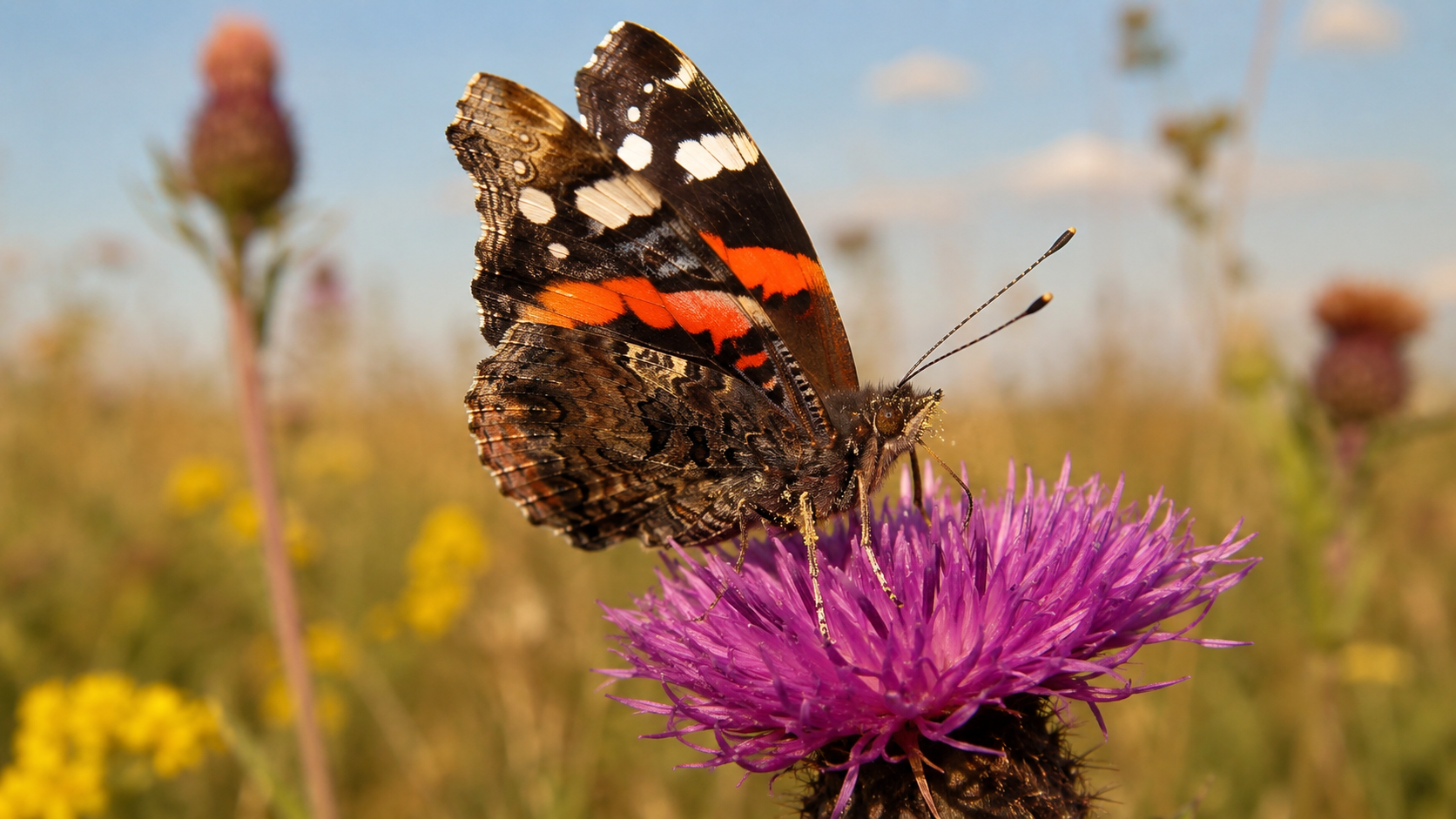
- Common thistles (Cirsium vulgare, C. arvense) — densely visited by almost all butterfly species; provide abundant accessible nectar
- Knapweeds (Centaurea scabiosa, C. nigra) — among the most important butterfly nectar sources in calcareous grassland
- Field scabious (Knautia arvensis) and devil's bit scabious (Succisa pratensis) — repeatedly shown to be key butterfly nectar sources; devil's bit also hosts the marsh fritillary
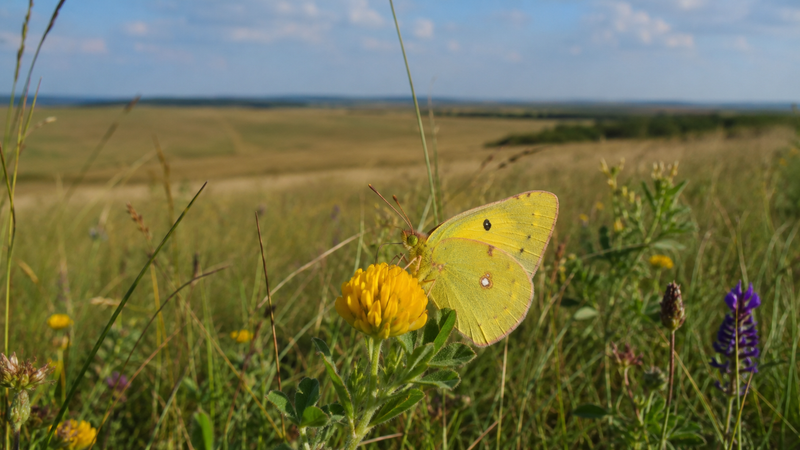
- Red clover (Trifolium pratense) — particularly important for long-tongued species such as swallowtails and fritillaries
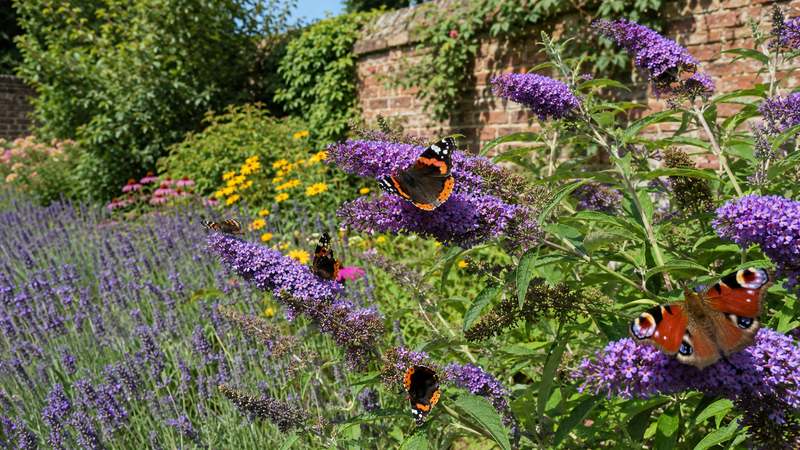
- Buddleia (Buddleja davidii) — introduced from China, now the most widely planted butterfly nectar source in European gardens; its dense flower spikes provide exceptional nectar rewards
- Purple loosestrife (Lythrum salicaria) — important for waterside butterfly communities
- Marjoram (Origanum vulgare) — among the most visited of all wildflowers by UK and central European butterflies in late summer
- Hemp agrimony (Eupatorium cannabinum) — a tall late-summer wildflower of damp habitats, heavily visited by admirals and fritillaries
Key pollination relationships
Monarch and milkweed
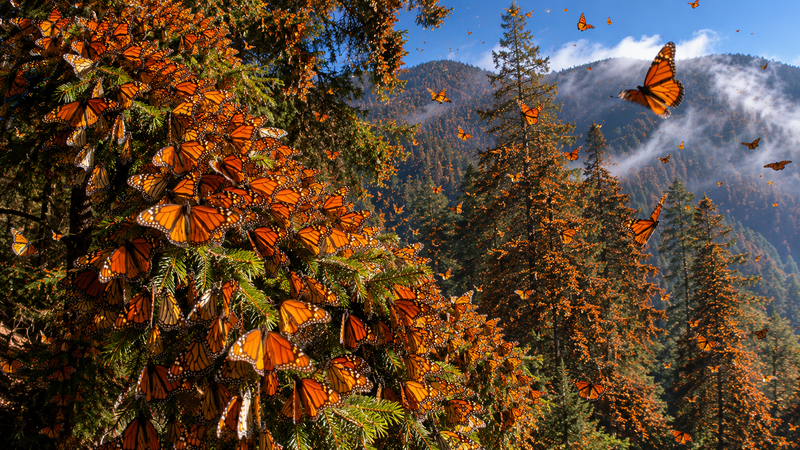
The monarch butterfly (Danaus plexippus) and Asclepias (milkweed) represent one of the most celebrated pollination relationships in the natural world. Monarchs are major visitors to milkweed flowers during their breeding season; the flowers have a specialised pollen transfer mechanism (pollinia — waxy pollen masses that attach to visiting insects) that monarchs transfer effectively. The relationship is genuinely mutualistic: monarchs depend on milkweed as the exclusive larval host plant; milkweed benefits from monarch pollination. The catastrophic decline of both monarchs and milkweed across the North American agricultural landscape illustrates the fragility of specific pollination dependencies.
Swallowtails and deep flowers
The swallowtail (Papilio machaon) has a proboscis approximately 20 mm long — sufficient to access deep tubular flowers unavailable to most other insects. Studies in alpine meadows have shown that swallowtails are significant pollinators of gentians (Gentiana lutea, G. purpurea), whose deep, narrow corollas are accessed by few other pollinators. In the absence of swallowtails and hawk-moths, some gentian populations show measurably reduced seed-set.
Heliconius and Psiguria in the Neotropics
In Neotropical rainforests, the Heliconius butterflies have developed one of the most specialised pollination relationships known in Lepidoptera. Several Heliconius species have evolved pollen-feeding — they actively collect and consume protein-rich pollen from Psiguria and Gurania vines (Cucurbitaceae), using it as an amino acid source that supplements nectar. These Heliconius return to the same individual Psiguria plants daily in a traplining behaviour — visiting a route of the same plants in the same order each day — that provides reliable, repeated pollination visits. The Psiguria vine has co-evolved with this relationship: its flowers open sequentially over a long period rather than all at once, maintaining attractiveness to Heliconius trapliners over weeks.
Ecological significance of butterfly pollinators
Plant community diversity
In calcareous grassland — one of Europe's most species-rich and butterfly-dependent habitats — butterflies are not merely incidental flower visitors but integral components of the plant-pollinator network. Removal or reduction of butterfly populations from grassland fragments has been linked to reduced seed-set in several butterfly-dependent plant species, including Knautia and Centaurea. Because these plants are themselves important host plants for specialist grassland insects, the loss cascades through the community.
Tropical forest canopy
In tropical forests, butterflies visiting canopy flowers — particularly large Nymphalidae and Papilionidae — may be the primary pollinators of some tall-canopy tree species that flower above the height accessible to bees working at ground level. This role is difficult to quantify but may be significant for tree species diversity in closed-canopy forest.
Long-distance seed and pollen dispersal
Migratory butterflies — the monarch, the painted lady (Vanessa cardui), the red admiral (Vanessa atalanta), and others — carry pollen across landscapes at a scale impossible for resident pollinators. A painted lady migrating from North Africa to Scandinavia may visit flowers in Morocco, Spain, France, the Netherlands, and Norway in a single season. The genetic consequences of this inter-population pollen transfer for plant populations along migratory routes have barely been studied.
The cost of butterfly decline
Across Europe, butterfly populations have declined substantially since the 1970s — the best-monitored butterfly fauna in the world shows an average decline of over 30% in grassland species since systematic monitoring began. In North America, the monarch has declined by approximately 80% over the same period. In Asia and the tropics, systematic monitoring data are scarce, but habitat loss trends suggest major population reductions.
The ecological cost of these declines includes:
- Reduced pollination of specialist wildflowers in calcareous grassland
- Weakened genetic connectivity between isolated plant populations
- Loss of specific butterfly-plant relationships in which the butterfly is the primary or dominant pollinator
- Reduced food availability for specialist predators and parasites that target butterfly adults, caterpillars, and eggs
Butterflies are among the best-studied of all pollinator groups — their population trends, habitat requirements, and host-plant relationships are well documented — making them valuable indicator species for the health of the broader insect pollinator community. A decline in butterfly pollinators is almost certainly accompanied by declines in less-studied groups with similar habitat requirements.
Supporting butterfly pollinators
The most effective actions for maintaining butterfly pollination services in agricultural and semi-natural landscapes are:
- Maintaining unimproved grassland — preventing conversion to improved grass monocultures or arable; supporting traditional hay-cutting and light grazing
- Planting diverse wildflower margins along field edges and roadsides — prioritising long-season nectar sources including knapweed, scabious, marjoram, and red clover
- Reducing pesticide use — particularly broad-spectrum insecticides and herbicides that eliminate both butterfly adults and their larval host plants
- Maintaining connectivity between flower-rich habitat patches — hedgerows, green corridors, and unmanaged verges allow butterflies to move between isolated patches, maintaining pollination network function across landscapes