Butterflies as Agricultural Pests
A small number of butterfly species damage crops as caterpillars feed on plants — cabbage whites are most important, plus legume and fruit-tree pests.
Butterflies versus moths as crop pests
A critical distinction at the outset: the vast majority of Lepidoptera that damage crops worldwide are moths, not butterflies. The armyworms (Spodoptera), the corn earworm (Helicoverpa zea), the codling moth (Cydia pomonella), and the diamondback moth (Plutella xylostella) — the insects responsible for billions of dollars in annual agricultural losses globally — are all moths. Butterflies (Rhopalocera) account for a small fraction of agricultural pest problems, confined largely to the Pieridae (whites and yellows) and a handful of other families.
This distinction matters for identification, control strategy, and the framing of conversations about butterflies and agriculture: promoting butterfly-friendly gardens and farming does not mean tolerating crop damage, because the species that cause damage and the species that need conservation help are almost entirely different animals.
The cabbage whites — principal butterfly pests
Large white (Pieris brassicae)
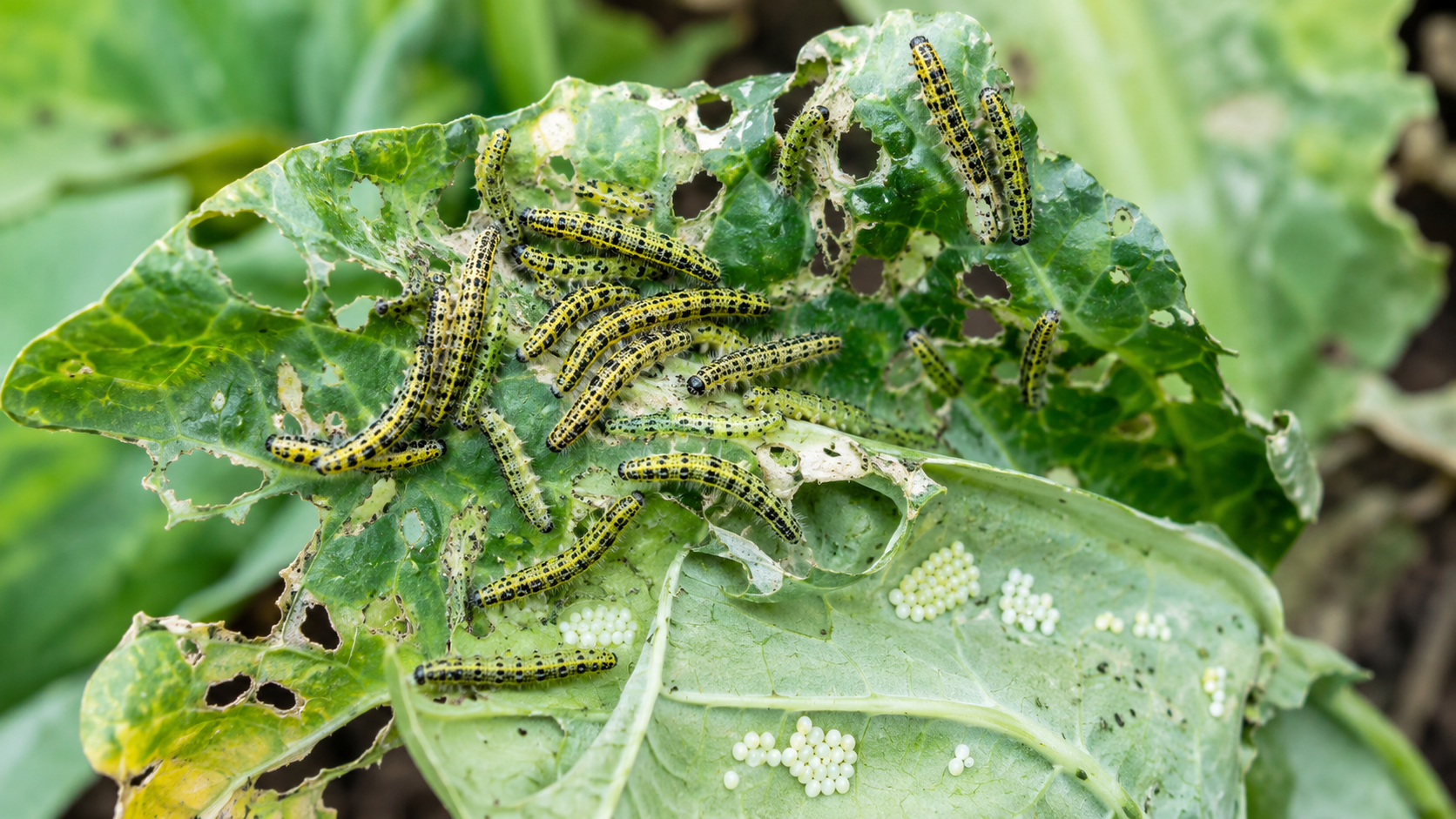
The large white is the most economically significant butterfly pest in Europe and temperate Asia. The female lays eggs in batches of 20–100 on the undersides of Brassica leaves — a distinctive behaviour shared with no other common European butterfly, which lays eggs singly. The resulting caterpillars are gregarious in early instars: a single egg batch produces a mass of yellow-and-black striped caterpillars that skeletonise leaves cooperatively before dispersing as fourth and fifth instars.
Crops affected:
- Cabbage, Brussels sprouts, broccoli, cauliflower, kale
- Rapeseed (Brassica napus) — significant in commercial oilseed rape crops
- Radish, turnip, rocket, nasturtium (Tropaeolum — a non-Brassica alternative host)
A single plant can be attacked by multiple overlapping broods — in a warm summer in Britain or central Europe, three overlapping generations produce continuous pressure from May to October. Damage ranges from leaf skeletonisation (leaving only the vascular ribs) to complete defoliation of young transplants.
Natural controls: The parasitoid wasp Cotesia glomerata is the most important natural enemy — it lays up to 20–30 eggs inside a single caterpillar, whose tissues feed the developing wasp larvae; the caterpillar eventually dies as the wasps pupate externally in yellow silk cocoons clustered on the caterpillar's remains. A second parasitoid, Pteromalus puparum, attacks the pupa. Together, these two species cause 50–90% parasitism in unsprayed populations in favourable years.
Small white (Pieris rapae)
The small white is arguably the most widely distributed butterfly on Earth. Originally Palearctic, it has been accidentally introduced to North America (1860, Quebec), Australia (1929, Melbourne), New Zealand, Hawaii, South Africa, and Chile — in every case establishing permanent breeding populations within a few years of arrival.
Unlike the large white, the small white lays eggs singly on Brassica leaves and the caterpillars are solitary and cryptically green, making them much harder to find than the gregarious, conspicuous large white larvae. Damage is characteristically scattered irregular holes through leaves rather than the complete stripping typical of large white attack.
The small white is a more significant commercial pest than the large white in many regions, precisely because its solitary caterpillars are harder to detect and control before they damage marketable produce.
Green-veined white (Pieris napi)
The green-veined white uses wild Brassicaceae (garlic mustard, cuckooflower, hedge mustard) rather than cultivated crops as its primary host, and seldom causes agricultural damage. It is occasionally found on cabbage and rocket at low density but is not economically significant.
Clouded yellows — legume pests
The clouded yellows (Colias species) affect legume crops in outbreak years. The pale clouded yellow (Colias hyale) and Berger's clouded yellow (C. alfacariensis) in Europe use clover (Trifolium) and alfalfa (Medicago sativa) as larval host plants; when adult numbers peak in late summer, females oviposit heavily on alfalfa fields. The caterpillars feed on leaf tissue and, more damagingly, on root nodules — the nitrogen-fixing structures critical to the plant's productivity.
In Russia and Central Asia, Colias erate (eastern clouded yellow) is a more significant pest, capable of causing localised heavy losses in alfalfa seed crops during outbreak years. Population irruptions are linked to dry, warm summers that accelerate larval development and favour multiple overlapping generations.
Other species with crop-pest status
| Species | Crop | Region | Severity |
|---|---|---|---|
| Large white (Pieris brassicae) | Brassica vegetables, rapeseed | Worldwide (Palearctic) | High |
| Small white (Pieris rapae) | Brassica vegetables | Worldwide (introduced) | High |
| Clouded yellow (Colias erate) | Alfalfa, clover | Russia, Central Asia | Moderate |
| Caper white (Belenois java) | Capparis, Brassica | South and SE Asia | Moderate |
| Lemon emigrant (Catopsilia pomona) | Cassia, Senna | South and SE Asia | Moderate |
| Common jezebel (Delias eucharis) | Loranthus (mistletoe) | India, SE Asia | Indirect |
| Citrus swallowtail (Papilio demodocus) | Citrus groves | Africa | Low–Moderate |
The citrus swallowtail (Papilio demodocus) — one of Africa's most common and beautiful swallowtails — uses wild Rutaceae as its primary host but regularly oviposits on cultivated citrus (orange, lemon, grapefruit) in gardens and small-scale orchards. Damage is generally minor in commercial groves with good canopy cover, but young trees with few leaves can be significantly defoliated.
The lemon emigrant (Catopsilia pomona) causes periodic damage to senna and cassia plantations in South and Southeast Asia, where these trees are cultivated for timber and medicinal bark. Outbreak years produce mass migrations of adults crossing hundreds of kilometres.
Control strategies
Physical exclusion
Fine insect-proof mesh (0.8 mm or finer) placed over Brassica crops is the most effective non-chemical method for small-scale growers. It prevents oviposition entirely. This approach is standard in organic horticulture and increasingly common in domestic vegetable gardens. The mesh must be secured at ground level to prevent butterflies from crawling underneath.
Biological control
Bacillus thuringiensis (Bt) subspecies kurstaki: A naturally occurring soil bacterium that produces a protein toxic to Lepidoptera caterpillars after ingestion, while being harmless to vertebrates, beneficial insects, and the environment. Applied as a spray, it kills caterpillars within 24–72 hours of feeding. It is effective for both large white and small white and is the primary organic pesticide for Brassica pests worldwide.
Parasitoid augmentation: Commercial releases of Trichogramma egg-parasitoid wasps are available in several countries. Applied at egg-laying peak, they can reduce the next caterpillar generation by 40–70%.
Encouraging natural enemies: Leaving areas of long grass, hedgerows, and wildflowers adjacent to vegetable gardens provides habitat for parasitoid wasps, hoverflies (which predate caterpillars), and ground beetles (which consume pupae). This approach is most effective when chemical inputs in adjacent areas are minimised.
Integrated pest management (IPM)
Commercial Brassica production uses IPM protocols that combine monitoring (weekly counts of egg batches and caterpillars), biological controls (Bt, parasitoids), and selective chemical treatments timed to pest population peaks rather than applied on calendar schedules. Threshold-based treatment — applying chemicals only when caterpillar counts exceed a damage threshold — substantially reduces total pesticide use while maintaining effective crop protection.
Butterflies and agriculture: the broader picture
The relationship between butterflies and agriculture is not simply adversarial. Most butterfly species — including all those of conservation concern — are neutral or beneficial from an agricultural perspective: their caterpillars feed on wild plants and their adults pollinate wildflowers in field margins. Only a handful of species, adapted to the nutrient-rich, disturbed conditions that Brassica cultivation provides, cause economic problems.
Effective pest management for the few problem species is therefore fully compatible with, and complementary to, creating butterfly-friendly farm environments — wildflower margins, unsprayed hedgerows, and reduced pesticide use — that support the many species that contribute to agricultural ecosystem services.