Butterflies and the Future: Modelling Range Shifts and Extinction Risk
Climate change is projected to redraw where butterflies can live — modelled winners expand, mountain and northern specialists run out of habitat.
From shifting dates to shifting maps
Much of the well-documented evidence for climate change's effect on butterflies concerns timing — earlier flight dates, additional broods, and similar phenological shifts recorded in decades-long monitoring datasets. A separate and, in the long run, more consequential question is where a species will be able to live at all as its climatic envelope moves across the landscape faster than many populations can track it. This article surveys what researchers project for future butterfly distributions and how conservation practice is beginning to respond.
Modelling future ranges
The standard tool for this kind of projection is the species distribution model (also called a climate envelope or ecological niche model). Researchers compile records of where a species currently occurs, extract the climate conditions — typically temperature and precipitation variables — associated with those locations, and use statistical or machine-learning methods to characterise the species' apparent climatic tolerance. Projecting that same tolerance onto future climate scenarios, generated by global climate models under different greenhouse-gas emission pathways, produces a map of where conditions are expected to remain suitable, newly become suitable, or cease to be suitable by some future date, commonly mid- or late twenty-first century.
These models have real, well-documented limitations. They generally treat climate as the only limiting factor, ignoring biotic interactions such as host-plant distribution, competition, and predation; they typically assume a species can disperse freely to track newly suitable habitat unless explicitly constrained; and they cannot capture a population's capacity for local adaptation or behavioural flexibility that might allow it to persist somewhat outside its historically observed climatic range. Despite these caveats, such models remain a genuinely useful screening tool for comparing relative risk across large numbers of species at once, and their broad qualitative patterns are increasingly corroborated by observed range shifts already under way.
The projected losers: mountains and the far north
Two groups of specialists appear consistently at the high-risk end of these projections, for a shared underlying reason: both are already confined to the coolest habitat available within their region, with progressively less of it available as warming continues.
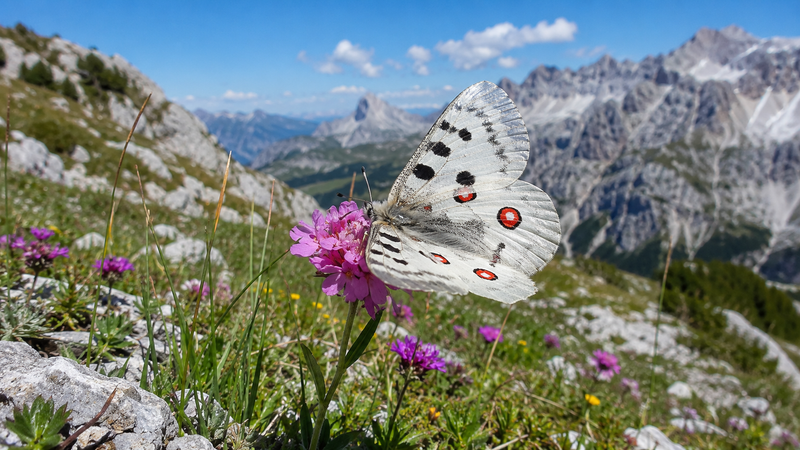
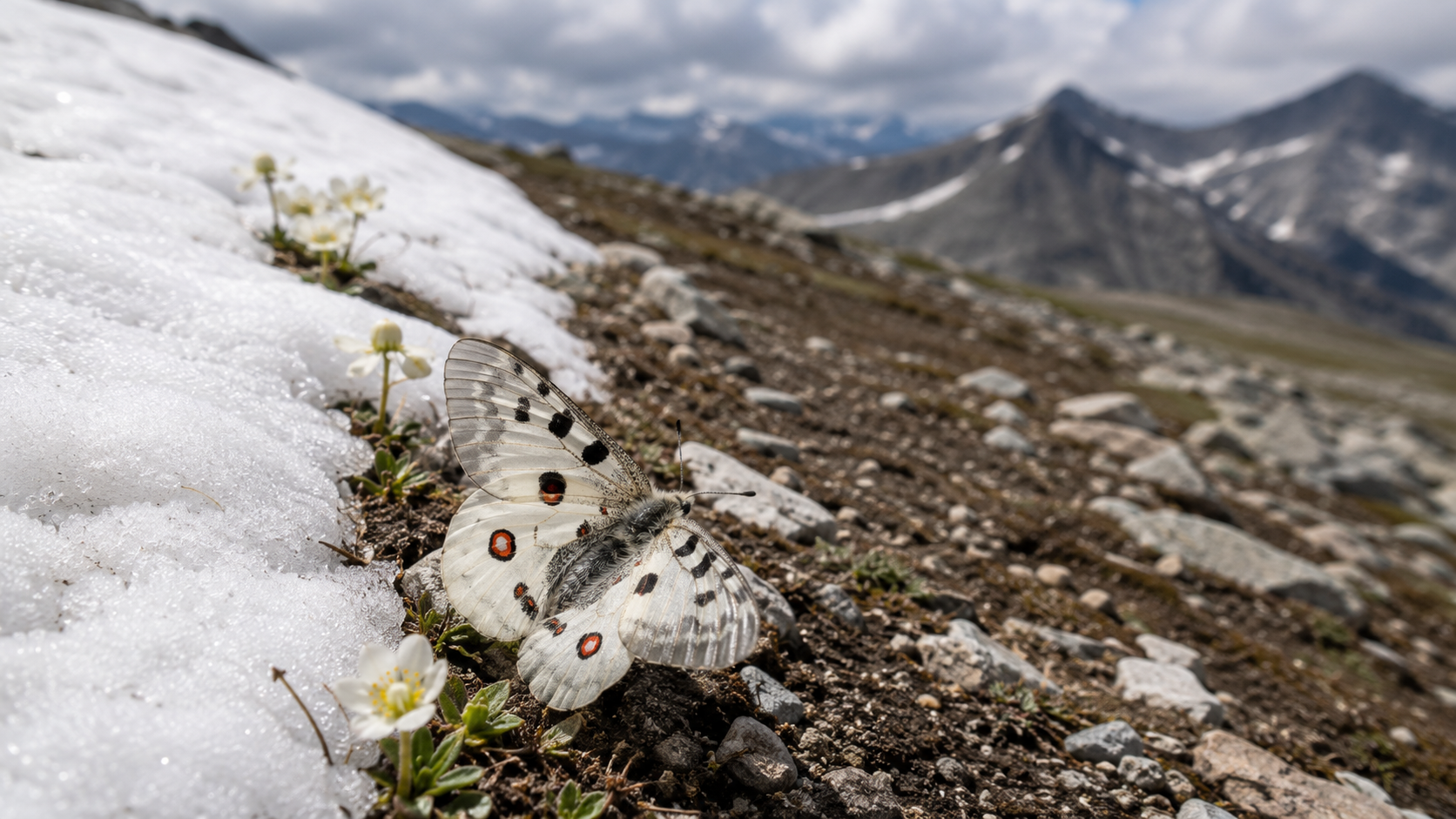
Mountain specialists — species restricted to cool conditions near or above the treeline, such as many Erebia ringlets, Parnassius apollos, and alpine Boloria fritillaries — are modelled as being pushed steadily upslope as warming shifts their climatic envelope to higher elevation. Because mountains narrow toward their summits, the total area of suitable habitat shrinks as species retreat upward, a dynamic sometimes described as an "escalator to extinction": there is, eventually, no higher ground left to retreat to.
Arctic and subarctic specialists face the geographic equivalent at high latitude rather than high altitude: species already confined to tundra and the northern limit of vegetation have nowhere further north to go once they reach a continent's or island's northern coastline, and models generally project substantial range contraction for this group across the Holarctic.
The projected winners: mobile generalists moving polewards
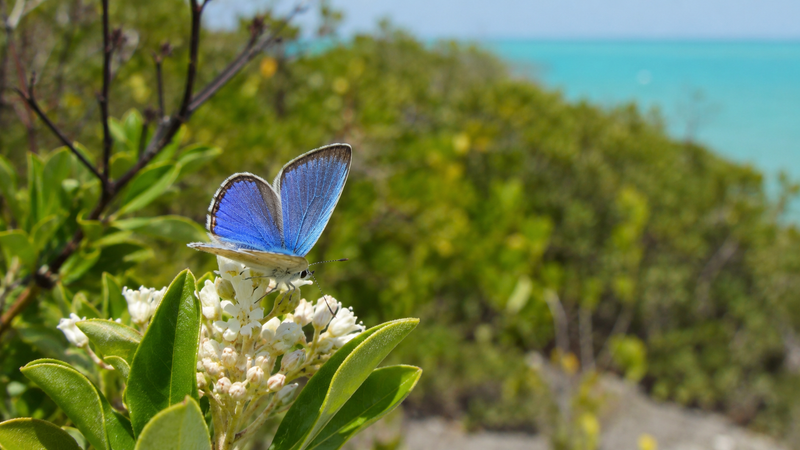
Models do not project uniform decline. Species currently limited toward the cooler, poleward or upper-elevation edge of their range primarily by low temperature — rather than by host-plant availability or other non-climatic factors — are frequently projected to expand as conditions warm, and a substantial number of such expansions have already been documented over recent decades, consistent with model predictions made years or decades earlier. Several southern European and Mediterranean butterflies, for instance, are projected to extend their range substantially into central and northern Europe, mirroring range expansions already recorded in some mobile, generalist species.
The aggregate picture that emerges from most well-studied regional butterfly faunas is therefore not so much a simple decline in total species richness as a reshuffling of community composition: geographically restricted, cool-adapted specialists broadly losing range at the same time that widespread, warm-adapted generalists gain it, with the net change in raw species counts in many regions projected to be considerably smaller than the underlying turnover in which particular species are present.
Conservation responses
Several conservation strategies aim specifically at the mismatch between how fast climate zones are shifting and how fast species and habitats can respond. Habitat corridors and stepping-stone reserves, designed to connect currently occupied habitat with climatically suitable areas that lie beyond a species' natural dispersal range, aim to give range-shifting populations a physical path to follow rather than leaving them isolated in shrinking pockets of historically suitable habitat. More controversially, assisted colonisation — the deliberate human-mediated introduction of a species to a site outside its historical range but within its projected future climatic envelope — has been trialled for a small number of severely range-constrained species, though it remains contested within conservation science owing to the risk of unintended ecological consequences in the recipient habitat. For mountain and Arctic specialists with limited scope for either approach, ex situ conservation — captive breeding programmes and seed or genetic banking of associated host plants — is increasingly discussed as a last-resort safeguard against extinction in the wild.
Why butterflies are a useful case study
Butterflies are unusually well suited to this kind of climate-impact modelling because of the depth and length of monitoring data available for many species, particularly in Europe, combined with their sensitivity to temperature as ectotherms and their comparatively well-documented host-plant relationships. This makes them one of the most thoroughly modelled animal groups for climate-range projections, and the broad patterns established in butterfly research — specialist decline, generalist gain, and an overall reshuffling rather than uniform collapse — are frequently cited as an indicative case study for how climate change is likely to reorganise, rather than simply impoverish, many other groups of temperature-sensitive organisms.