Butterflies of Mountain Ecosystems
Mountain butterflies face extreme conditions — intense UV, cold nights, thin air — yet alpine zones support specialised, spectacular communities.
The mountain environment
Mountains impose severe constraints on life. Above the treeline, temperatures drop sharply, wind speeds increase, UV radiation intensifies, and the growing season shrinks to a few weeks. Yet butterflies thrive in these conditions — and in many mountain ranges they form communities of remarkable diversity and beauty.
The key reason is altitude zonation: each 300–400 m gain in elevation corresponds to a northward shift of roughly 200–300 km in climate. A single mountain in the Central Alps therefore contains, stacked one above another, the equivalent of several climatic zones — from warm temperate at the foot to Arctic at the summit. Each zone supports its characteristic butterfly community.
Altitude zones and their butterflies
Montane zone (700–1,500 m)
The lower mountains are transitional. Many lowland species reach their upper limit here, and the first genuine montane specialists appear. In the Alps, this is the zone of:
- Scarce swallowtail (Iphiclides podalirius) — warm, south-facing limestone slopes
- Large blue (Phengaris arion) — short, dry, anthills-rich grasslands
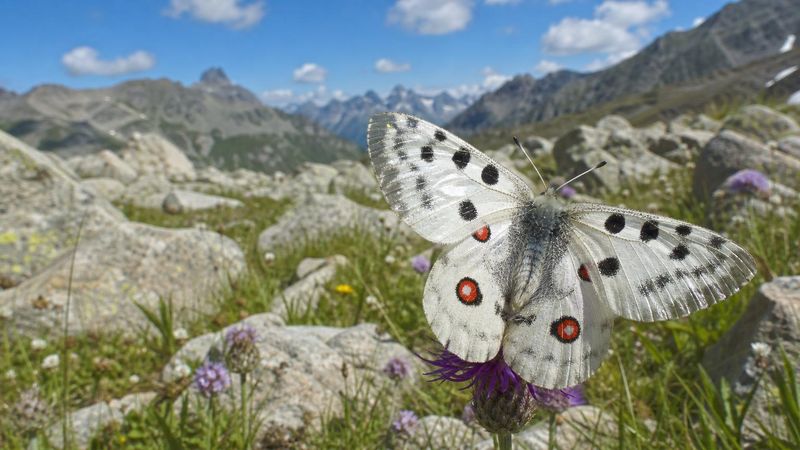
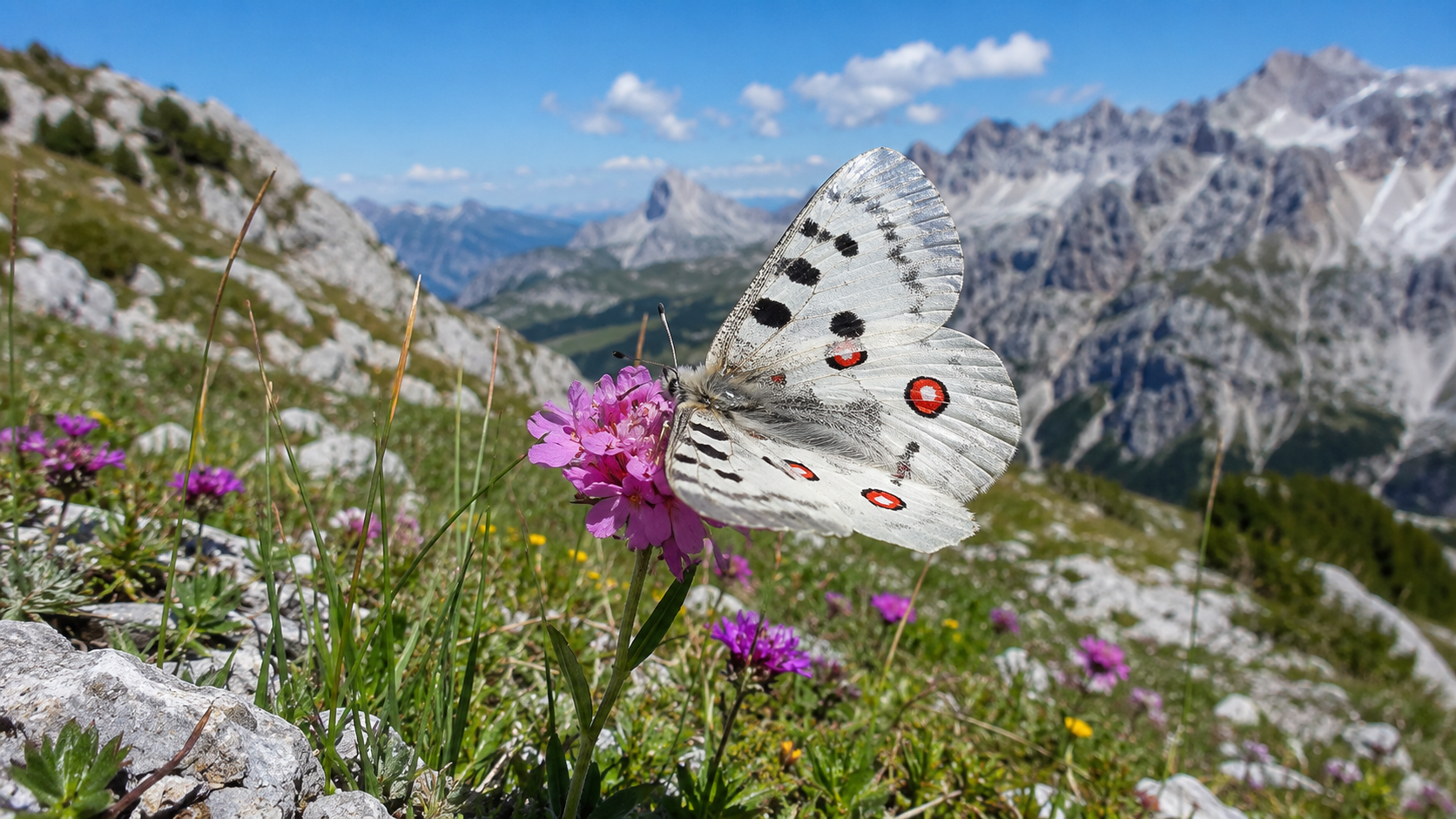
- Apollo (Parnassius apollo) — rocky limestone and sedum-rich ledges
- Woodland ringlet (Erebia medusa) — damp tall-grass meadows
Subalpine zone (1,500–2,200 m)
Above the beech and conifer treeline lies the richest butterfly zone in European mountains. Flower-rich hay meadows, alpine pastures, and willow scrub support high species density:
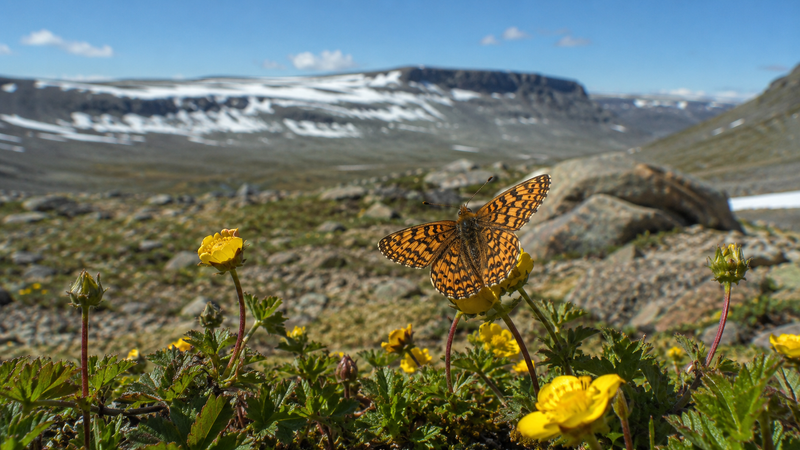
- Shepherd's fritillary (Boloria pales) and Titania's fritillary (Boloria titania)
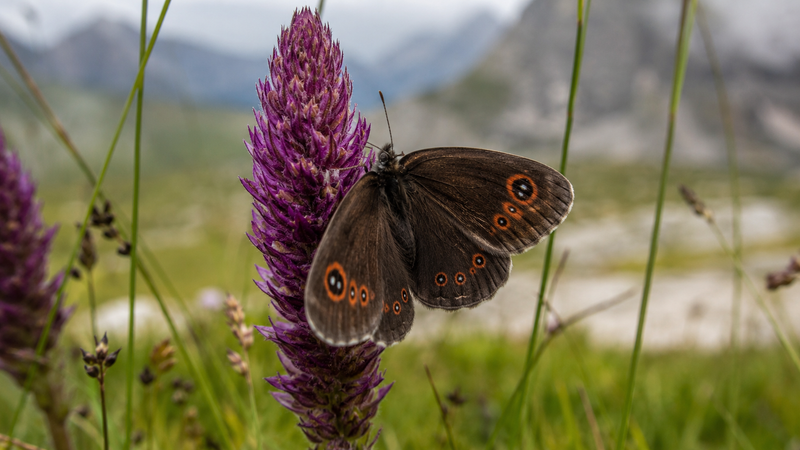
- Multiple Erebia species: sooty ringlet (E. pluto), dewy ringlet (E. pandrose), Silky ringlet (E. gorge)
- Mazarine blue (Cyaniris semiargus) and Alpine blue (Polyommatus eroides)
- Mountain clouded yellow (Colias phicomone) — characteristic of snowbed vegetation
Alpine zone (2,200–3,000 m)
Above the continuous grassland belt, vegetation becomes sparse and patchy. Only the most cold-adapted species reach here:
- Small Apollo (Parnassius phoebus) — snowbed hollows and rock ledges
- Erebia gorge and E. nivalis — gravelly rocky slopes
- Alpine grizzled skipper (Pyrgus andromedae) — sparse rocky grassland
Nival zone (above 3,000 m)
Above permanent snowfields, butterflies occur only as occasional windblown visitors. Yet even at 3,500 m in the Alps, painted ladies (Vanessa cardui) and red admirals (Vanessa atalanta) have been recorded on exceptional thermal days.
Adaptations to cold and altitude
Alpine butterflies show a suite of physiological and behavioural adaptations:
Melanism. Many montane species and populations are darker than their lowland counterparts. Dark pigmentation absorbs radiant heat faster, allowing shorter basking time and longer flight time in a cool environment.
Slow development. Most alpine species are single-brooded and some take two years to complete their life cycle. Apollo eggs hatch in summer, the caterpillar overwinters once or twice, and the adult emerges the second or third spring.
Cold-tolerant life stages. Erebia caterpillars can tolerate body temperatures below 0 °C. Eggs of Parnassius species survive sustained sub-zero temperatures by entering a diapause state.
Behavioural thermoregulation. Basking on south-facing rocks is essential for flight. Many species adopt a lateral basking posture, tilting the wing surface perpendicular to the sun, to maximise heat gain.
Endemism and relict populations
Mountains harbour high numbers of endemic butterfly species — species found only on one or a few massifs. Examples include:
- Oberthür's grizzled skipper (Pyrgus armoricanus carthami) — local Pyrenean and Cantabrian form
- Nicholl's ringlet (Erebia zapateri) — Iberian System endemic
- Various Parnassius subspecies restricted to individual Himalayan or Central Asian ranges
Many of these endemics are relict populations that survived the last glaciation in isolated refugia and have remained isolated by the warming of intervening valleys since.
Climate change and mountain butterflies
Alpine butterflies are among the most climate-sensitive organisms in Europe. As temperatures rise, species shift upward — but unlike migratory lowland species, alpine endemics cannot move to higher latitudes. Their available habitat area decreases as the alpine zone is compressed toward the summits.
Long-term monitoring in the Alps shows that since 1990 the average elevation of butterfly communities has shifted upward by 60–100 m. Species currently restricted to the highest zones face extinction if warming continues, since there is nowhere higher to go.