Butterflies of Norway
Around 85 butterfly species are recorded in Norway, whose latitudinal range spans mild coasts and harsh Arctic fell, supporting boreal and Arctic specialists.
Overview
Norway stretches almost 2,000 km from latitude 57°N to 71°N, encompassing a remarkable range of climates and landscapes. Mild Atlantic-influenced valleys in the south support warm-loving species, while the high fell plateau (vidda) and the arctic north are home to hardy specialists found nowhere else in Western Europe.
About 85 species of day-flying butterflies are recorded, considerably fewer than in Central Europe, but the proportion of rare and range-restricted species is disproportionately high.
Key regions
Southern lowlands and coast
The lowlands of Vestfold, Østfold, and the Oslo Fjord district hold the greatest overall diversity. Limestone grasslands around the Oslo Fjord support species typical of Central Europe — green hairstreak (Callophrys rubi), Grizzled skipper (Pyrgus malvae), Duke of Burgundy (Hamearis lucina) — that approach their northern range limits here.
Coastal heathlands and flower-rich meadows hold populations of the dark green fritillary (Speyeria aglaja) and pearl-bordered fritillary (Boloria euphrosyne).
Boreal forests
Conifer and birch forests of eastern and central Norway are the domain of several forest species: poplar admiral (Limenitis populi), purple emperor (Apatura iris), and Freija's fritillary (Boloria freija). The Camberwell beauty (Nymphalis antiopa) is a characteristic species of birch forest edges.
Mountain fell (fjell)
The open fell plateau, typically 900–1,800 m, is Norway's most distinctive butterfly zone. The short, intense summer supports a suite of montane and Arctic species:
- Thor's fritillary (Boloria thore) — bog meadows with alpine violet
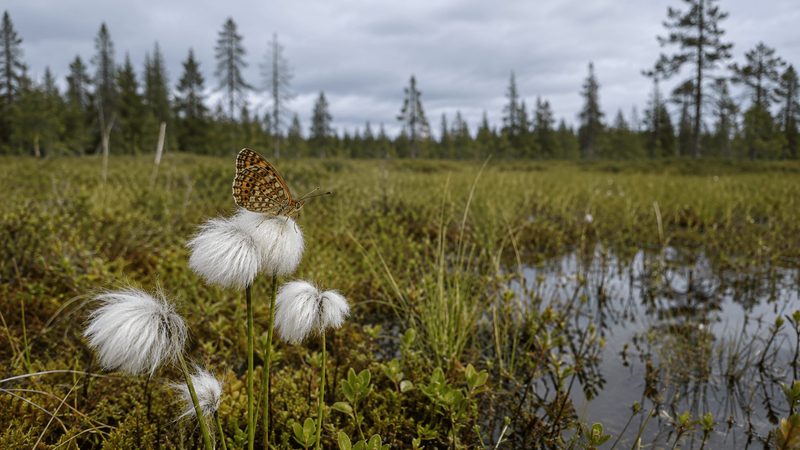
- Freija's fritillary (Boloria freija) — bogs with cloudberry
- Mountain ringlet (Erebia epiphron) and Arran brown (Erebia ligea) — fell grasslands
- Woodland ringlet (Erebia medusa) — damp moor-grass meadows
- Northern blue (Plebejus idas) — heather moors and fell scrub
Arctic north (above 69°N)
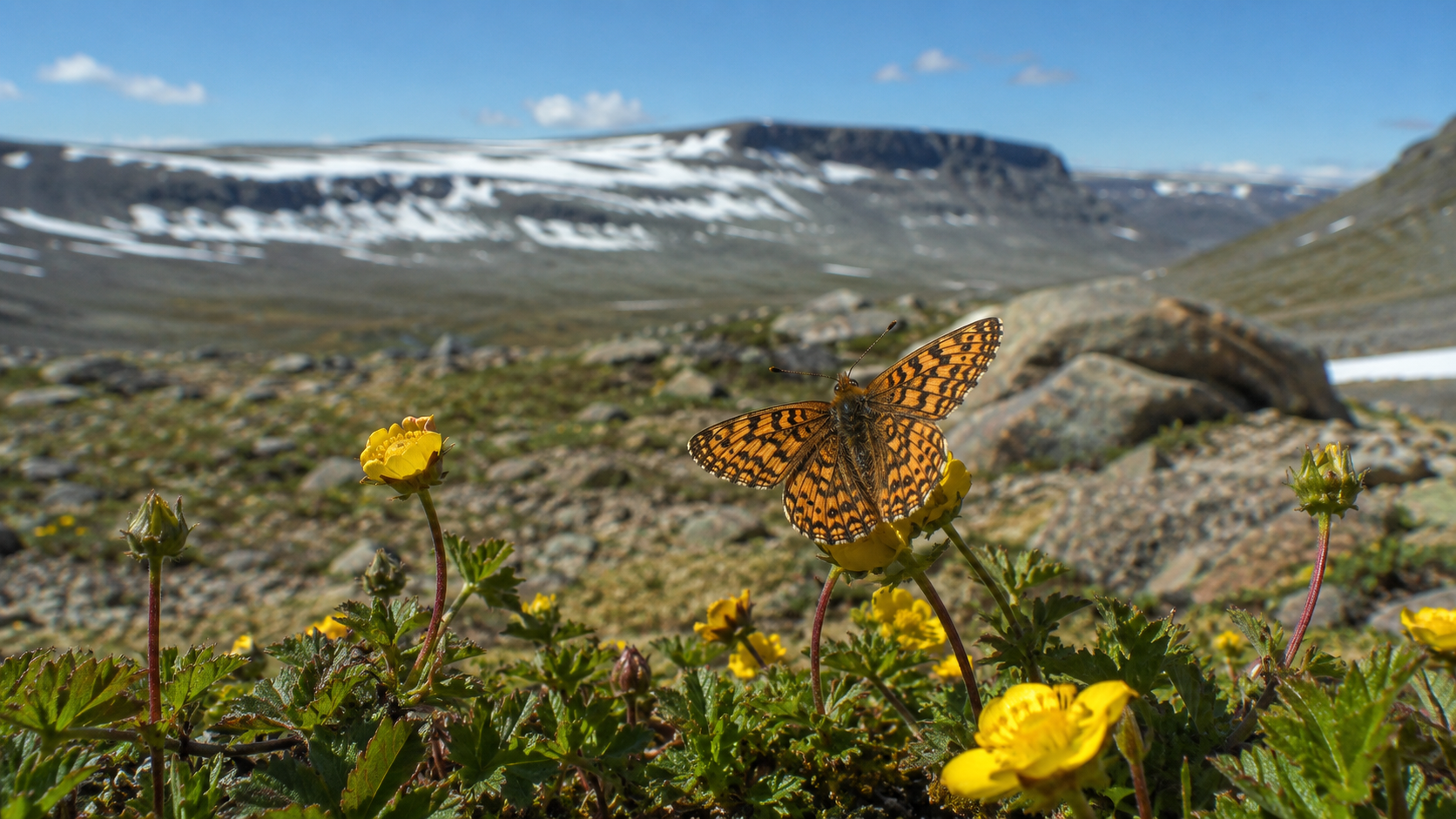
North of the Arctic Circle, species richness drops to around 20–30 regularly occurring species. Here the genuine Arctic specialists come into their own:
- Arctic fritillary (Boloria chariclea) — fell tundra with mountain avens
- Lapland ringlet (Erebia embla) — boggy tundra
- Moorland clouded yellow (Colias hecla) — driest fell ridges
- Pale Arctic clouded yellow (Colias nastes) — high-altitude rocky tundra
Seasonality
| Period | Highlights |
|---|---|
| March–April | Overwintered adults: brimstone, small tortoiseshell, Camberwell beauty |
| May–June | First broods in the south: whites, blues, pearl-bordered fritillary |
| June–July | Peak diversity in the fell; all Arctic species in flight |
| August | Second broods in the south; migrants (red admiral, painted lady) |
Observation tips
The most productive sites combine open, flower-rich grassland with shelter from wind. In the fell, sunny south-facing slopes warm up fastest and attract males patrolling for females. The best weather is calm and sunny; even in midsummer many fell species simply do not fly on cold or overcast days.
Key sites include the limestone grasslands around the Oslo Fjord, the Dovrefjell–Sunndalsfjella National Park (excellent for fell species), and the Varanger Peninsula in Finnmark for Arctic specialists.