Butterflies of Romania
Romania is a great European butterfly country — Carpathian wilderness, Transylvanian meadows and Danube Delta support over 200 species, many rare elsewhere.
Overview
Romania occupies the northeastern corner of the Balkan Peninsula, bordered by Ukraine and Moldova to the north and east, the Black Sea to the southeast, Bulgaria to the south, Serbia to the southwest, and Hungary to the west. At 238,000 km², it is the largest country in southeastern Europe.
The geographical structure of Romania is distinctive: the Carpathian arc sweeps in a great C-shape through the heart of the country, enclosing the Transylvanian plateau within its curve. Outside the Carpathians, three major plains extend in different directions — the Wallachian Plain to the south between the Carpathians and the Danube, the Moldavian Plain to the east, and the Dobrogea plateau along the Black Sea coast. The Danube Delta at the far east forms one of Europe's largest and most important wetland systems.
Each of these zones has a distinct butterfly fauna.
Habitats and butterfly communities
The Carpathian arc
The Romanian Carpathians — including the Southern Carpathians (Transylvanian Alps), Eastern Carpathians, and Western Carpathians (Apuseni) — are among the most ecologically intact mountain ranges in Europe. With the largest brown bear, wolf, and lynx populations in the EU, they represent a temperate wilderness unusual for a country of Romania's size and population.
For butterflies, the altitude gradient from foothill to alpine produces a complete succession of communities:
- Oak and mixed forest zone (200–700 m): white admiral, purple emperor (Apatura iris), silver-washed fritillary, high brown fritillary, woodland browns
- Beech forest zone (700–1,400 m): Scotch argus (Erebia aethiops), woodland ringlet (E. medusa), lesser marbled fritillary (Brenthis ino)
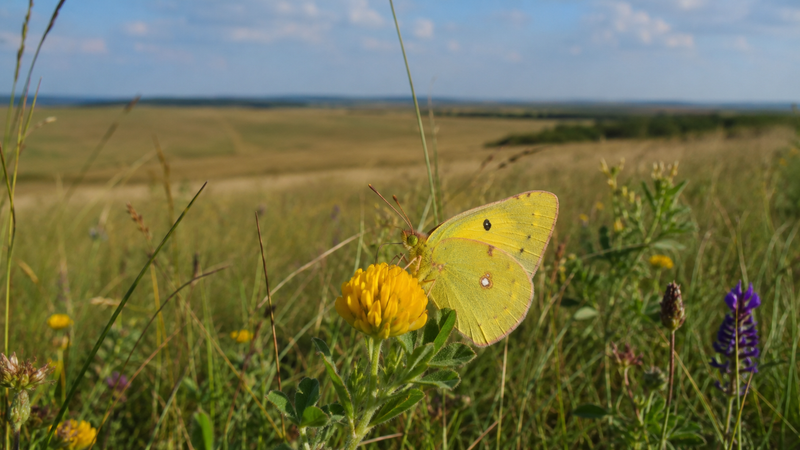
- Subalpine meadow (1,400–2,000 m): mountain clouded yellow (Colias phicomone), shepherd's fritillary (Boloria pales), mountain ringlet (Erebia epiphron), violet copper (Lycaena helle)
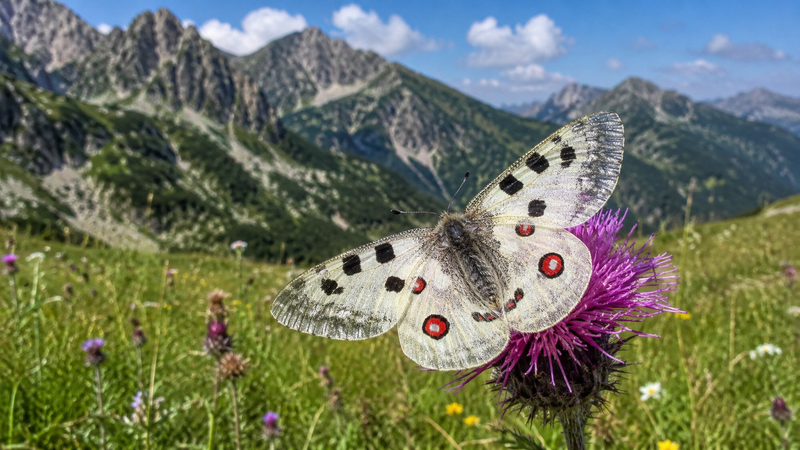
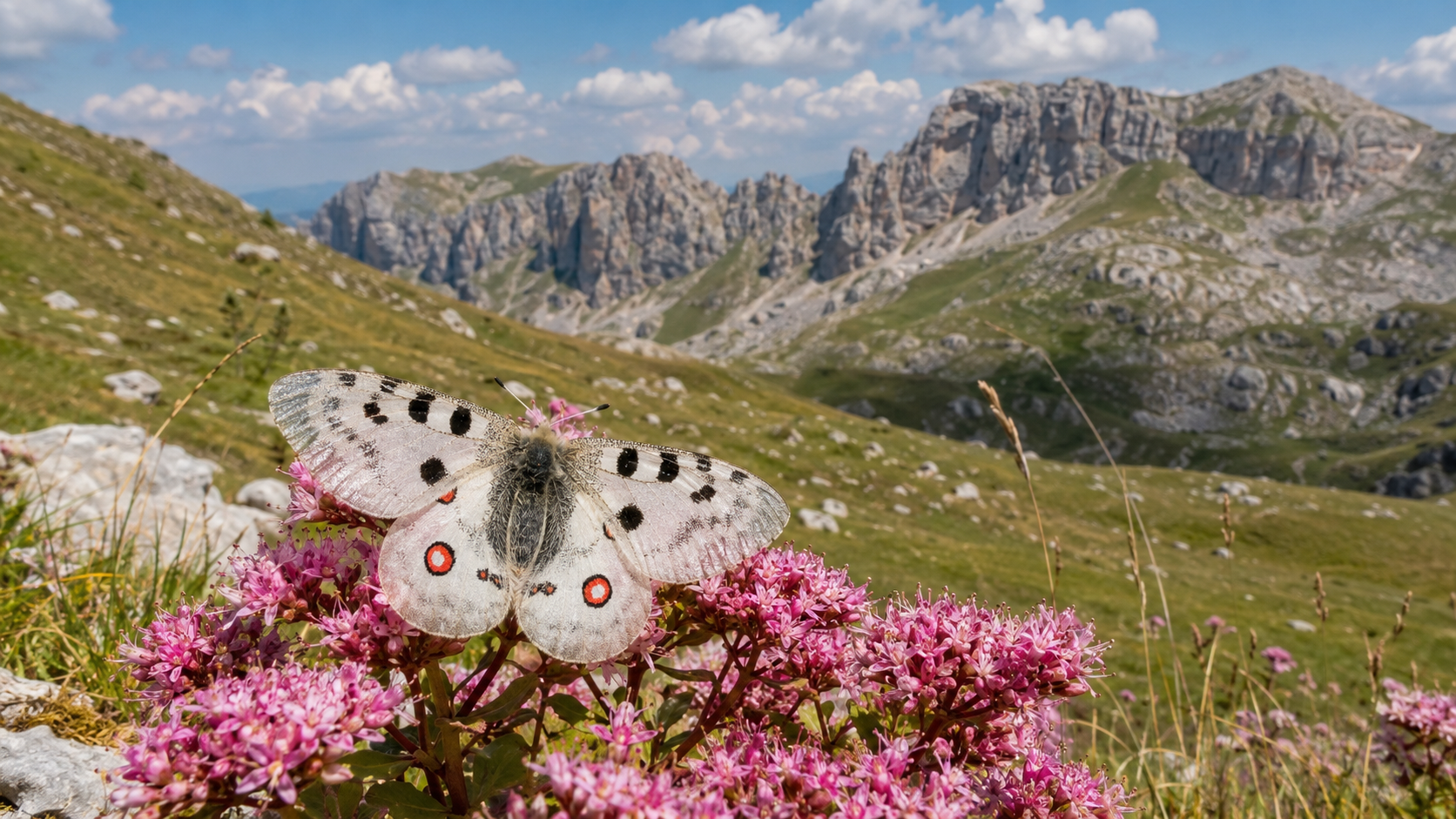
- Alpine zone (above 2,000 m): Apollo (Parnassius apollo), small Apollo (P. phoebus), Dewy ringlet (Erebia pandrose), the highest Erebia species
The Bucegi Mountains, rising above Sinaia and Buşteni, are the most accessible high-altitude butterfly site in Romania — a plateau above 2,000 m reached by cable car, with good Apollo populations on limestone outcrops and abundant Erebia in the surrounding grassland.
Retezat National Park (2,509 m peak) in the Southern Carpathians holds the largest undisturbed subalpine and alpine butterfly community in Romania, including all Carpathian Erebia species in their optimal habitats.
Transylvanian hay meadows
Inside the Carpathian arc, the Transylvanian plateau preserves one of the last extensive areas of traditionally managed European hay meadow. Small farms using horse-drawn equipment, hand-scything, and late hay cuts maintain meadow swards of extraordinary botanical richness — up to 50–80 plant species per 4 m² in the best examples. These meadows support the highest butterfly densities anywhere in central Europe:
- Maculinea (Phengaris) blues: four species occur in Transylvania and adjacent Moldova
- Large blue (P. arion) — dependent on Thymus and Myrmica ant nests
- Alcon blue (P. alcon) — on Gentiana pneumonanthe in damp meadows
- Scarce large blue (P. teleius) and dusky large blue (P. nausithous) — on Sanguisorba officinalis
- Marsh fritillary (Euphydryas aurinia) — in damper meadow sections with Succisa pratensis
- Knapweed fritillary (Melitaea phoebe) and Glanville fritillary (M. cinxia)
- Numerous Polyommatus and Lysandra blues on calcareous grassland edges
The areas around Sibiu (Hermannstadt) and the villages of the Saxon heartland (Viscri, Biertan, Criş) are particularly celebrated for meadow butterfly diversity and have attracted conservation attention from organisations including Rewilding Europe.
Dobrogea
The Dobrogea plateau, between the Danube and the Black Sea, is Romania's most continental region — hot, dry summers, cold winters, and a steppe character unlike anything else in the country. Its butterfly fauna reflects this distinctiveness:
- Steppe fritillary (Melitaea arduinna) — virtually confined in Romania to Dobrogea
- Eastern rock grayling (Hipparchia syriaca)
- Large wall brown (Lasiommata maera) in its warmest, darkest forms
- Numerous xerophilous Lycaenidae, including several Polyommatus and Plebeius species at their distribution limits
- Scarce swallowtail (Iphiclides podalirius) in warm valley scrub
Danube Delta and floodplains
The Danube Delta — a UNESCO World Heritage Site and one of Europe's largest wetlands — adds a different community: wetland specialists of reed beds, riverside willows, and river islands.
- Large copper (Lycaena dispar) — the most celebrated butterfly of the Danube floodplains; Romania holds one of Europe's largest populations in the Delta and along the lower Danube
- Purple-shot copper (Lycaena alciphron) in drier grassland between river channels
- Poplar admiral (Limenitis populi) in tall riparian poplar and willow forests
- Migrant species arrive and rest along the Black Sea coast — painted ladies, clouded yellows, and occasionally vagrant species from Asia Minor
Conservation context
Romania's traditional agricultural landscape — maintained by small-scale farming, late hay cuts, and limited mechanisation in rural Transylvania and Moldova — is one of the most important butterfly conservation assets in Europe. However, it is under pressure:
- Agricultural intensification: EU subsidy structures have driven mechanisation and earlier hay cuts, reducing the number of butterfly generations completing their life cycle before mowing
- Agricultural abandonment: younger generations leaving villages leads to scrub invasion of meadows, particularly in remote valleys
- Infrastructure development: road and tourism development pressure in the Carpathians threatens habitat connectivity
- Wetland drainage: historical drainage of Danube floodplains has reduced large copper habitat; the surviving population depends on remaining unregulated sections
Romania's membership of the EU Habitats Directive protects key species (large copper, all Maculinea/Phengaris species, Apollo) and their habitats through the Natura 2000 network. But effective conservation requires agri-environment payments sufficient to make traditional farming economically viable — the fundamental challenge for all of Europe's meadow butterfly faunas.