Butterflies of Bulgaria
Bulgaria — one of Europe's finest butterfly destinations, over 220 species. Black Sea coast to Balkan peaks: endemics and mountain specialists.
Overview
Bulgaria occupies the eastern part of the Balkan Peninsula, bordering Romania to the north, Serbia and North Macedonia to the west, Greece and Turkey to the south, and the Black Sea to the east. Its 110,000 km² encompass an extraordinary range of habitats: the flat, warm Thracian Plain in the south; the Balkan Mountains (Stara Planina) running east–west across the country's centre; the Rhodope massif extending south toward Greece; and the high crystalline peaks of Rila and Pirin in the southwest, reaching 2,925 m at Musala — the highest point in the Balkans outside Greece.
This geographical diversity, combined with Bulgaria's position where three biogeographical zones converge, makes it the most butterfly-rich country in Europe relative to its size.
Biogeographical zones and their butterfly faunas
Central European zone
The north and the interior follow a Central European pattern: oak and beech forest with the typical suite of European forest butterflies — purple emperor (Apatura iris), white admiral (Limenitis camilla), silver-washed fritillary (Argynnis paphia), and woodland Satyridae. Species here are broadly shared with Romania, Poland, and Germany.
Mediterranean zone
Southern Bulgaria — primarily the Rhodopes, the Thracian valley below them, and the Sakar and Strandzha hills near the Turkish border — receives significant Mediterranean influence. Species reaching their northern limit in Bulgaria include:
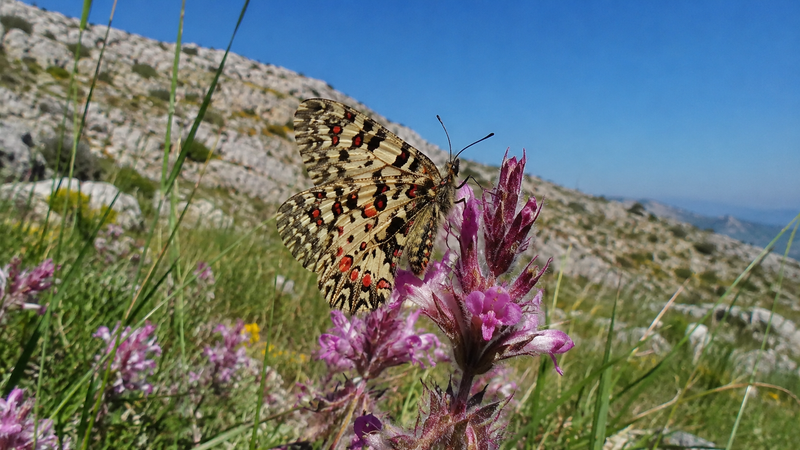
- Eastern festoon (Zerynthia cerisyi) — a spectacular swallowtail whose larva feeds on Aristolochia in rocky hillside scrub; Bulgaria holds a major EU population
- False Apollo (Archon apollinus) — black-and-white patterned swallowtail of the eastern Mediterranean, found in the Eastern Rhodopes in small colonies
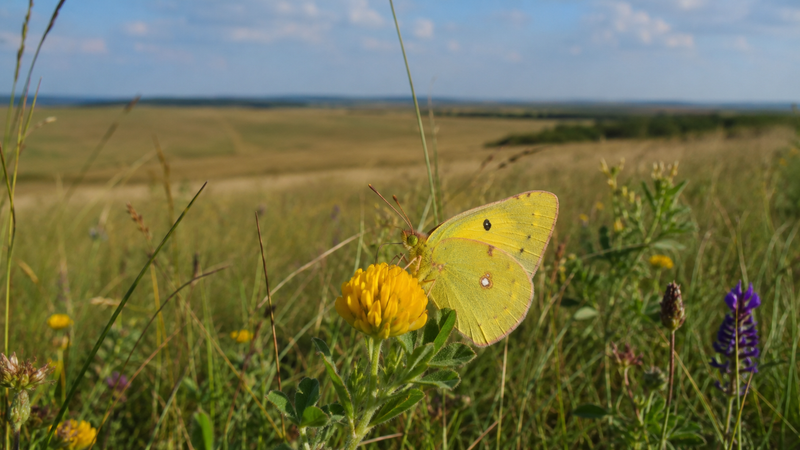
- Cleopatra (Gonepteryx cleopatra) — vivid yellow-green male of Mediterranean scrub; reaches the Eastern Rhodopes and Sakar hills
- Lang's short-tailed blue (Leptotes pirithous) and other southern Lycaenidae at their range edge
- Two-tailed pasha (Charaxes jasius) — the largest European nymphalid, found locally in Strandzha where its larval host Arbutus unedo grows
Pontic-Steppic zone
The Black Sea coast and the eastern lowlands carry a steppe element from the Pontic region:
- Freyer's purple emperor (Apatura metis) — found in Bulgaria's riparian willow thickets, its westernmost EU populations on the Danube and its Bulgarian tributaries
- Steppic Colias and Polyommatus species of the drier eastern lowlands
- Bulgarian hermit (Chazara briseis) — on hot, dry rocky slopes of the eastern lowlands and Rhodope foothills
Key regions
Eastern Rhodopes
The Eastern Rhodopes — a lower, drier, and more sun-baked extension of the main Rhodope massif — are the jewel of Bulgarian butterfly country. The terrain is a mosaic of dry rocky slopes, calcareous grassland, ancient oak scrub, and limestone gorges near the Greek border. In May–June, this area can produce extraordinary diversity: 50+ species in a single day is achievable. The combination of Mediterranean warmth (facilitated by the low altitude and southern exposure) with Balkan geological diversity creates conditions found nowhere else in the EU in such a compact area.
Key species of the Eastern Rhodopes include the eastern festoon, false Apollo, large tortoiseshell (Nymphalis polychloros), eastern rock grayling (Hipparchia syriaca), Krueper's small white (Pieris krueperi), and a remarkable concentration of Polyommatus blues.
Strandzha Nature Park
Strandzha, in the extreme southeast near the Turkish border, is the northernmost extension of a Pontic flora zone that extends south through Turkey. It holds several species that enter Bulgaria here and nowhere else in the EU, including thermophilous forest species of distinctly eastern character. The combination of ancient deciduous forest (dominated by Oriental beech, Fagus orientalis) with Mediterranean scrub creates a rich edge community.
Rila National Park
At 2,900 m, Rila is Bulgaria's highest and most glaciated massif. Alpine butterfly communities here are among the best in the eastern Balkans:
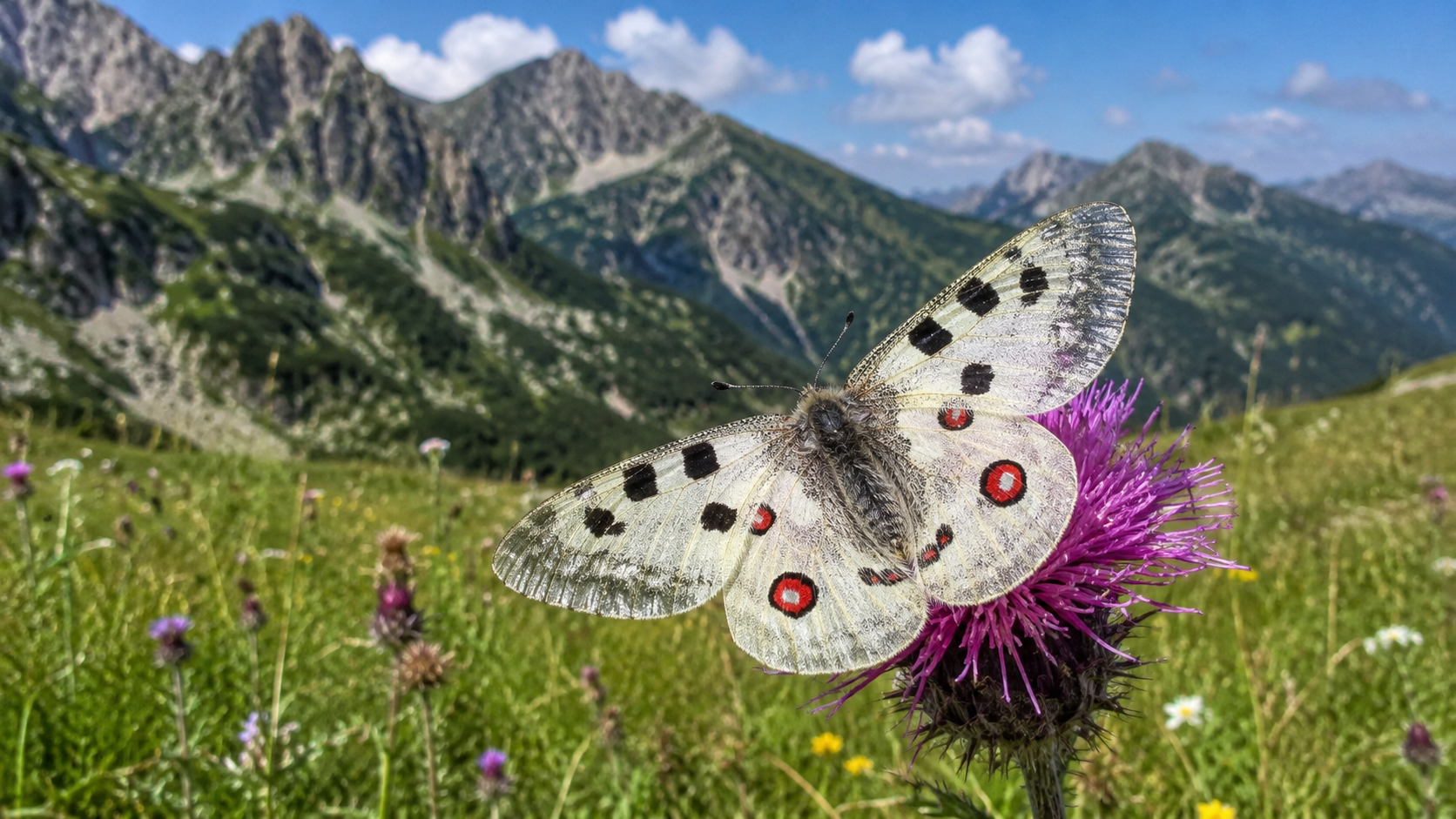
- Apollo (Parnassius apollo) — on rocky slopes and flower-rich meadows at 1,400–2,000 m
- Small Apollo (Parnassius phoebus) — in the highest zones above 2,000 m
- Mountain clouded yellow (Colias phicomone) — in alpine grassland
- Multiple Erebia species: E. medusa, E. epiphron, E. manto, E. alberganus, E. cassioides — each occupying a distinct altitude band
- Violet copper (Lycaena helle) — in wet mountain meadows with Polygonum bistorta
- Cranberry blue (Vacciniina optilete) — in boggy moorland with Vaccinium
Pirin National Park
Pirin, to the southwest of Rila, has the warmest and most calcareous high mountain in Bulgaria — its white marble massif gives it a different flora and butterfly community from the granite Rila. The limestone meadows hold strong populations of Polyommatus blues and calcareous-grassland fritillaries, with the Bulgarian populations of the Balkan endemic Macedonian grayling (Pseudochazara cingovskii) at their northwestern limit.
Vitosha Nature Park (Sofia)
The mountain directly above the capital gives Sofians access to reasonable mountain butterfly fauna without leaving the city's metropolitan area — species reaching 1,800 m on Vitosha include several Erebia, mountain fritillaries, and moorland specialists.
Seasons
| Period | Highlights |
|---|---|
| April–May | Eastern festoon, false Apollo, first fritillaries in the Rhodopes |
| June | Peak Eastern Rhodopes diversity; alpine season begins in Rila and Pirin |
| July | Alpine peak: Apollo, Erebia, mountain blues at high altitude |
| August | Second brood in lowlands; Chazara, graylings on hot rocky slopes |
| September | Clouded yellows, late blues and coppers; migrants along Black Sea coast |
Conservation
Bulgaria's accession to the EU in 2007 brought its Natura 2000 network into force — Bulgaria now has one of Europe's highest proportions of Natura 2000 designated land (34% of the country). Many key butterfly sites are covered by this designation. The principal threats to Bulgaria's butterfly fauna are:
- Agricultural abandonment: as traditional grazing and hay-cutting decline, calcareous grasslands — the richest butterfly habitat — are being colonised by coarse grasses and scrub
- Afforestation: government and EU afforestation programmes have planted conifers on formerly open calcareous hillsides, destroying butterfly habitat
- Pesticide use in Thracian Plain agriculture: reducing the butterfly diversity of farmland and field margins
- Tourism pressure: ski development in Rila and Pirin fragments high-altitude habitats and increases disturbance
Despite these pressures, Bulgaria remains one of Europe's most important countries for butterfly conservation — its Eastern Rhodopes, Rila, and Strandzha populations hold species that have been lost from much of Western Europe.