Raising Butterflies at Home
Raising butterflies through metamorphosis, from egg to adult, is a rewarding home experience — equipment, host plants, and care for common European species.
Why rear butterflies?
Watching a caterpillar you have cared for transform into a butterfly — the chrysalis splitting, the crumpled wings pumping up to full size, the first tentative flight — is one of the most vivid natural history experiences available to a careful observer at any age. Rearing butterflies at home makes the abstract fact of metamorphosis immediate and personal. It also develops observation skills, responsibility for a living animal, and an understanding of the relationship between butterflies and specific plants that no book or video can match.
Choosing a species
The most important principle: start with a species whose host plant you can reliably supply. A healthy, thriving caterpillar will eat continuously; if the plant runs out or wilts, the larva often dies within hours.
| Species | Host plant | Difficulty | Notes |
|---|---|---|---|
| Painted lady (Vanessa cardui) | Thistle, nettle, mallow | ★ Beginner | Commercial kits available; completes in 4–5 weeks |
| Small tortoiseshell (Aglais urticae) | Stinging nettle | ★ Beginner | Wild nettle patches provide free food |
| Red admiral (Vanessa atalanta) | Stinging nettle | ★ Beginner | Caterpillars fold leaves around themselves |
| Brimstone (Gonepteryx rhamni) | Buckthorn (Rhamnus) | ★★ Moderate | Host plant must be sourced from garden centre |
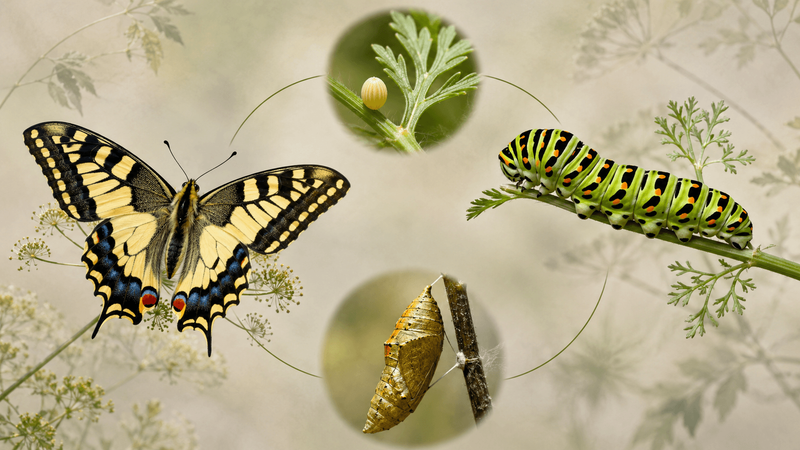
| Swallowtail (Papilio machaon) | Fennel, dill, parsley | ★★ Moderate | Spectacular; host plants grown easily in pots |
| Orange tip (Anthocharis cardamines) | Garlic mustard, cuckooflower | ★★ Moderate | Overwinters as pupa; needs cool storage |
| Comma (Polygonia c-album) | Stinging nettle, hop | ★★ Moderate | Two colour forms of caterpillar |
| Large white (Pieris brassicae) | Cabbage, nasturtium | ★ Beginner | Garden pest species; caterpillars group-living |
Equipment
Rearing cage
A ventilated mesh cage is the core piece of equipment. The key requirements:
- Mesh size: fine enough to prevent escape of newly hatched first-instar caterpillars (mesh under 1 mm); nylon voile or fine insect mesh works well
- Size: at least 30 × 30 × 30 cm for most species; larger (50 × 50 × 50 cm or more) for large species like the swallowtail, to allow wing expansion on emergence
- Ventilation: all-mesh sides or top; never fully sealed
- Access: a zipper or Velcro flap for inserting food plants and removing waste
Commercial butterfly rearing cages are sold online at modest cost. A DIY alternative: cut windows in all sides of a cardboard box, glue fine mesh over the openings, and seal the base with a plastic sheet for easy cleaning.
Host plants
Growing host plants in pots provides the most reliable food supply:
- Fennel (Foeniculum vulgare) for swallowtail — grows easily from seed in a 20 cm pot, producing enough for one or two caterpillars through to pupation
- Stinging nettle — cut stems placed in a small jar of water last several days and can be replaced; or pot up a clump from the garden
- Cabbage or nasturtium for large and small white — widely available
- Buckthorn (Rhamnus cathartica or Frangula alnus) for brimstone — available from native plant nurseries
Avoid collecting host plants from roadsides with heavy traffic (exhaust deposits are toxic to caterpillars) or from areas where herbicides are used.
Step-by-step rearing
Finding eggs and caterpillars
The easiest starting point is searching for eggs on host plants in the field. Butterfly eggs are typically laid on or near the foodplant; look on the undersides of leaves and on young shoots. Most butterfly eggs are 0.5–2 mm, globular, and visible with a hand lens. Newly hatched first-instar caterpillars are very small and fragile — handle with a fine paintbrush.
Alternatively, second or third instar caterpillars found on host plants in the field are much more robust and easier to establish in a cage. For beginners, starting with a visibly active caterpillar rather than an egg reduces early failure.
Feeding and daily care
- Replace food plant before it wilts — fresh is always better than wilted
- Clean the cage floor daily or every two days — frass (droppings) is harmless but damp frass promotes mould
- Avoid direct sunlight on the cage — temperatures above 35 °C kill caterpillars
- Do not mist or spray inside the cage — excess moisture causes fatal bacterial infections
- Handle caterpillars as little as possible — let them walk onto fresh sprigs rather than picking them up
Pupation
When a mature caterpillar stops feeding, wanders restlessly, and begins to shrink slightly, it is ready to pupate. At this point:
- Ensure the cage has suitable pupation sites — rough surfaces, twigs, or hanging mesh where the caterpillar can attach its silk pad and cremaster
- Do not disturb the caterpillar during pre-pupal quiescence (the contracted, immobile stage before the skin splits)
- The chrysalis forms within hours of the final skin split; leave it completely undisturbed for 24 hours
Overwintering pupae
Species that overwinter in the pupal stage — orange tip, brimstone, most European swallowtail subspecies — must experience a cool winter period (4–8 °C) to break diapause and trigger spring emergence. Options:
- An unheated garage, shed, or outbuilding provides natural temperature fluctuations and is ideal
- A refrigerator set to 4–6 °C works; check every few weeks and mist lightly if the pupa looks desiccated
- Never allow pupae to freeze solid; never keep overwintering pupae in a warm room
Emergence and release
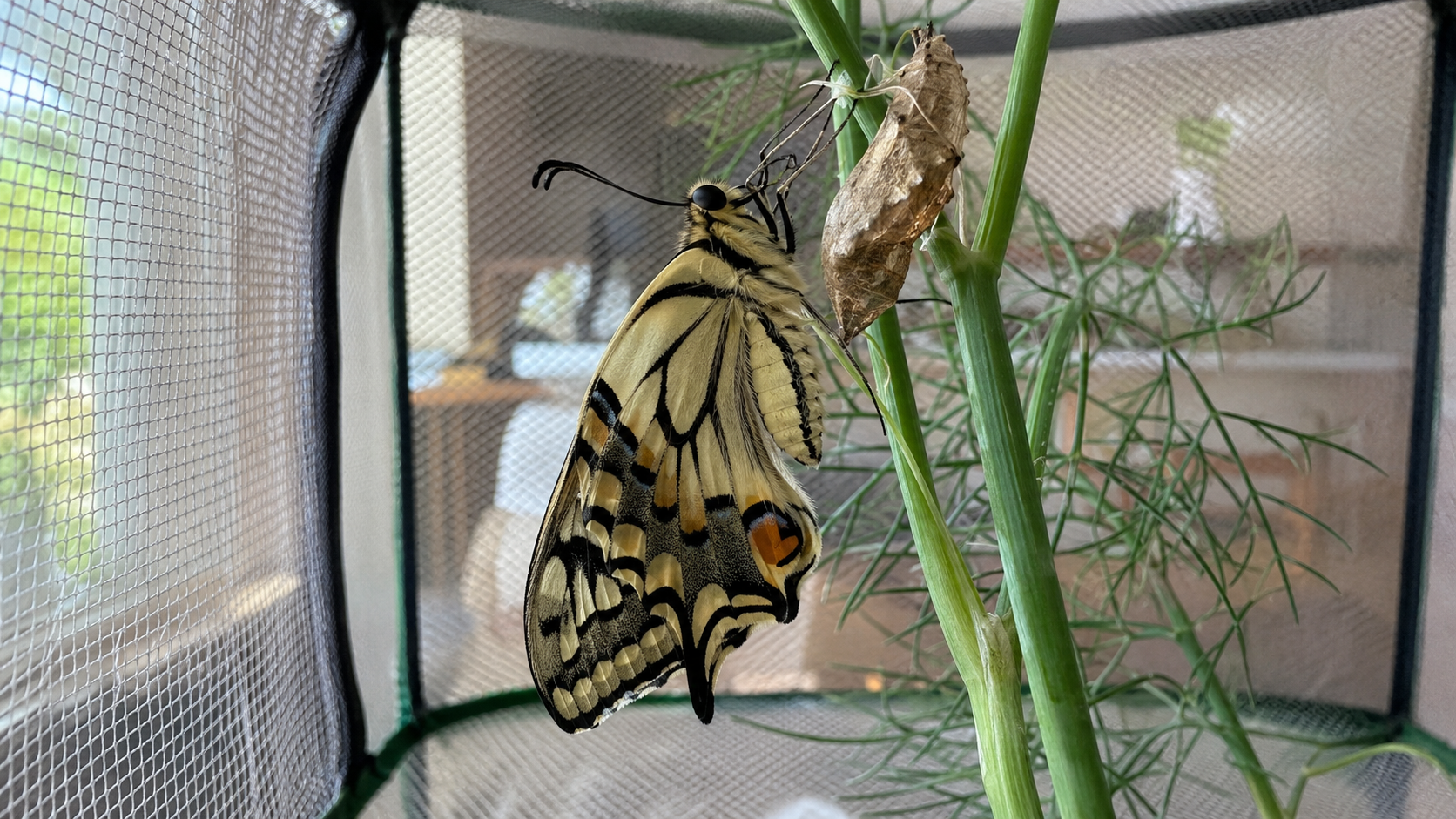
Adult emergence occurs rapidly — the chrysalis becomes transparent in the hours before eclosion, then splits and the butterfly emerges over several minutes. The wings must expand fully before the adult moves — typically 2–3 hours in a warm room. Disturbing an adult before its wings are fully hardened causes permanent wing deformities.
Release the adult into the garden on a warm, calm, sunny day, near the host plant of its species. Adults should be released within their natural range — do not release non-native species outdoors.
Common problems and solutions
| Problem | Likely cause | Solution |
|---|---|---|
| Caterpillar dies suddenly | Bacterial infection from damp frass | Clean cage more frequently; improve ventilation |
| Caterpillar stops eating | Preparing to moult (normal) or too hot | Wait 24–48 h; check temperature |
| Black-spotted caterpillar | Nuclear polyhedrosis virus (NPV) — fatal | Remove immediately; disinfect cage |
| Pupa shrivels | Desiccation in overwintering storage | Mist lightly with water; check for condensation |
| Adult emerges with crumpled wings | Disturbed during wing expansion | Prevention only; once hardened, deformity is permanent |
| Mould on cage or plant stems | Excess moisture | Remove mouldy material; increase air circulation |
Ethics and responsibility
Rearing butterflies at home, done thoughtfully, has no negative impact on wild populations — collecting a few eggs or caterpillars from a large, healthy population is ecologically insignificant. The key ethical rules:
- Never collect protected species (check your national red list)
- Never release non-native species into the wild
- Do not over-collect: take no more than 5–10 eggs or caterpillars from any single patch of host plant
- Dispose of dead animals, frass, and used host plant in general household waste, not in compost that goes back to the garden (to prevent pathogen spread)
The experience gained from rearing even a single species to adult dramatically improves field recognition skills, ecological understanding, and the depth of enjoyment in future butterfly watching.