Plain Tiger
The Plain Tiger (Danaus chrysippus) is among the world's most widely distributed butterflies, ranging from Africa to South Asia and Australia.
Key facts
- Latin name
- Danaus chrysippus
- Family
- Nymphalidae
- Wingspan
- 70-90 mm
- Flight season
- Year-round in tropics; March–October in Mediterranean fringe
- Host plants
- Asclepias spp. (milkweeds), Calotropis procera (Sodom's apple), Calotropis gigantea, Gomphocarpus spp., Cynanchum spp.
- Conservation status
- LCLeast Concern
A butterfly of three continents
The Plain Tiger (Danaus chrysippus) has one of the widest ranges of any butterfly species: it occurs across the whole of sub-Saharan Africa, along the North African coast and through the Middle East, across the Indian subcontinent and Southeast Asia, and into northern and eastern Australia. It has established a resident population in the Canary Islands and occasionally appears as a vagrant in southern Spain and Cyprus — the northernmost records for the species.
This extraordinary range is possible because the Plain Tiger is adaptable and its larval host plants — plants in the milkweed family (Apocynaceae subfamily Asclepiadoideae) — are widespread weeds in disturbed and semi-arid habitats on multiple continents. Wherever Calotropis procera (Sodom's apple) grows in Africa and Asia, the Plain Tiger is usually present.
Appearance and recognition
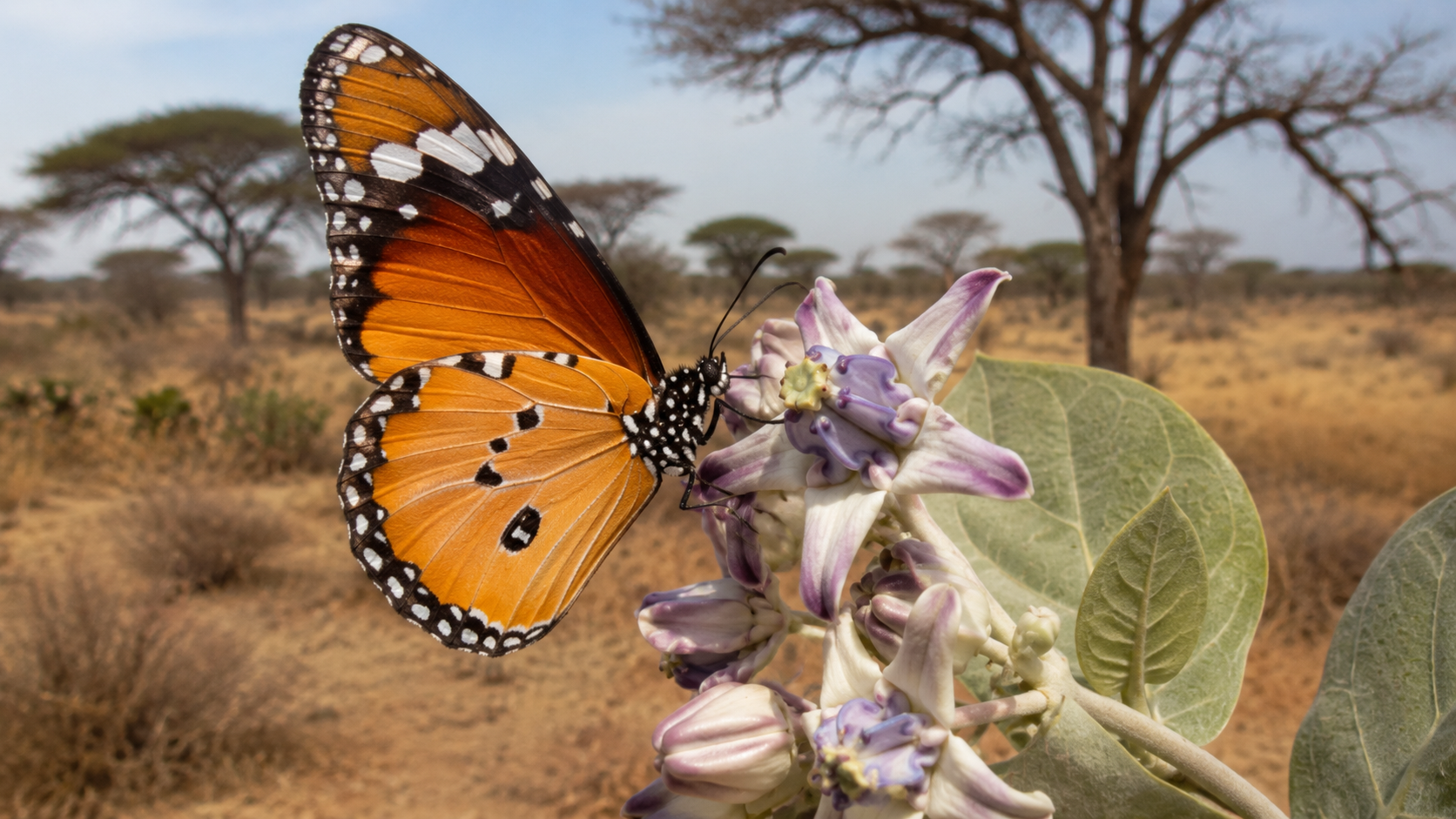
The Plain Tiger is a medium-sized butterfly with a wingspan of 70–90 mm. Both sexes share the same basic pattern:
- Forewings: tawny orange with a broad black apex and a band of white spots across the tip; black cell stripe near the body
- Hindwings: orange with fine black veining and a border of black-and-white spots; a small black sex-brand (androconial patch) on the hindwing of males
- Underside: paler orange-buff, pattern mirroring the upperside but with more distinct white markings
The species is immediately distinguishable from the related African Monarch (Amauris niavius) and from the Monarch (Danaus plexippus) by its size, proportions, and spot pattern. In flight, the Plain Tiger has a characteristic slow, gliding motion at medium height — a typical danaline flight style that advertises its unpalatability to predators.
Female polymorphism
Females of the Plain Tiger across Africa are highly polymorphic, with three main forms:
- Form chrysippus (typical): orange hindwings like the male — the most common form in East Africa
- Form alcippus: white hindwings, closely resembling the toxic Amauris niavius (African Monarch); very common in West Africa and parts of East Africa
- Form dorippus: intermediate; hindwing partly orange, partly white
The relative frequency of these forms varies markedly between regions and is maintained by mimicry-related frequency-dependent selection.
Chemical ecology: milkweed toxins
The key to understanding the Plain Tiger is its relationship with toxic host plants. Caterpillars feed almost exclusively on Calotropis and related genera (Gomphocarpus, Asclepias, Cynanchum) — all containing cardenolide cardiac glycosides that interfere with the sodium-potassium pumps of vertebrate heart muscle.
The caterpillars not only tolerate these toxins but sequester them, concentrating cardenolides in their bodies. The toxins persist through metamorphosis into the adult butterfly. A bird that captures and eats a Plain Tiger typically vomits, experiences cardiac symptoms, and learns to avoid the orange-and-black pattern thereafter.
Cardenolide concentration varies among individual butterflies depending on the specific host plant used, the plant's age and condition, and the part of the plant eaten. This variation has ecological consequences: some individuals are barely toxic, others highly so. Predators that encounter a low-toxicity individual may be less effectively deterred, which partly explains why the species still suffers some predation despite its chemical defences.
Mimicry
The Plain Tiger stands at the centre of one of the most complex mimicry networks in the insect world. Because it is common, toxic, and distinctively patterned, a large number of other butterfly and moth species have evolved to resemble it.
Key mimics include:
- Hypolimnas misippus (Diadem) — a non-toxic nymphalid; females are precise mimics of Plain Tiger female forms, matching each regional morph of chrysippus in its local form; males are completely different (black with iridescent blue patches). This is one of the most studied examples of Batesian mimicry.
- Acraea (Telchinia) species* — some species are toxic Müllerian co-mimics sharing the orange-black pattern
- Various moths (family Arctiidae) — unrelated but visually convergent
The polymorphism in female Plain Tigers (multiple colour forms) is partly maintained by the need to track the relative frequencies of toxic models: a mimic is most effective when it is less common than its model, so having multiple forms allows the mimicry to remain effective across varied model compositions.
Lifecycle and behaviour
The Plain Tiger breeds throughout the year in tropical parts of its range; at the edges of its range (Mediterranean fringe, temperate Australia) it is seasonal.
Eggs are laid singly on the leaves of host plants, particularly young leaves of Calotropis and Gomphocarpus. The egg is pale green, ribbed, and visible on the underside of leaves.
Caterpillars are strikingly patterned: white, yellow, and black banding, often with red-tipped tentacles. This aposematic colouration warns predators of toxicity even at the larval stage. The caterpillars are not hidden; they feed openly on the leaf surface, relying on chemical defence rather than concealment.
Pupae are smooth, pale green with golden spots — a characteristic feature of danaline chrysalides. The gold metallic spots are structurally reflective rather than pigmented.
Adults fly slowly and deliberately, spending time at flowers (particularly Heliotropium, Lantana, and other small-flowered species). Males engage in hill-topping behaviour at prominent vegetation, establishing territories and intercepting females. The species does not migrate over long distances like the Monarch, but may undergo local or regional movements in response to resource availability.
Distribution and habitat
The Plain Tiger is primarily a species of open habitats: savannah, grassland, scrub, semi-desert margins, agricultural land, and gardens. It avoids dense forest interior. In Africa it is one of the commonest butterflies across most of the continent except the central Congo Basin forest block. In India it is one of the most familiar garden and roadside butterflies, known locally as the "Tiger butterfly."
In Australia the species (Danaus chrysippus subsp. petilia, sometimes treated as a separate species) occurs across the north and east, wherever milkweed relatives are present.
Interesting facts
- The Plain Tiger is the suspected model for more mimics than any other butterfly species in Africa — a consequence of its combination of abundance, toxicity, and striking, distinctive wing pattern
- Despite being toxic, Plain Tigers are occasionally parasitised by tachinid flies (Imitomyia) whose larvae develop inside the living butterfly — the flies appear to have evolved some tolerance to cardenolide toxins
- The variation in female form across Africa follows a geographical gradient that has been mapped in detail: alcippus form dominates in West Africa; chrysippus form dominates in East Africa; mixed populations occur in between — a system studied since the 1960s as a model for evolution and mimicry
- The species was used by amateur naturalists in the 19th century as an accessible model for studying insect mimicry, predating modern genetic tools; conclusions reached from field observations of this species in the 1860s–1880s were largely confirmed by molecular studies 150 years later