Giant Silk Moths
Giant silk moths (Saturniidae) — the world's largest moths, marked by eyespots on the wings. Adults do not feed and live only a few days.
What are giant silk moths
Giant silk moths (Saturniidae) are a family of large to very large night-flying moths, with around 2,300 described species distributed worldwide except Antarctica, with the greatest diversity in the tropics of the Americas, Africa, and Asia. This family includes the largest moths and butterflies on the planet by wing area and wingspan.
Characteristic features
Enormous size. Most species have a wingspan measured in tens of centimetres; the largest, including the atlas moth, reach 25–30 cm.
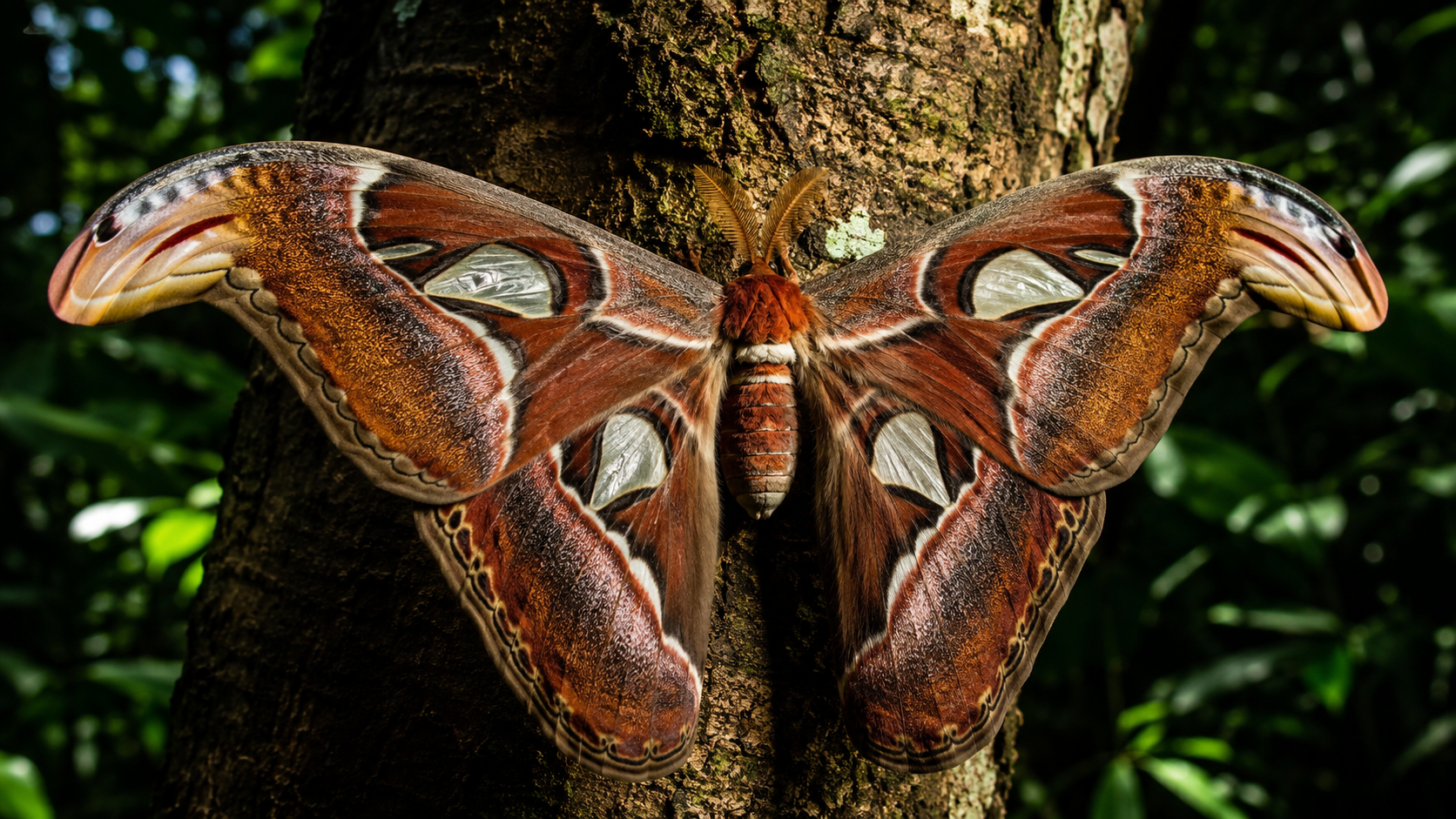
Eyespots and transparent windows. The wings of many genera carry large round spots mimicking the eyes of a larger animal — a defensive display triggered when disturbed. In some genera, scaleless transparent patches ("windows") have evolved instead, and wingtips can mimic a snake's head.
Reduced adult mouthparts. In the vast majority of species, the adult's proboscis is vestigial and incapable of feeding — the entire adult life is sustained purely by fat reserves accumulated at the caterpillar stage.
Feathery male antennae. Males have large, strongly feathered antennae capable of detecting a female's pheromones from several kilometres away — a necessary adaptation given an adult life lasting only a few days.
Dense silk cocoon. The caterpillars of many species spin a strong cocoon before pupating; in some genera, including the atlas moth, cocoons have traditionally been used by people as a source of silk.
Main representative
Atlas moth (Attacus atlas) — the world's largest moth by wing area, with distinctive snake-head-shaped wingtips and a complete absence of functional adult mouthparts. Species page.
Range and habitat
Giant silk moths occur on almost every continent except Antarctica, with the greatest species diversity concentrated in the tropical and subtropical forests of Southeast Asia, South America, and Africa. Temperate-zone species, including several genera in Eurasia, are usually smaller than their tropical relatives but retain the family's shared traits — eyespots, a short adult life, and the absence of feeding in adults.
How not to confuse them with other families
- From tiger moths: giant silk moths are noticeably larger and almost always bear large eyespots rather than a drab-forewing/bright-hindwing contrast.
- From hawk moths (Sphingidae): hawk moths have narrow, elongated wings and a streamlined, spindle-shaped body adapted for fast flight and hovering at flowers; giant silk moths are broader and heavier, and their adults do not feed at all.
- From day-flying butterflies: giant silk moths fly at night and rest with their wings spread flat rather than folded upright over the back.