Skippers
Skippers (Hesperiidae) — stocky butterflies with a large head and a darting flight, morphologically intermediate between typical butterflies and moths.
What are skippers
Skippers (Hesperiidae) are one of the largest butterfly families, with roughly 4,000 described species worldwide. The name reflects the group's main morphological trait — a large, broad head relative to the body, giving the butterflies a stocky, thick-set appearance. In some classifications, skippers are treated as a separate superfamily, Hesperioidea, distinct from "true" butterflies (Papilionoidea in the narrow sense), owing to their morphology intermediate between butterflies and moths.
Molecular phylogenetic studies show that Hesperiidae split from the main butterfly lineage among the earliest, around 98 million years ago — before swallowtails, whites, blues, and nymphalids — making the family one of the oldest living lineages of Lepidoptera.
Characteristic features
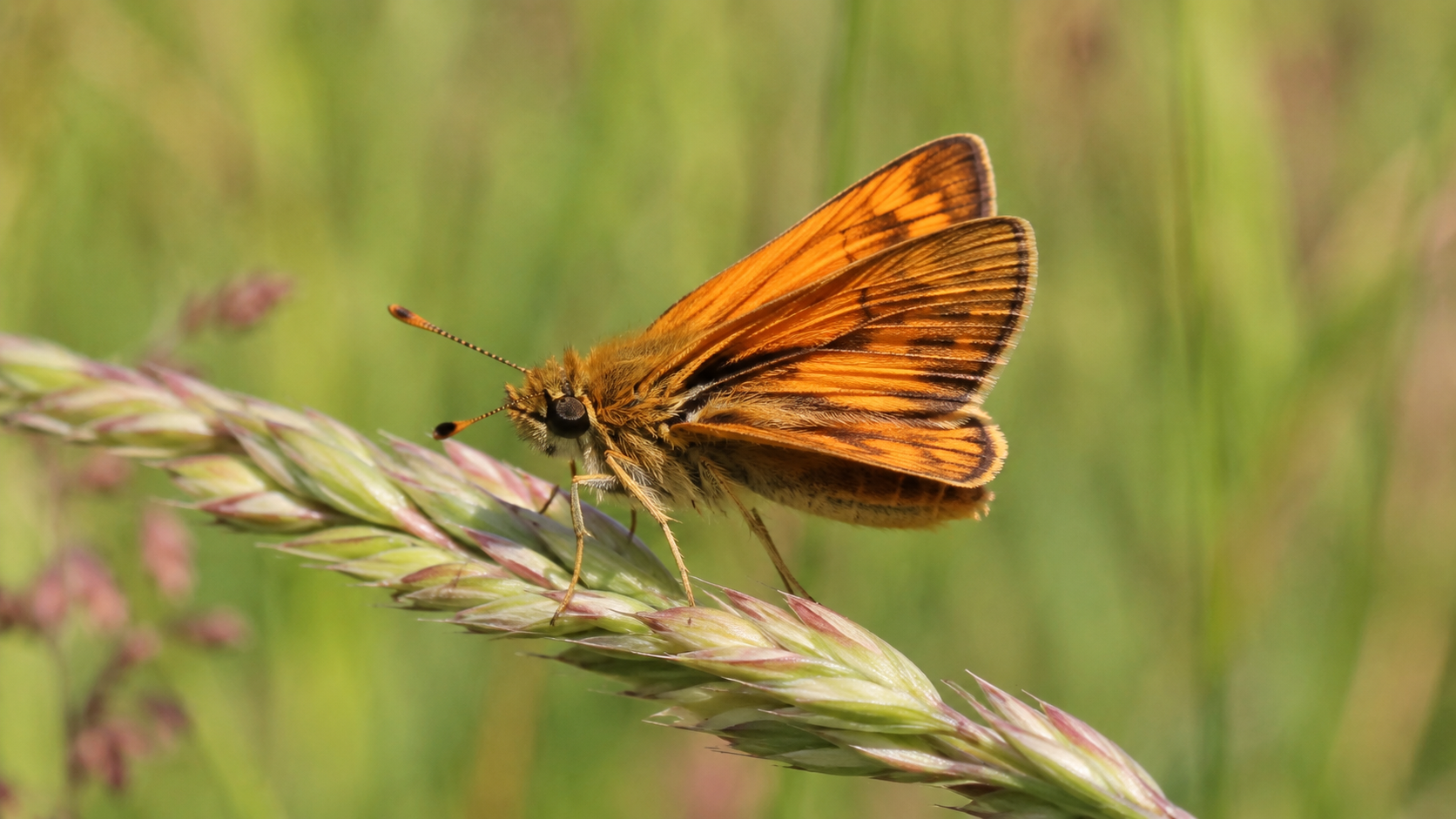
Stocky body. Skippers are noticeably thicker and "furrier" relative to their wing area than most other butterflies — a build that visually links them to moths.
Fast, "skipping" flight. Skipper flight is rapid, low, and buzzing, with sharp bursts between short perching stops — this manner of flying is precisely what gave the family its English name.
Characteristic basking posture. Many species bask with their forewings raised at an angle and hindwings held flat — an asymmetrical position rare among other butterflies.
Hooked antennae. In most species the antennae end in a distinct hook or bend at the tip of the club — an additional diagnostic feature of the family.
Main representatives in Russia
Grizzled skipper (Pyrgus malvae) — one of Europe's smallest and earliest-flying skippers, with a chequered black-and-white wing pattern. Species page.
Large skipper (Ochlodes sylvanus) — orange-brown, a common species of forest edges and clearings. Species page.
Range and habitat
Hesperiidae occur almost worldwide except Antarctica, with the greatest diversity in the tropics of South America and Southeast Asia. In temperate latitudes, including Russia, skippers are common inhabitants of meadows, steppes, forest edges, and clearings, often serving as indicators of grassland habitat quality thanks to many species' narrow association with particular coarse or low-growing grasses.
How not to confuse them with other families
- From blues: skippers are larger and stockier, without the metallic sheen of blue wings.
- From satyrs: skippers lack large eyespots, and their flight is considerably faster and more darting.
- From day-flying moths: despite superficial resemblance, skippers are true butterflies with clubbed (not feathery or comb-like) antennae.