Bhutan Glory
The Bhutan Glory is a spectacular Himalayan swallowtail with iridescent tails, found in cool forests of Nepal, Bhutan, and northeast India.
Key facts
- Latin name
- Bhutanitis lidderdalii
- Family
- Papilionidae
- Wingspan
- 90-110 mm
- Flight season
- May — August (single generation)
- Host plants
- Aristolochia griffithii, Other Aristolochia spp. (Aristolochiaceae)
- Conservation status
- LCLeast Concern
Appearance
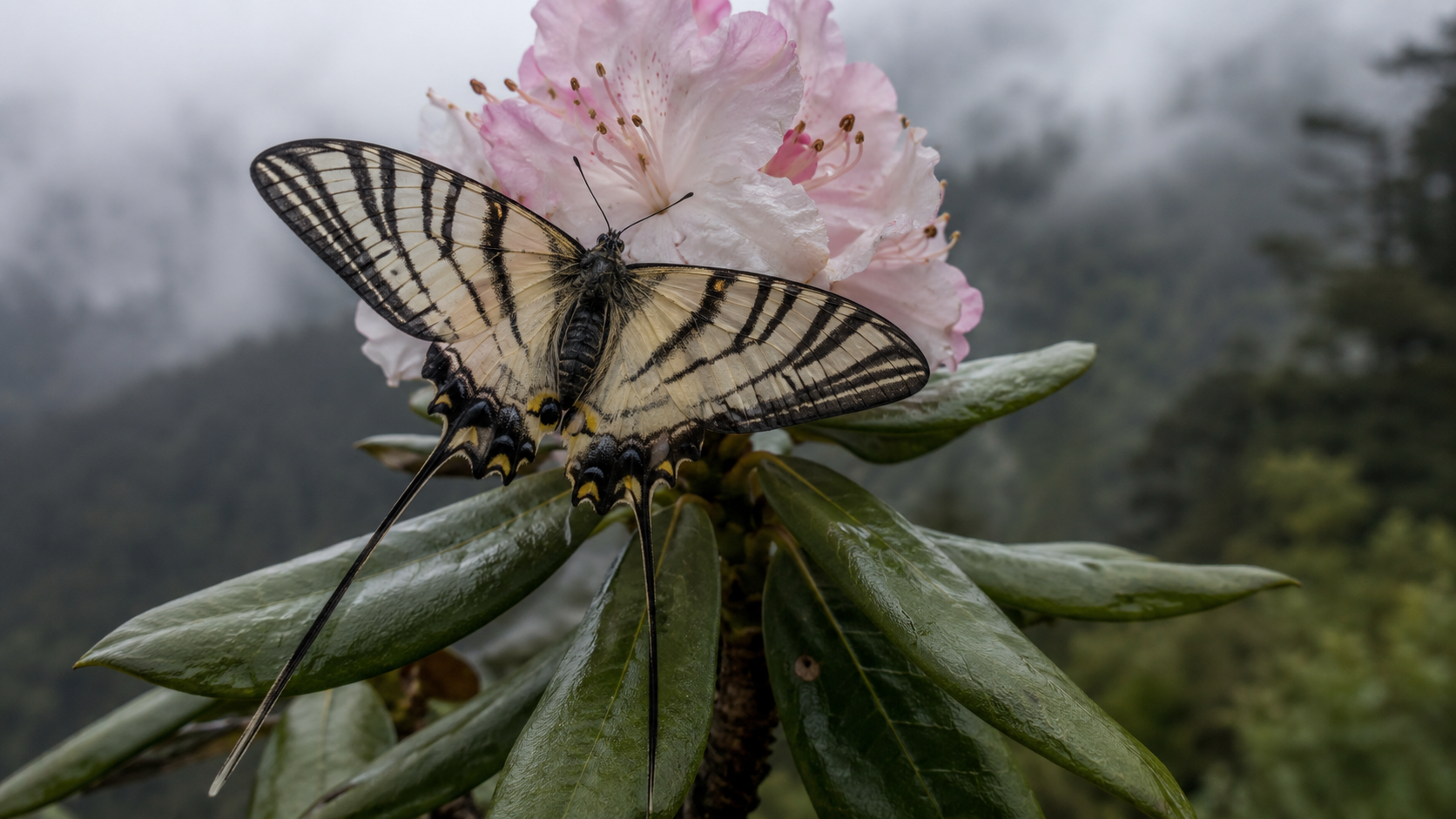
The Bhutan glory (Bhutanitis lidderdalii) is a medium-to-large swallowtail, wingspan roughly 90–110 mm, immediately recognisable by its pattern of pale, semi-translucent stripes crossing dark brown-black wings, and by the hindwing's several long, slender, spoon-tipped tails — a feature unique among Himalayan swallowtails to the small genus Bhutanitis, whose few species are restricted to the eastern Himalaya and adjacent mountains of southwestern China. Patches of red and blue lunules along the hindwing margin add further colour to what is, overall, one of the most delicately patterned swallowtails found anywhere in Asia.
Range and habitat
The species occupies a narrow, elevational band of cool, humid temperate broadleaf and mixed forest along the eastern Himalaya, from central and eastern Nepal through Sikkim and Bhutan to Arunachal Pradesh in northeast India, with a further extension into adjacent parts of southeastern Tibet and northern Myanmar. It typically flies between about 1,500 and 2,700 m, in forest clearings, along streamsides, and at the margins of rhododendron and oak-dominated woodland, closely tracking the patchy distribution of its Aristolochia host vines rather than occurring evenly across suitable-looking forest.
Feeding and behaviour
Adults fly with a characteristically slow, gliding flight, often low along forest edges and streambanks, visiting rhododendron and other montane flowers for nectar. Males are somewhat more frequently seen than females, patrolling likely host-plant sites and forest clearings in search of mates, while females spend more time in the vicinity of the Aristolochia vines on which they lay their eggs.
Reproduction
Eggs are laid singly on the leaves of Aristolochia griffithii and related host vines. As in other Aristolochia-feeding swallowtails, the caterpillars sequester toxic compounds from their host plant, which likely affords the adults some degree of chemical protection from predators, though the species' cryptic mountain distribution has meant it has received far less detailed behavioural study than its more accessible lowland relatives. A single generation flies per year, timed to the relatively short Himalayan growing season between the region's dry winter and its summer monsoon.
Conservation
Bhutanitis lidderdalii is IUCN Least Concern (LC). The whole genus is listed on CITES Appendix II. Local threats remain: a naturally narrow mid-elevation range and continuing pressure on Himalayan forest from logging, terracing, and grazing. Because it depends on a specific, patchily distributed host vine within an already limited habitat band, further clearance of mid-elevation forest across its Nepal-to-northeast-India range could disproportionately affect it compared with more habitat-generalist swallowtails sharing the same mountains.
Interesting facts
- The genus Bhutanitis is considered one of the more evolutionarily distinctive lineages within the swallowtail family, with a fossil record and biogeography suggesting its ancestors once ranged more widely across a cooler, wetter Asia before contracting to their present narrow Himalayan and southwest Chinese distribution.
- Its long, multiple tails are unusual even among tailed swallowtails, most of which carry a single tail per hindwing rather than several.
- The species is named for the Lidderdale family, associated with early British natural history collecting in colonial-era India and the Himalaya.
- Because of its restricted range and striking appearance, the Bhutan glory has long been a sought-after species among specialist collectors, adding an additional, if now more tightly regulated, pressure to its conservation picture.