Black Hairstreak
The Black Hairstreak is one of Europe's most localised butterflies, tied to blackthorn in woodland edges. Its short June–July season makes it easy to miss.
Key facts
- Latin name
- Satyrium pruni
- Family
- Lycaenidae
- Wingspan
- 32-38 mm
- Flight season
- Late May – July (peak June)
- Host plants
- Prunus spinosa (Blackthorn / Sloe), Prunus domestica (Plum), Prunus cerasifera (Cherry Plum), Prunus padus (Bird Cherry)
- Conservation status
- LCLeast Concern
A specialist of old scrub
The Black Hairstreak (Satyrium pruni) is one of the most exacting of European butterflies in its habitat requirements. While many lycaenids are adaptable generalists, the Black Hairstreak is tied to a specific structural feature of the landscape: old, mature blackthorn (Prunus spinosa) stands in ancient woodland edges, scrubby rides, and hedgerows with a long history of continuity.
This requirement — not just for blackthorn, but for old, tall blackthorn rather than young coppice or clipped hedges — defines the species' distribution across Europe and explains its extreme rarity in intensively managed agricultural landscapes. Where ancient blackthorn thickets persist in woodland edges, the Black Hairstreak is often present but invisible, spending most of its short adult life in the canopy.
Appearance
The Black Hairstreak is a medium-small lycaenid with a wingspan of 32–38 mm. As with all hairstreaks, adults nearly always rest with wings closed; the upperside is rarely seen.
Upperside: dark blackish-brown in both sexes. Females have an orange flush on the hindwing and sometimes on the forewing tornus. Males are virtually uniform dark brown. The upperside is almost never visible in the field.
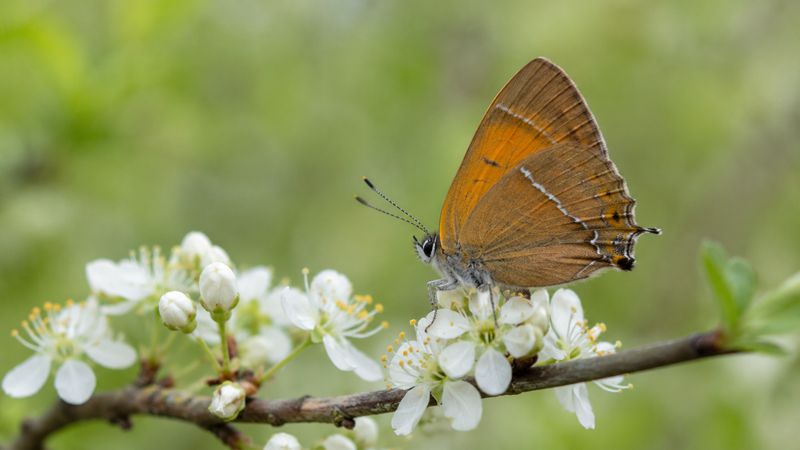
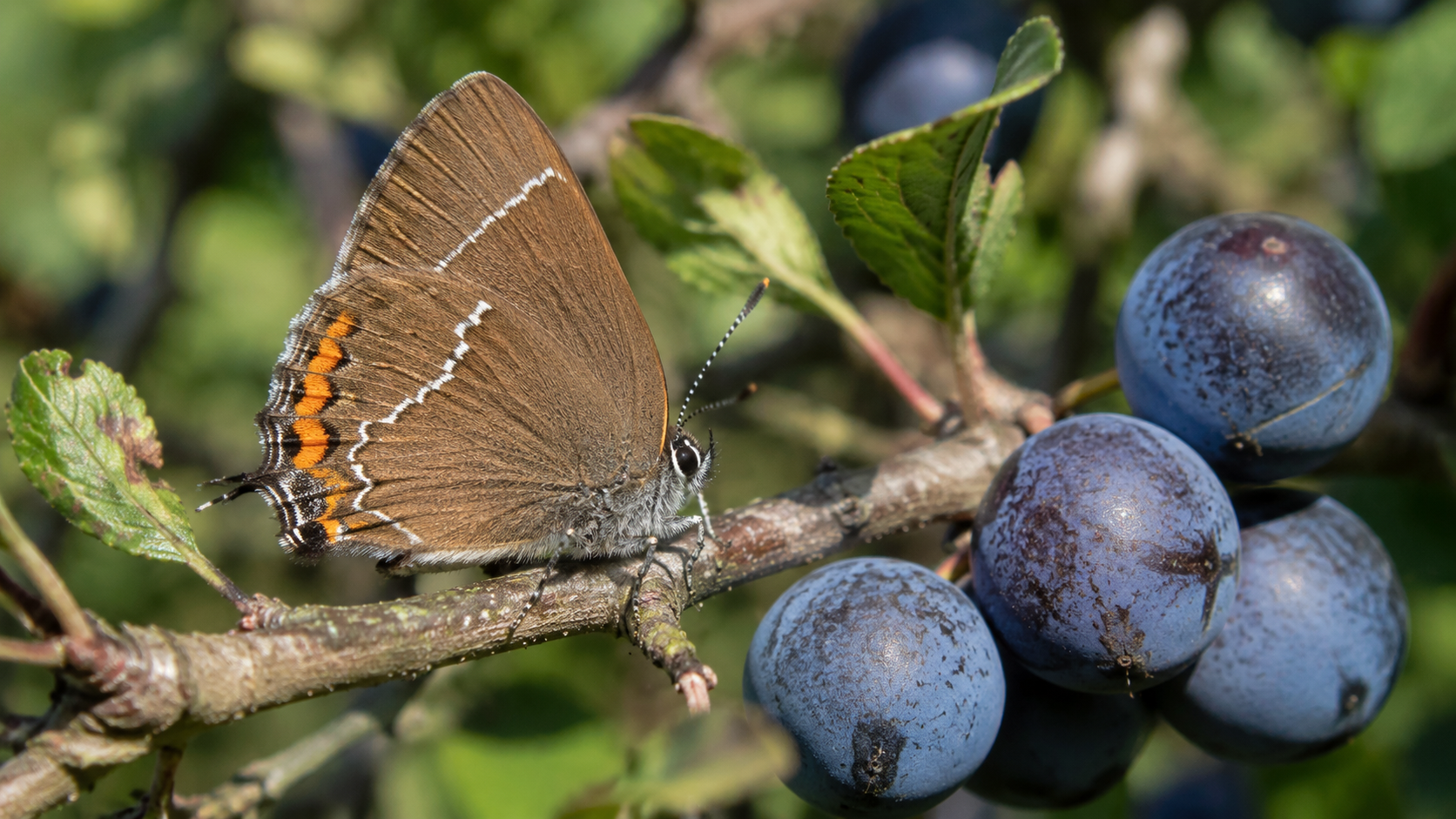
Underside: the diagnostic pattern. Ground colour is warm golden-brown. The distinguishing feature is a band of orange lunules running across the hindwing, bordered on the outer side by a row of black dots with white pupils (the "black" spots that give the species its English name). A fine white hairstreak line runs parallel to the outer margin of both wings. The forewing underside has a similar but less pronounced row of spots.
The underside is immediately distinguishable from all other European hairstreaks by the combination of orange lunule band and black-and-white spot row. The closely related Brown Hairstreak (Thecla betulae) lacks the orange band and has plain warm-ochre undersides with only two white hairstreak lines.
Hindwing tails: one short tail at the tornus, orange at the base.
Lifecycle
Egg
Eggs are laid in August — before the adults of the previous generation have died — on blackthorn twigs, typically on two- to three-year-old wood in sheltered, sunny positions within the scrub interior. Unlike the Brown Hairstreak, which prefers the outermost young growth, Black Hairstreak eggs are placed on older, established growth within the body of the scrub.
The egg is small, discoid, white-grey, similar in form to other hairstreak eggs but usually placed in less accessible positions. Eggs overwinter, hatching in April when blackthorn buds break.
Caterpillar
The caterpillar is bright green with yellow diagonal side stripes — extremely cryptic against young blackthorn leaves. It feeds on the young leaves and flower buds from April to June. Caterpillars of Satyrium pruni are attended by ants (Lasius and Myrmica species), which harvest secretions from the dorsal nectary organ; in return the ants may provide some protection from parasitoids.
Pupa
The pupa is formed low in the scrub, occasionally on the ground. It is brown, mottled, and resembles a piece of bark or old wood — well-camouflaged where it rests in leaf litter or on rough bark.
Adult
Adults emerge in late May to early June and fly for approximately three weeks — one of the shortest adult flight seasons of any European butterfly. Peak flight is typically in the second and third weeks of June in most of Europe.
Adults feed primarily on aphid honeydew in the canopy — an energy-rich resource that does not require descending to ground level. They will also take nectar from privet (Ligustrum vulgare), bramble (Rubus fruticosus), and wild roses when these are available at the scrub edge. Visits to flowers at low level are the most reliable opportunities for observation.
Males are territorial, establishing perches on sunny blackthorn and ash near the top of the scrub, from which they chase rivals and intercept females. Mating takes place in the canopy; females then search for suitable oviposition sites on older blackthorn growth.
Distribution and habitat
The Black Hairstreak ranges from England in the west through central and eastern Europe — France, Germany, Switzerland, Austria, Poland, Czech Republic, Hungary, Romania — across temperate Asia to Japan. It is absent from the Iberian Peninsula, most of the Mediterranean coast, Scandinavia, and the British Isles outside the East Midlands.
In Britain, the species has one of the most restricted ranges of any butterfly: a roughly 30 × 30 km area centred on the Oxfordshire-Buckinghamshire-Northamptonshire borders. Bernwood Forest (Oxford Wildlife Trust / Forestry England) and Whitecross Green Wood (Berks, Bucks and Oxon Wildlife Trust) are the most accessible and reliable sites. A handful of private woodland sites complete the British range.
Across continental Europe the species is more widespread but never abundant. It favours:
- Ancient woodland edges with established blackthorn thickets
- Scrubby limestone grassland with old sloe bushes
- Old hedgerows retaining tall, multi-stemmed blackthorn
- Coppice woodland rides where blackthorn has been allowed to age
Conservation
The Black Hairstreak's restricted range in Britain and its dependence on old blackthorn make it vulnerable to habitat change. Key threats:
Loss of old blackthorn: modern woodland management often removes or coppices blackthorn; agricultural improvement clears old hedgerows. The species requires blackthorn that has been left uncut for at least 15–20 years to develop the structural characteristics it needs.
Scrub succession: paradoxically, complete cessation of management also threatens the species — if blackthorn scrub is left entirely unmanaged, it is eventually overtopped by ash and other shade-tolerant trees, reducing the sunny conditions that adults and caterpillars require.
Isolation: British colonies are highly isolated; natural recolonisation of suitable habitat is effectively impossible. This makes each existing colony irreplaceable.
Conservation management at known sites focuses on:
- Leaving core blackthorn stands uncut while managing adjacent areas to maintain sunny conditions
- Creating and maintaining rides that provide edge habitat with flowering privet and bramble
- Monitoring egg counts annually to track population trends
In continental Europe the species benefits from less intensive woodland management and is less precarious, though it has declined in some western European countries with changing agricultural practices.
Interesting facts
- The Black Hairstreak's English name is slightly misleading: the "black" refers to the black-spotted underside pattern, not to the general wing colour; the wings are dark brown, not black — and the underside is warm golden-brown
- In continental Europe the species is sometimes called the Sloe Hairstreak or Plum Hairstreak, names that more accurately reflect its host plant association
- Adults at Bernwood Forest are reliably seen feeding at privet flowers in late June, making this one of the few British butterfly sites where a species can be observed predictably at low level despite its general reclusive canopy behaviour
- The Black Hairstreak has been proposed as an indicator species for ancient woodland continuity in central Europe: its presence at a woodland site is considered good evidence that the site has maintained its woodland character over at least several decades, because the species does not recolonise recently established scrub