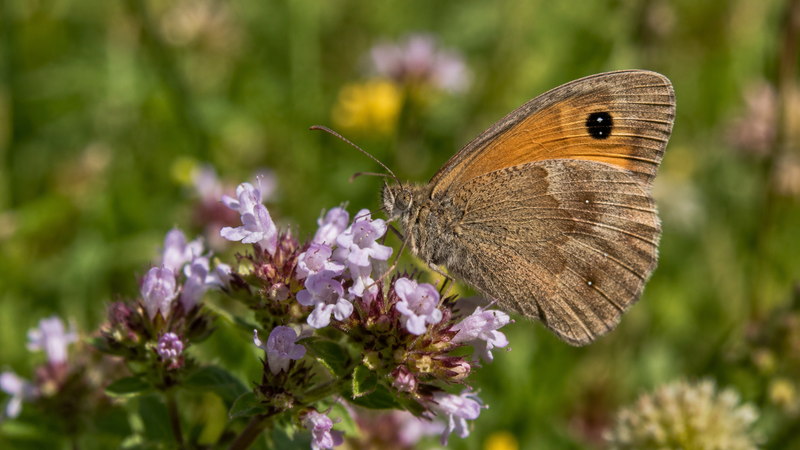
Small Copper
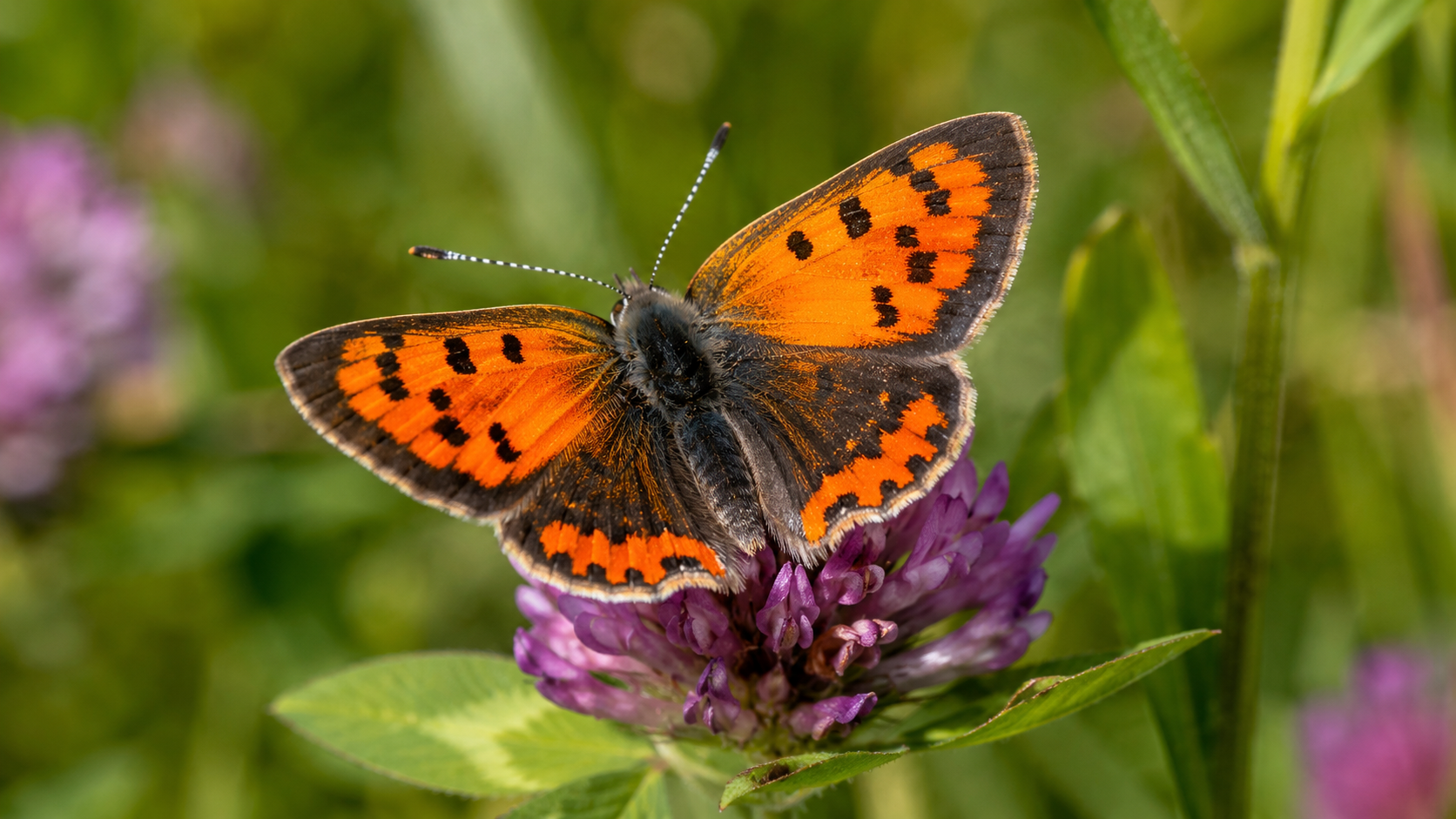
The small copper is one of Europe's most vivid small butterflies — fiery orange-copper forewings flash in sun across meadows and heathlands worldwide.
Key facts
- Latin name
- Lycaena phlaeas
- Family
- Lycaenidae
- Wingspan
- 26-36 mm
- Flight season
- April — October
- Host plants
- Common sorrel (Rumex acetosa), Sheep's sorrel (Rumex acetosella), Broad-leaved dock (Rumex obtusifolius)
- Conservation status
- LCLeast Concern
Appearance
The small copper (Lycaena phlaeas) is a small butterfly with a wingspan of 26–36 mm. Despite its size it is instantly recognisable: the upper surface of the forewings blazes fiery orange-copper with a row of dark brown spots and a dark outer border. The hindwings above are predominantly dark brown with an orange submarginal band.
The undersides are more subdued — pale grey-brown with small dark spots — providing camouflage when the butterfly rests with wings closed. In some individuals (form caeruleopunctata) the hindwing underside carries a row of small blue spots just inside the orange marginal band, which creates a striking effect in hand.
The intensity of the forewing copper colour varies with individual age, season, and the angle of light, but in fresh individuals the metallic sheen is remarkable for such a small insect.
Range and habitat
The small copper has one of the widest ranges of any European butterfly. It occurs throughout Europe and temperate Asia from Ireland to Japan, and in North Africa. It is also found across North America (as a separate subspecies hypophlaeas). In Russia it is common from Kaliningrad to the Pacific coast, from the steppe zone north to the taiga edge.
Preferred habitats are open and semi-open areas: meadows, heathlands, road verges, field margins, railway embankments, dry grassland, woodland clearings, and rough ground. It is characteristic of any disturbed or lightly grazed land where sorrels and docks grow abundantly. It is one of the few lycaenids that regularly colonises urban brownfield sites.
Behaviour and territorial habits
The small copper is notoriously aggressive for its size. Males select a prominent perching spot — a flower head, a bare patch of earth, or a low twig — and make rapid sallies to intercept any passing insect, including bumblebees and large butterflies several times their own size. After each sortie they return to the same perch.
This territorial behaviour is most marked on sunny days. On overcast days or in the morning the butterfly basks on low vegetation with wings spread flat, angled towards the sun to maximise heat absorption.
Flight season
Across most of Europe adults fly in two to three broods: April–June (first brood), July–August (second brood), and September–October in warm years (partial third brood). In the British Isles and Scandinavia two broods are typical. In Russia's southern regions up to three broods occur; in Siberia usually only one brood (July–August).
Reproduction
The female lays single eggs on the upper or lower surface of sorrel or dock leaves, preferring younger leaves on sunny, sheltered plants. The caterpillar is small and flattened, bright green with a faint pink dorsal stripe — almost invisible on the leaf. It feeds on the leaf tissue leaving the upper epidermis intact, producing characteristic "windowed" patches visible against the light.
Pupation occurs in leaf litter or on low plant stems. The pupa overwinters in at least some regions; in warmer parts of the range it is the egg or young caterpillar that overwinters.
Similar species
The small copper can be confused with:
- Purple-edged copper (Lycaena hippothoe) — larger, male has purple gloss on forewings; females have more orange; wet meadows.
- Scarce copper (Lycaena virgaureae) — male almost entirely orange above with minimal spotting; female brown with orange; slightly larger.
- Sooty copper (Lycaena tityrus) — darker, less vivid; male blackish-brown above; female pale with orange spots.
In all cases the small copper's combination of vivid fiery orange forewings, clear dark spots, and small size is distinctive.
Conservation status
The small copper is listed as Least Concern (LC) globally and is one of Europe's most abundant butterflies. It has benefited from brownfield regeneration in cities and road verge management that maintains rough grassland. However, intensification of agriculture — particularly the reseeding of traditional meadows with ryegrass monocultures that eliminate sorrel — has caused local declines in some intensively farmed areas of western Europe.
Interesting facts
- Despite its small size, the small copper was one of the first British butterflies to be recorded using GPS tracking; males were found to defend territories of only 20–30 m² for days at a time.
- The blue-spotted form caeruleopunctata appears in most populations at low frequency; in some Alpine populations it is the commonest form.
- In Japan the small copper (Lycaena phlaeas daimio) is the most frequently illustrated butterfly in ukiyo-e woodblock prints and textile patterns.