Meadow Brown
The meadow brown is the commonest butterfly in Britain and one of Europe's most abundant, with a distinctive forewing eyespot.
Key facts
- Latin name
- Maniola jurtina
- Family
- Nymphalidae
- Wingspan
- 40-60 mm
- Flight season
- June — September
- Host plants
- Meadow grasses (Poa, Festuca, Brachypodium), False brome (Brachypodium sylvaticum), Annual meadow grass (Poa annua)
- Conservation status
- LCLeast Concern
Appearance
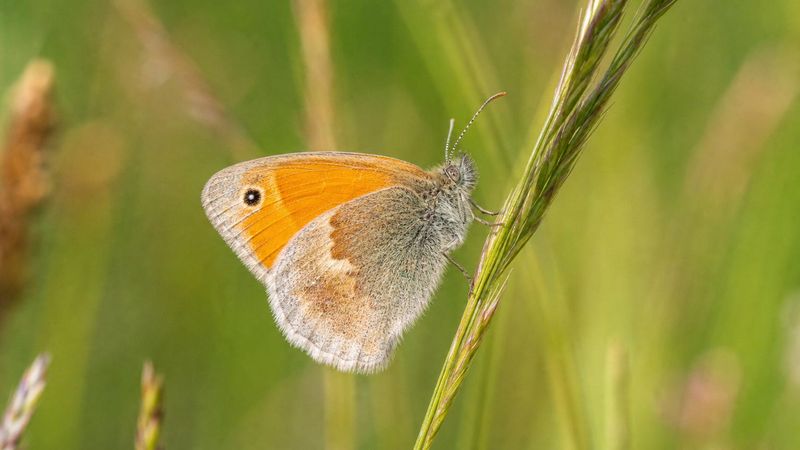
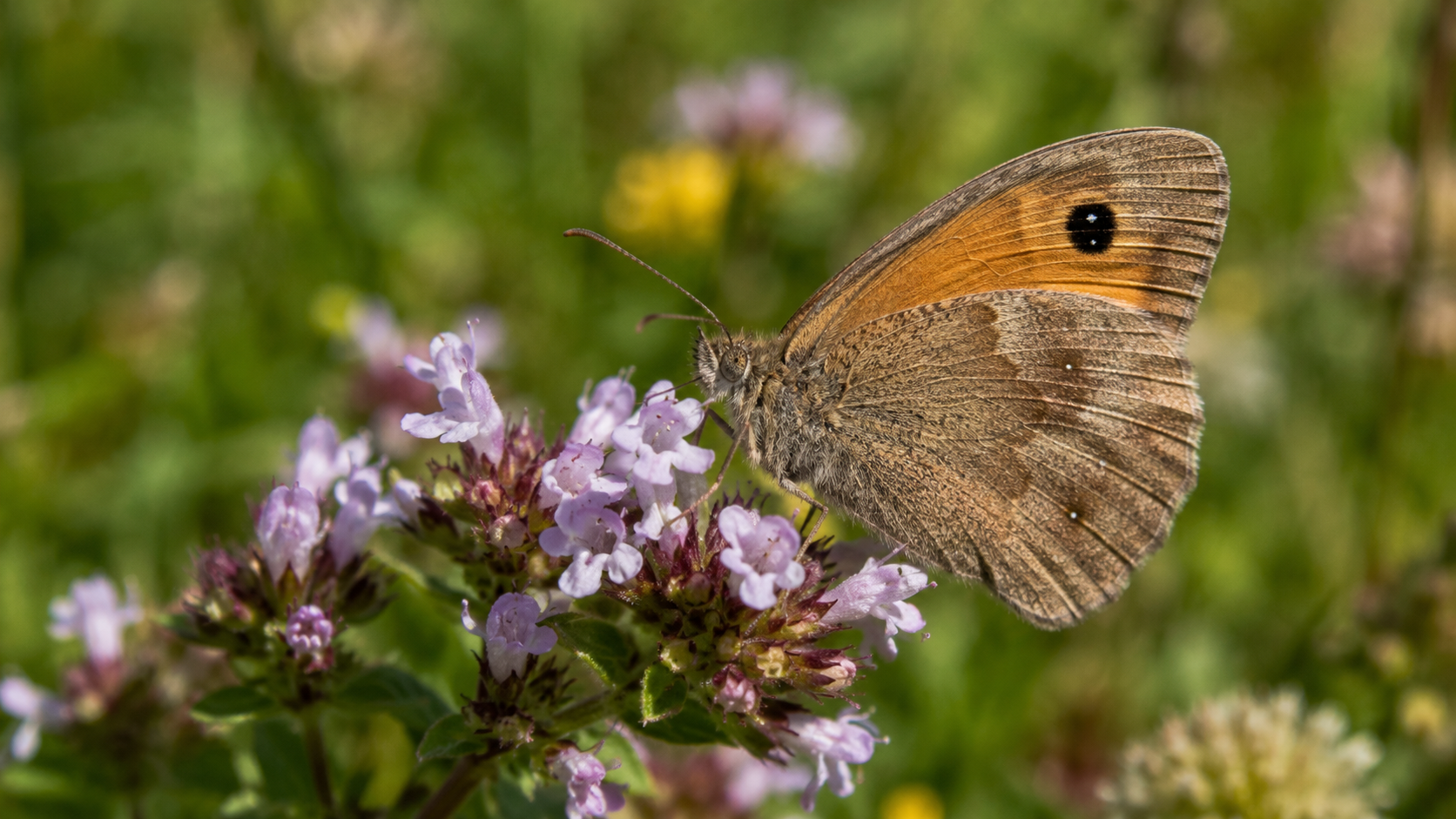
The meadow brown (Maniola jurtina) is a medium-sized butterfly with a wingspan of 40–60 mm, classified in the subfamily Satyrinae (browns). Its colour is predominantly warm brown, and the key identification feature is the black eyespot with a white pupil on the forewing upper surface, sitting within or near an orange-yellow patch.
Sexual dimorphism is pronounced:
- Female — larger (50–60 mm); broad orange-yellow patch on the forewing surrounding the eyespot; sometimes a hint of orange on the hindwing.
- Male — smaller (40–50 mm); dark brown with a reduced or absent orange patch; a distinctive smudge of darker androconial scales (sex brands) across the forewing creates a subtle texture visible in hand.
The underside of the hindwing is pale greyish-brown with a slight marbling — excellent camouflage on dry grass stems when the butterfly rests with wings closed. The forewing underside repeats the eyespot pattern seen above.
Range and habitat
The meadow brown is distributed across the entire Palaearctic temperate zone from the Azores and Canary Islands to Central Asia. In Russia it is widespread in the European part from the Kola Peninsula south to the Caucasus; it is absent from Siberia east of the Urals.
Preferred habitats are all types of unimproved grassland: traditional hay meadows, roadside verges, railway embankments, woodland rides and clearings, chalk downland, cliff tops, and rough field margins. It avoids very short-grazed turf (where grass tussocks are absent) and dense forest interior. One or two metres of tall, tussocky grass is all it requires.
The meadow brown is consistently the most numerous butterfly species at grassland survey sites across Britain and much of northern Europe.
Behaviour
Unlike many butterflies, the meadow brown remains active on overcast and relatively cool days — down to about 14–15°C — when other species are grounded. This is an adaptation to the cool, cloudy summers of northwest Europe and is one reason it is so often the only butterfly visible in overcast British or north German weather.
Males fly low over grass in a characteristic lazy, slightly bouncing flight, searching for females and investigating any moving insect. On sunny days they bask on flower heads — particularly knapweed, marjoram, bramble, and ragwort. Females are more secretive and spend more time among grass stems.
The species is not territorial in the way that some small coppers or browns are; males fly widely through suitable habitat rather than defending fixed perches.
Flight season
The meadow brown has a single brood per year with a long, staggered adult season: late June to early September in most of Britain and northern Europe, with a peak in July. In southern Europe and the Mediterranean the season extends from May to October and there may be a partial second brood.
In Russia the main flight period is June–August across most of the range.
Reproduction
The female lays single eggs loosely among grass stems or even drops them in flight onto suitable vegetation — an unusual behaviour that effectively broadcasts eggs across a wider area. The caterpillar hatches in late summer, feeds on various fine grasses through the autumn, and overwinters in a semi-dormant state among grass roots. It resumes feeding in early spring and pupates in April–May, low among grass stems.
The caterpillar is green with white longitudinal stripes and a forked tail tip — the typical satyrid larval form. It is nocturnal, feeding at night and resting at the base of grass tussocks by day.
Similar species
Several European browns can be confused with the meadow brown:
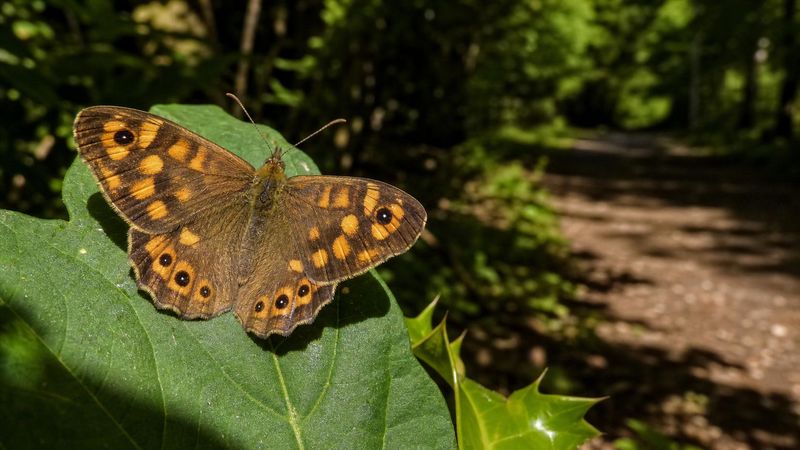
- Gatekeeper (Pyronia tithonus) — smaller; brighter orange forewing patch; hindwing has multiple small eyespots below; woodland edges.
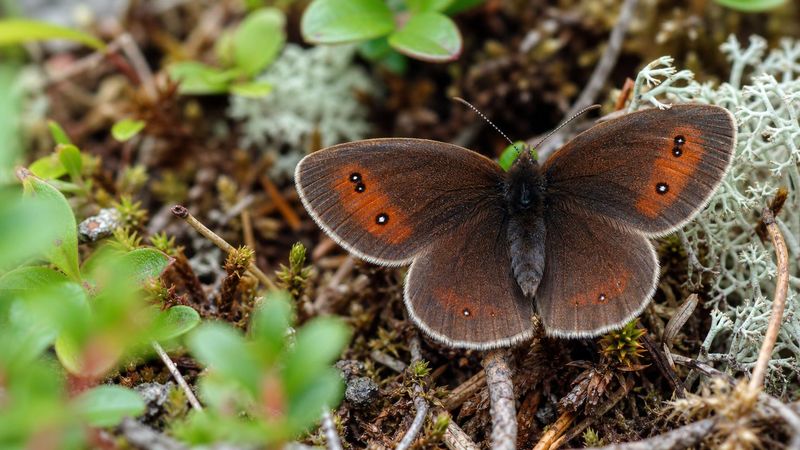
- Ringlet (Aphantopus hyperantus) — uniformly dark brown; multiple cream-ringed eyespots on both wing surfaces; no orange patch; very similar flight habitat.
- Small Heath (Coenonympha pamphilus) — much smaller; no eyespot on upper surface; always rests with wings closed.
- Dusky Meadow Brown (Hyponephele lycaon) — smaller, paler; male has two sex brands; drier, stonier habitats; more continental distribution.
Distribution in Russia
In Russia the meadow brown is a common and widespread species in the European part, found from the Kola Peninsula (Murmansk region) south through the Central Russian Upland to the Caucasus. It is particularly abundant in the forest-steppe zone where traditional meadow-farming landscapes persist. It is absent from the Urals and does not occur in Siberia.
At the northern edge of its range in Russia the flight season is compressed into July–August, and the single brood is smaller and darker than populations further south.
Conservation status
The meadow brown is Least Concern (LC) globally and is not threatened at the species level. However, it has declined in some western European countries due to agricultural intensification: the ploughing and reseeding of unimproved meadows with grass monocultures removes the structural diversity that the species needs. Conservation measures targeting unimproved grassland — delayed hay cutting (after late July), maintenance of rough field margins, and reduced pesticide use — directly benefit meadow brown populations.
Interesting facts
- The meadow brown is the subject of one of the longest-running butterfly population genetics studies: ongoing since 1950, examining geographic variation in wing spot patterns across Britain.
- Females can store sperm for several weeks and may mate only once; males, however, attempt to mate with any female they encounter regardless of mating history.
- The Russian common name "воловий глаз" (literally "ox eye") refers to the prominent circular eyespot on the forewing — the same morphological feature that gives the species its Bulgarian, Czech, and Slovak folk names.