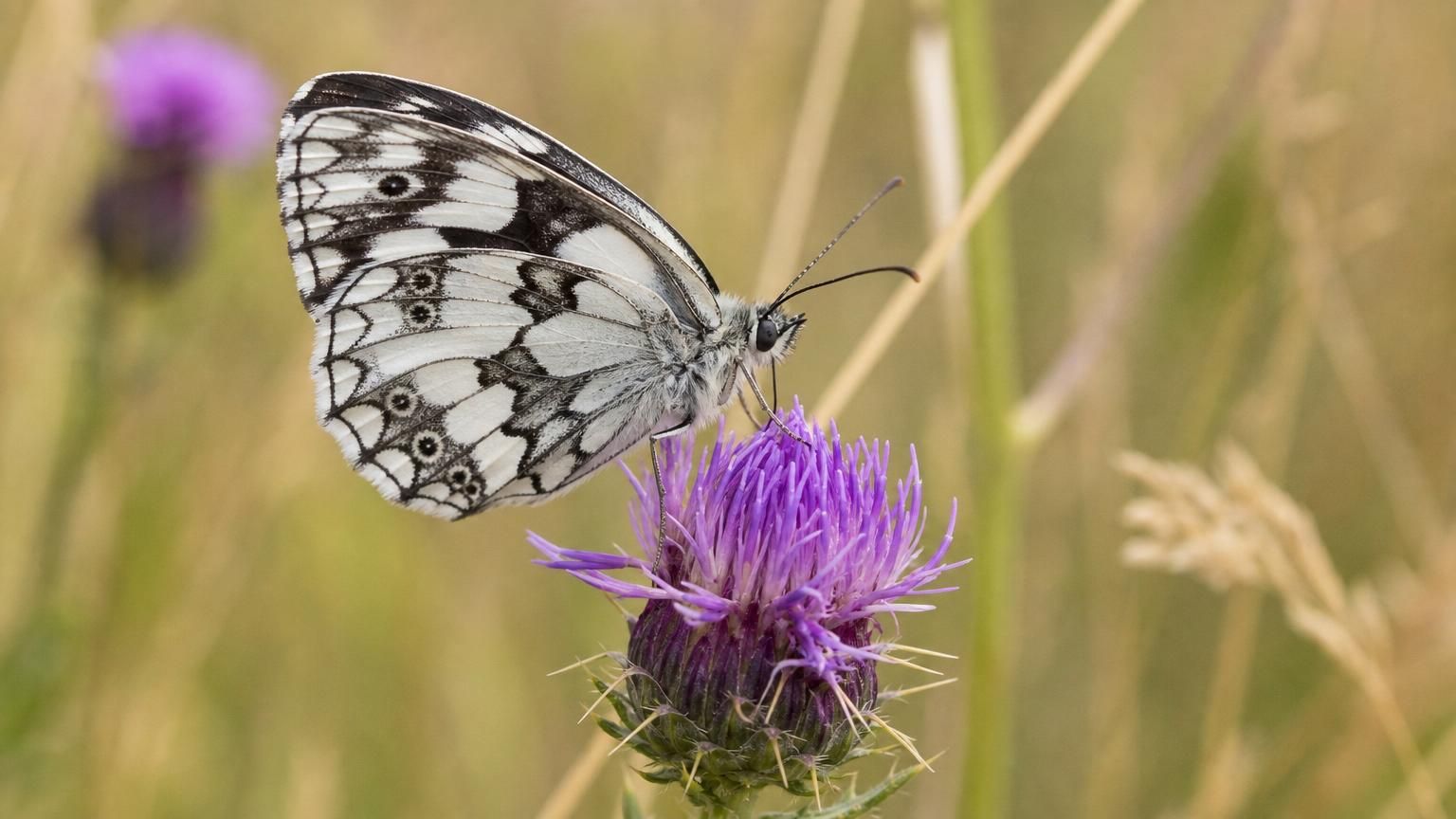
Marbled White
The marbled white is a large black-and-white butterfly. Its bold contrast makes it one of Europe's most recognizable species.
Key facts
- Latin name
- Melanargia galathea
- Family
- Nymphalidae
- Wingspan
- 46-56 mm
- Flight season
- June — August
- Host plants
- Meadow fescue, Timothy, Meadow grass, Cock's-foot
- Conservation status
- LCLeast Concern
Appearance
The marbled white (Melanargia galathea) is a large butterfly with a wingspan of 46–56 mm. The upper side is white with a bold black mosaic — one of the most recognizable and atypical satyrids. The underside of the hindwings is pale gray with a dark pattern and a row of small eyespots.
Females are slightly paler than males; pattern is stable in both sexes.
Range and habitat
Found in Europe and Western Asia. In Russia in the steppe and forest-steppe of the European part.
It inhabits chalk and limestone meadows, dry rough ground, and glades. Closely linked to grass diversity — host plants of caterpillars.
Life cycle
One generation per year. Flight June–August.
Eggs are scattered in flight over grassland — the female does not glue them to plants. The caterpillar hatches in autumn and overwinters small without feeding. It resumes feeding on grasses in spring. Pupa on the ground.
Meadow pollinator
The marbled white visits flowers actively, especially thistles, burnet, sheep's-bit, and clover. In good habitat its numbers contribute significantly to pollination of meadow plants.
The genus name Melanargia means "black-and-white" — an exact description of its coloration.