Brown Hairstreak
The Brown Hairstreak is one of Europe's most secretive butterflies, living high in tree canopies. Its eggs on blackthorn twigs reveal it in winter.
Key facts
- Latin name
- Thecla betulae
- Family
- Lycaenidae
- Wingspan
- 35-42 mm
- Flight season
- Late July – September
- Host plants
- Prunus spinosa (Blackthorn), Prunus domestica (Plum), Prunus avium (Wild Cherry), Prunus padus (Bird Cherry), Betula spp. (Birch, rarely)
- Conservation status
- LCLeast Concern
The canopy's secret
Of Europe's lycaenid butterflies, the Brown Hairstreak (Thecla betulae) is one of the most difficult to observe as an adult. Unlike most butterflies that spend their time at or near ground level, adult Brown Hairstreaks are primarily canopy insects — they bask, feed on aphid honeydew, and mate high in the crowns of ash, oak, and sycamore trees, rarely descending to eye level. A colony can go undetected for years in suitable habitat simply because observers do not look upward.
The species is most reliably detected not as a living adult but as a tiny white egg on a blackthorn twig in midwinter — an approach that has transformed our understanding of its distribution in many European countries.
Appearance
The Brown Hairstreak is the largest and most robustly built of the European hairstreaks, with a wingspan of 35–42 mm.
Upperside (males): uniform dark brown with a narrow orange bar near the tornus (rear corner) of the hindwing. The upperside is rarely seen in the field as the butterfly typically rests with wings closed.
Upperside (females): similar dark brown, but with a large, well-defined orange patch on the forewing — making females the more striking sex when they do open their wings. This orange patch is diagnostic and visible from a distance.
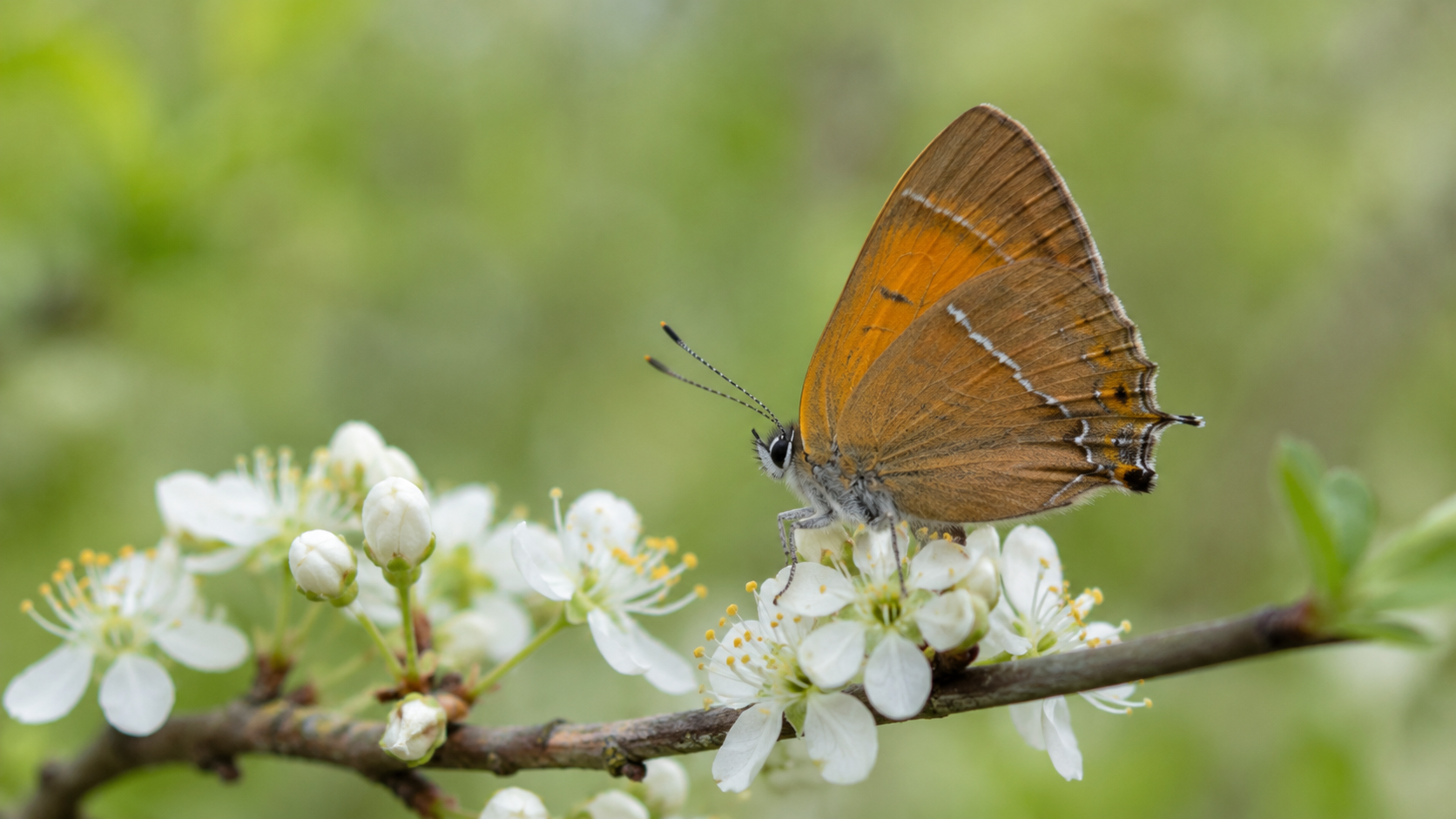
Underside (both sexes): warm golden-orange-brown with two white hairstreak lines, edged with black, running across both wings. A short hindwing tail, orange at the base, is visible at rest. The underside colouration gives the species its name.
In worn individuals the orange on the underside fades considerably. Fresh individuals, typically seen in July–August, are particularly striking with their warm ochre undersides.
Lifecycle
Egg and winter
The Brown Hairstreak has one of the most distinctive egg sites of any European butterfly. Eggs are laid in August and September on blackthorn (Prunus spinosa), placed singly at the base of buds on young growth — specifically the junction between one-year-old smooth bark and older rougher bark, and on the outer shoots of hedges and scrub where they receive sunlight.
The egg is flattened and discoid, white, with a textured surface of small pits and ridges. At about 1 mm across, it is visible to the naked eye against the dark twig. Eggs remain on the plant through the entire winter, hatching in April when blackthorn buds break.
Caterpillar and pupa
The caterpillar is cryptic green, matching the leaves of blackthorn; it feeds openly on the young leaves from April to June. Caterpillars of hairstreaks are typically attended by ants, and Thecla betulae caterpillars do associate with ants, though this relationship is less obligate than in some blue lycaenids.
The pupa is formed low down — sometimes on the ground among leaf litter at the base of the blackthorn — and is chocolate-brown, stocky, and difficult to find.
Adult
Adults emerge in late July and August, with the flight season extending into September. The adult lifespan is several weeks, but individual sightings are brief and infrequent because of the canopy habit.
Adults of both sexes feed at flowers: bramble (Rubus fruticosus) is the most used nectar source and is where most reliable adult sightings occur. They also feed on aphid honeydew in the canopy — a behaviour that keeps them out of sight for much of the day.
Males establish territories in tree canopies, spiralling up from a prominent perch to intercept passing females. The "master tree" — a tall ash or oak with a broad, sunlit crown — is a classic feature of Brown Hairstreak colonies; known master trees are visited by observers specifically to scan for spiralling males.
Mating and oviposition occur in late summer, after which all adults die; the species overwinters exclusively as an egg.
Distribution and habitat
The Brown Hairstreak ranges from western Ireland and the Iberian Peninsula east through Europe and temperate Asia to Japan. It is absent from Scotland, Scandinavia north of approximately 60°N, and most Mediterranean islands.
In Europe the species occurs where blackthorn hedges, scrub, or woodland edges exist within a landscape that also provides suitable canopy trees for adults. It is not a forest species per se — it needs the open scrub and hedgerow for breeding — but it uses the canopy of adjacent trees for adult activities.
Suitable habitats include:
- Traditional agricultural landscapes with unmanaged blackthorn hedges
- Scrubby woodland edges and rides with mature trees nearby
- Abandoned or lightly managed farmland reverting to scrub
- Railway embankments and road verges where blackthorn is established
Conservation
The Brown Hairstreak has declined substantially in western Europe. The principal cause is hedge management: flail-cutting of blackthorn hedges in autumn removes the outer growth — precisely the young shoots where eggs are laid — before the eggs hatch in April. Annual or biennial flail-mowing of a hedge eventually eliminates all eggs before caterpillars can emerge, extirpating local populations without any direct persecution.
Conservation measures that have proven effective:
- Delaying hedge-cutting until after April, allowing eggs to hatch
- Cutting hedges on a three-to-five-year rotation rather than annually, allowing young growth to develop and persist through the winter
- Retaining wide, tall hedges rather than reducing them to short, narrow strips
- Leaving uncut blackthorn at field margins and woodland edges
In Ireland, targeted conservation management — promoted through the Butterfly Conservation Ireland monitoring programme — has shown that relatively simple hedge management changes can measurably increase Brown Hairstreak egg counts within a few years.
In central and eastern Europe (Poland, Czech Republic, Hungary, Romania) the species is considerably more abundant, reflecting historically less intensive hedge management.
Interesting facts
- The Brown Hairstreak's scientific name betulae (from Betula, birch) is a misnomer — the species very rarely uses birch as a host plant; blackthorn is overwhelmingly the primary host. The name was assigned by Linnaeus based on early literature that cited birch, possibly from a misidentification of the host plant.
- Females are the more conspicuous sex when seen well — their large orange forewing patch makes them appear as a different species from the uniformly dark-brown males. In Ireland, the orange female is sometimes called the "Orange Hairstreak" in older literature, a source of historical confusion.
- The master tree phenomenon is so consistent that butterfly recorders in Britain maintain lists of known master trees and visit them specifically during the August–September peak, using binoculars to watch for spiralling males in the canopy — a technique borrowed from birdwatching
- Brown Hairstreak eggs survive remarkably harsh winter conditions: they have been recorded intact after prolonged frost and even after being submerged by flooding, traits that reflect adaptation to the unpredictable British winter climate