Clouded Apollo
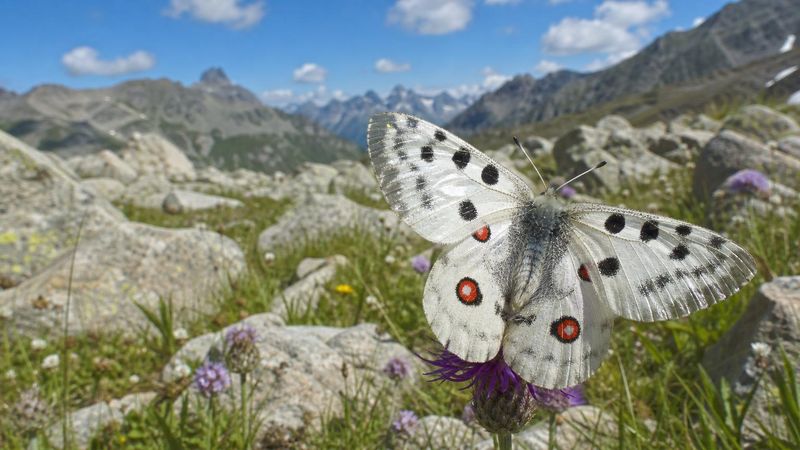
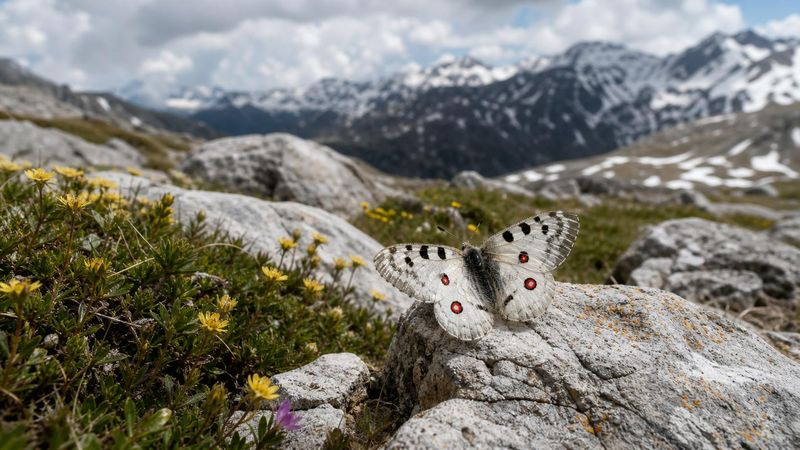
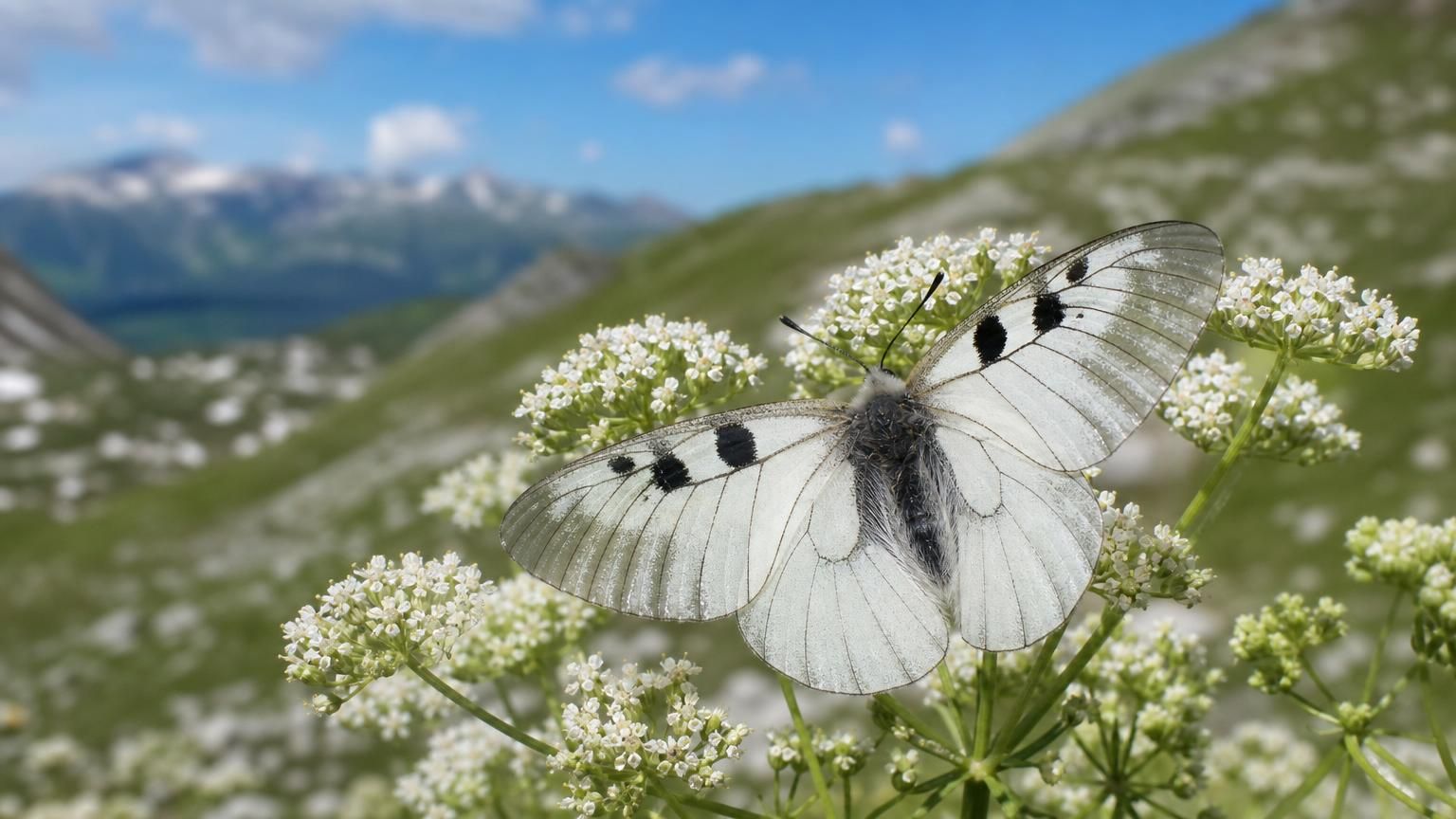
The clouded Apollo is a rare mountain butterfly with white semi-transparent wings and black spots. Listed in Red Data Books of many regions of Russia.
Key facts
- Latin name
- Parnassius mnemosyne
- Family
- Papilionidae
- Wingspan
- 46-62 mm
- Flight season
- May — July
- Host plants
- Hollowwort, Dense-flowered corydalis
- Conservation status
- NTNear Threatened
Appearance
The clouded Apollo (Parnassius mnemosyne) is a butterfly with a wingspan of 46–62 mm. Wings are white, semi-transparent, with several black spots. Unlike Apollo, there are no red "eyespots" — only black spots and a grayish smoky wing border.
The body is covered with pale hairs. Wings lack "tails." Females often have smokier wings; males are cleaner white.
Large transparent areas make the clouded Apollo one of the most "airy" butterflies in Europe.
Range and habitat
Found in Europe and Asia. In Russia in the European part, the Urals, Caucasus, and Siberia. Tied to broadleaved forest and mountain valleys with corydalis.
Typical habitat is shady ravines and beech forest with rich herb layer where corydalis flowers in April–May.
Life cycle
One generation per year. Flight May–July.
Eggs are laid in soil or leaf litter near corydalis. The caterpillar hatches in spring and is active only briefly — until corydalis wilts. Egg or young caterpillar overwinters. Pupa forms in a loose cocoon in litter.
Conservation
Not on the 2020 federal Red Data Book of Russia list; protected in regional Red Books, the Bern Convention, and the EU Habitats Directive. European IUCN status is NT (Near Threatened); there is no global assessment. Not listed on CITES. The main threat is logging of broadleaved forest with corydalis.