Butterflies of the Democratic Republic of Congo
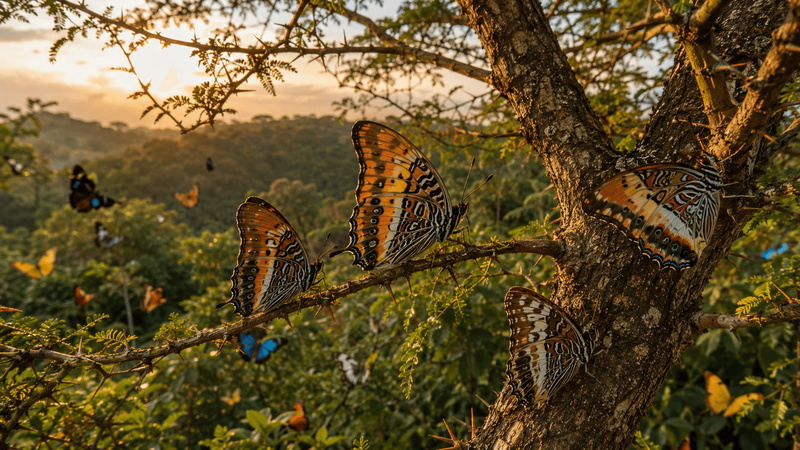
DR Congo may be Earth's most butterfly-rich country: 5,000+ species in the Congo Basin rainforest, with unique Charaxes, Cymothoe, and swallowtails.
Overview
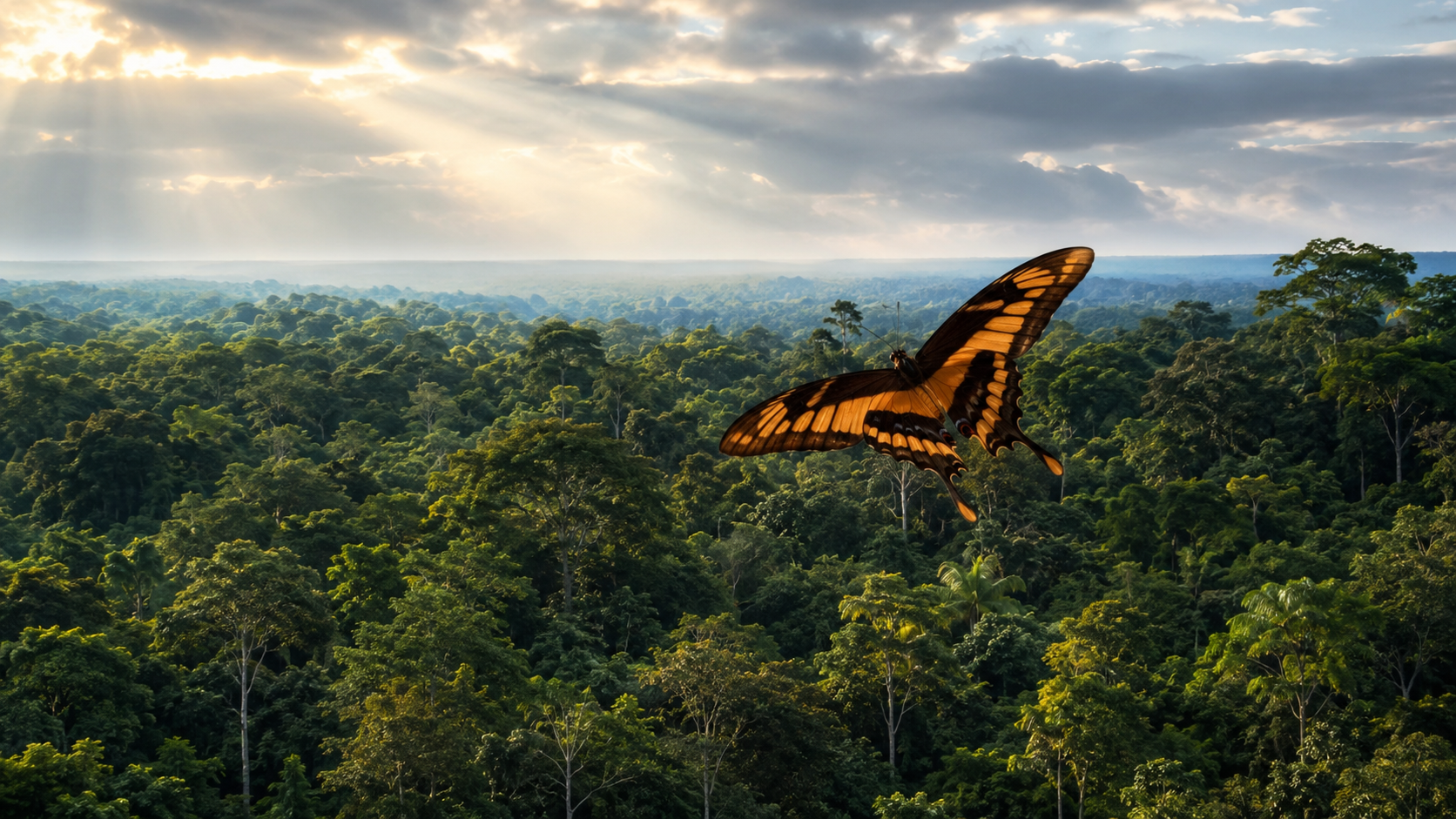
The Democratic Republic of Congo (DRC) is the largest country in sub-Saharan Africa and one of the most biologically extraordinary places on Earth. Its territory of 2.3 million km² is dominated by the Congo Basin — the world's second-largest tropical rainforest, covering approximately 60% of the country with a continuous canopy interrupted only by the Congo River and its vast network of tributaries.
For butterflies, the DRC represents what may be the single richest territory on the planet. Estimates of species richness exceed 5,000 — a number that exceeds the entire Palearctic fauna and rivals the most biodiverse areas of Amazonia. Much of this diversity remains undescribed or poorly documented; new species continue to be recognised from historical museum collections made in the colonial period and from the rare modern surveys that reach interior areas.
The Congo Basin — structure and diversity
The Congo Basin is not a uniform block of rainforest. It is a mosaic of:
- Lowland rainforest: the dominant cover, with a closed canopy at 30–40 m and dense understorey
- Flooded forest (igapó equivalent): seasonally or permanently flooded areas along river margins with a specialised aquatic-margin butterfly community
- Forest-savanna mosaic: extensive in the south and east, where forest gives way to the Miombo woodland of the Katanga plateau
- Afromontane forest: in the east, along the Albertine Rift escarpment, where altitude modifies the lowland fauna dramatically
Each of these habitat types has a distinct butterfly community, and their juxtaposition across millions of square kilometres produces diversity that accumulates rather than replaces.
Key taxa
Charaxes — the jewels of the Congo
The genus Charaxes (brush-footed nymphalids, subfamily Charaxinae) reaches its global maximum diversity in the Congo Basin and adjacent regions. Over 200 of the world's approximately 190–200 described Charaxes species occur in the DRC — the global figures are themselves driven by Congolese diversity. These large, fast-flying butterflies are among the most spectacular in Africa:
- Charaxes castor (giant charaxes) — one of the largest African butterflies, wingspan to 110 mm
- Charaxes zoolina and relatives — complex of forest species with brilliant underwing patterns
- Charaxes candiope — green-backed charaxes of forest margins
- Charaxes protoclea — vivid red-and-black species of western Congo
Many Congolese Charaxes are known from only a handful of specimens collected before 1960 and have not been relocated since.
Cymothoe — the "bleeding gliders"
Cymothoe is a genus of medium-sized forest nymphalids, predominantly red, orange, or white in the males, with cryptically patterned females. The DRC holds approximately 50–55 of the world's ~80 Cymothoe species — many endemic to the Congo Basin or to specific forest blocks within it. The brilliant scarlet-red males of species like C. sangaris (blood-red glider) and C. coccinata are among the most vivid butterflies in Africa.
Papilionidae — swallowtails and birdwings
The DRC's swallowtail fauna includes:
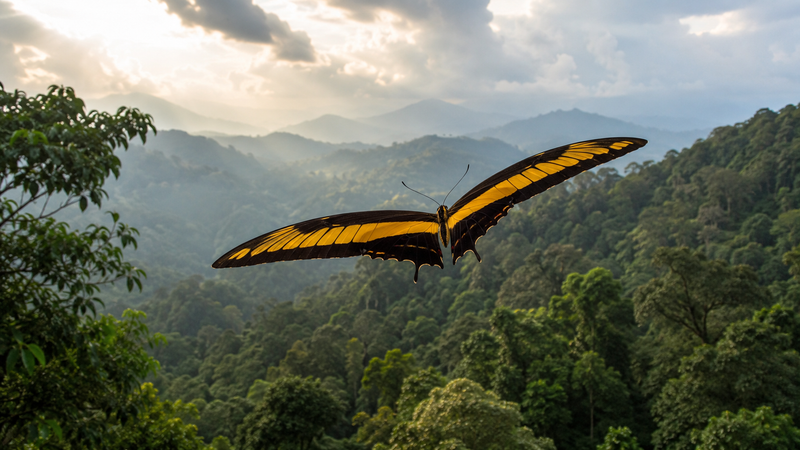
- Papilio antimachus (African giant swallowtail) — wingspan 230–250 mm, the largest butterfly in Africa; core range in the Congo Basin lowlands
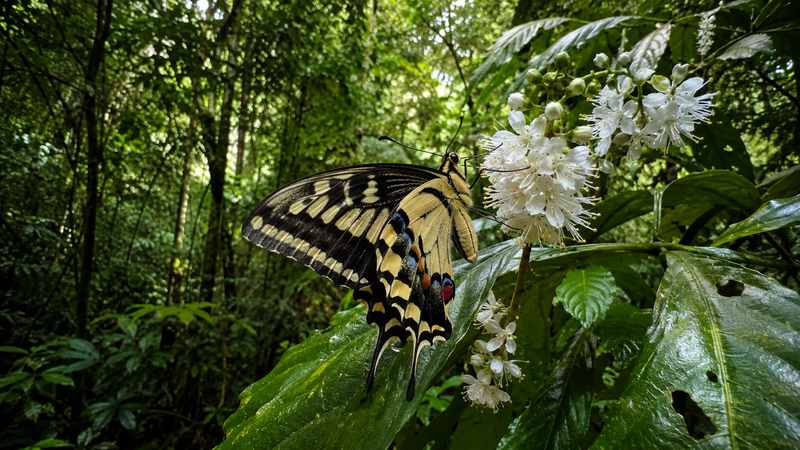
- Papilio zalmoxis (giant blue swallowtail) — enormous pale blue-grey swallowtail of lowland forest canopy; one of the world's most impressive Papilio
- Graphium species — multiple kite swallowtails of forest rides
Satyrinae and Acraeinae
The Congo Basin holds an endemic radiation of forest satyrs and acraeid nymphalids, many known only from the type locality and with biology almost entirely undocumented.
Regional highlights
Yangambi and the central Congo
The Yangambi Biosphere Reserve, on the Congo River east of Kisangani, was the site of intensive systematic collection from the 1930s to 1950s and remains the best-documented locality for Congo Basin butterflies. Its species lists — compiled by Belgian entomologists at the Institut National pour l'Étude Agronomique du Congo (INEAC) — provide the foundational knowledge of equatorial Congo butterfly diversity.
The Albertine Rift (eastern DRC)
The eastern border zone — Virunga, Kahuzi-Biega, and Maiko National Parks — adds the complete Albertine Rift montane fauna to the lowland Congo community. This is also the most biogeographically complex zone, where lowland Congo species, Albertine Rift endemics, and East African elements all overlap.
Katanga plateau (southern DRC)
The Miombo woodland plateau of Katanga has a drier, more open-country fauna distinct from the rainforest: Colotis and Teracolus orange-tips, Acraea fritillaries adapted to dry grassland, and the spectacular wanderer (Pareronia tritaea) migrating across the savanna in season.
Conservation and access
The DRC faces severe pressure on its forest resources: artisanal charcoal production is the principal driver of deforestation near major cities, while commercial logging concessions, agricultural expansion (particularly palm oil in the northwest), and artisanal gold and coltan mining in the east all reduce and fragment forest. Political instability in the east has prevented systematic conservation monitoring for decades.
The national park network — including Virunga (the oldest national park in Africa, founded 1925), Salonga (the largest tropical forest protected area in Africa), Garamba, and Kahuzi-Biega — is World Heritage-listed but severely under-resourced. Despite ongoing challenges, Virunga's ranger force has maintained a degree of protection in the most contested area of the continent.
For lepidoptery, the DRC remains one of the great frontiers — a country where any systematic survey of a previously unvisited area can be expected to produce new species records and almost certainly new species descriptions.