Butterflies of Uganda
Uganda records around 1,200 butterfly species — one of Africa's highest densities, home to species found nowhere else, including the world's largest.
Overview
Uganda is landlocked in East Africa, straddling the equator between the Eastern and Western Rift Valleys. To the west, the Albertine Rift — the chain of mountains and lakes that forms the border with the Democratic Republic of Congo — concentrates some of the most ancient and diverse forest habitats in the continent. To the east, savanna and acacia woodland extend toward the shores of Lake Victoria and the drier plains.
This combination of habitats, compressed into a country the size of the United Kingdom, produces a butterfly fauna of approximately 1,200 species — a density of diversity matched by almost nowhere else on Earth at this latitude. Uganda is recognised by the World Wildlife Fund as the most biodiverse country per unit area in Africa.
The Albertine Rift — Africa's butterfly heartland
The mountains along Uganda's western border — the Rwenzori, the Virunga volcanoes, and the escarpments above Lakes Edward, George, and Albert — form part of the Albertine Rift biodiversity hotspot, one of 36 global hotspots identified as irreplaceable for conservation.
The forests here survived the climatic oscillations of the Pleistocene as refugia when much of the surrounding landscape dried out. Species isolated in these refugia evolved in place over millions of years; the result is high endemism — at every taxonomic level, from subspecies to full species, the Albertine Rift has more unique forms than any other part of Africa.
Bwindi Impenetrable Forest
Bwindi, famous for its mountain gorillas, is Uganda's premier butterfly site. The forest is ancient, unlogged, and extraordinarily rich:
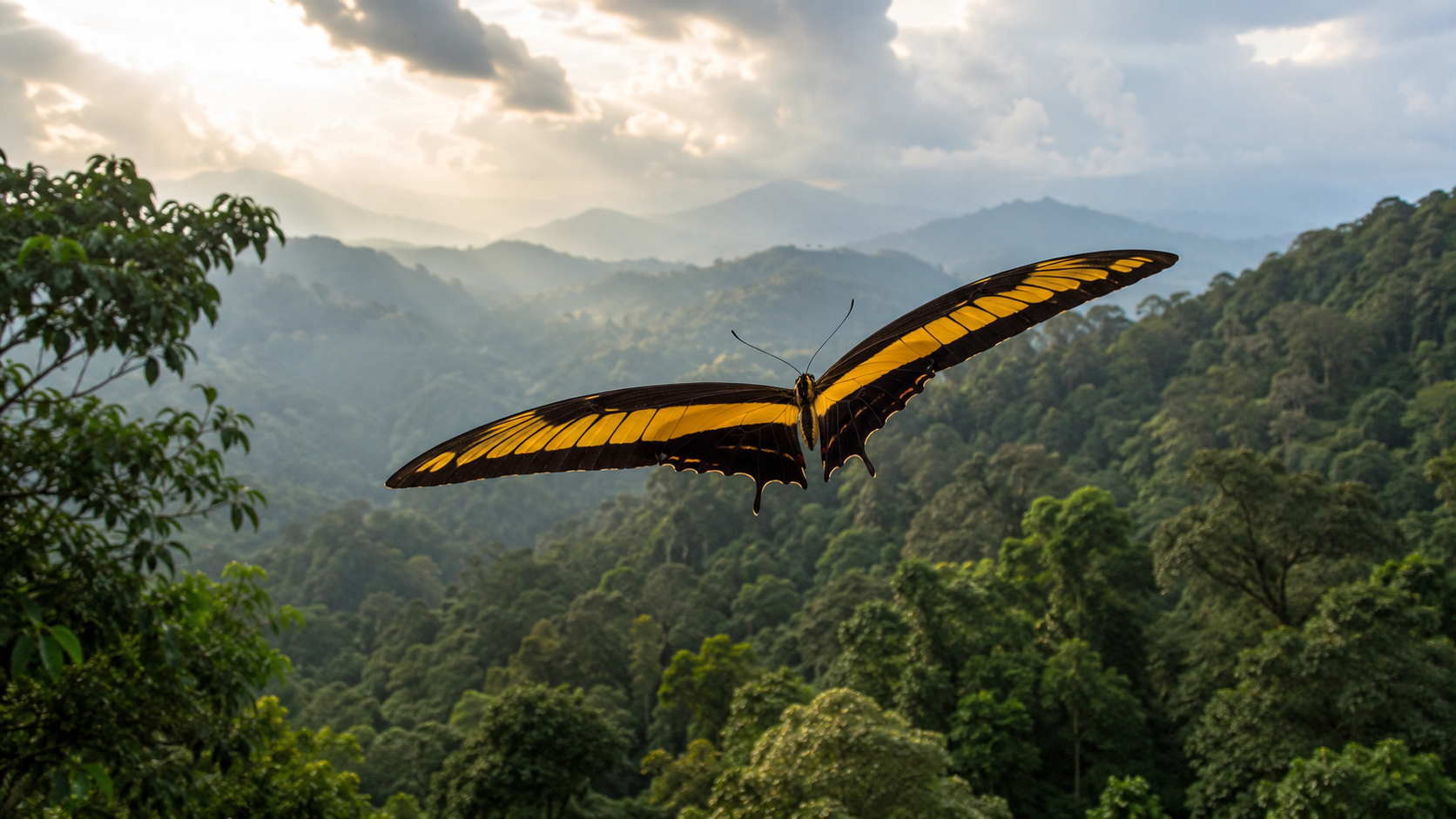
- African giant swallowtail (Papilio antimachus) — males patrolling high ridges; occasionally gliding down to muddy stream banks
- Mocker swallowtail (Papilio dardanus) — common at forest edges, females mimicking various distasteful species
- African blue tiger (Tirumala petiverana) — forest clearings and rides
- Multiple Charaxes species — Uganda holds over 60 of Africa's ~190 Charaxes, many concentrated in Bwindi
The higher elevations of Bwindi (up to 2,607 m) add montane forest species shared with the Virunga chain.
Kibale Forest National Park
Kibale's mid-altitude moist forest (1,110–1,590 m) holds an exceptionally accessible and well-studied butterfly community:
- African monarch (Danaus chrysippus) — forest margins and clearings
- Cymothoe species — bright red and orange nymphalids of the forest interior
- Forest queen (Euhaploea core) — dark forest glades
- Numerous small Lycaenidae endemic or near-endemic to the Albertine Rift
Rwenzori Mountains
The "Mountains of the Moon" rise to 5,109 m (Margherita Peak) and support a complete montane sequence from lowland forest to afroalpine tundra:
- Below 2,000 m: lowland forest species shared with Kibale and Bwindi
- 2,000–3,000 m: Afromontane forest with several endemic Papilio and Charaxes
- Above 3,000 m: heather and giant groundsel zone with specialised small lycaenids and skippers
Beyond the Rift — savanna and lake shore
Uganda's eastern and northern regions, dominated by savanna, acacia woodland, and the extensive wetlands around Lake Victoria, hold a different but complementary fauna:
- African map butterfly (Cyrestis camillus) — riverine forest edges
- Citrus swallowtail (Papilio demodocus) — ubiquitous in gardens and orchards
- Wanderer (Pareronia tritaea) — migratory pierid of open savanna
- African clouded yellow (Colias electo) — dry grassland
The Budongo Forest Reserve, northeast of Murchison Falls, is the most accessible large forest site in northern Uganda and provides a productive introduction to Ugandan forest butterflies.
Seasonality
| Period | Conditions and highlights |
|---|---|
| December–February | Dry season: peak activity at forest edges; giant swallowtail visible |
| March–May | Long rains: reduced activity but good for forest-interior species |
| June–August | Second dry season: another peak period; Rwenzori montane species |
| September–November | Short rains: lower activity; some migratory species arrive |
Conservation
Uganda's forests face pressure from an expanding agricultural frontier, charcoal production, and the demands of one of Africa's fastest-growing populations. Bwindi and Kibale are both national parks with strong protection and well-established tourist infrastructure (primarily for gorilla and chimpanzee tracking), which provides economic incentives for forest conservation. The Albertine Rift Conservation Programme coordinates research and protection across the national borders with DRC, Rwanda, and Burundi.
The main threat to butterfly diversity outside protected areas is the loss of forest-edge and riverine forest habitat to small-scale agriculture. Several endemic Albertine Rift species — particularly the smaller lycaenids and skippers — are known from only a handful of forest patches and are acutely vulnerable to habitat reduction.