Death's-head Hawkmoth
The death's-head hawkmoth is a dramatic sphingid with a skull-like thorax pattern, powerful flight, and a squeak when disturbed — a regular migrant to Europe.
Key facts
- Latin name
- Acherontia atropos
- Family
- Sphingidae
- Wingspan
- 90-130 mm
- Flight season
- June — October (migrant); year-round in the south
- Host plants
- Potato (Solanum tuberosum), Deadly nightshade (Atropa belladonna), Lilac (Syringa vulgaris), Privet (Ligustrum spp.), Ash (Fraxinus spp.), Jerusalem cherry (Solanum pseudocapsicum)
- Conservation status
- LCLeast Concern
The moth with a skull on its chest
Among European Lepidoptera, few species provoke as strong a reaction as the death's-head hawkmoth (Acherontia atropos). The pale marking on the dark thorax — shaped unmistakably like a human skull — has made it a symbol of superstition, horror fiction, and natural-history fascination for centuries. Add a wingspan of up to 13 cm, powerful hovering flight, and an ability to squeak when handled, and the species occupies a unique place in the public imagination.
Despite its ominous reputation, A. atropos is a harmless insect. It does not sting, does not bite humans, and plays a normal ecological role as a pollinator and prey item. Its notoriety is almost entirely visual and cultural.
Appearance and identification
Adult
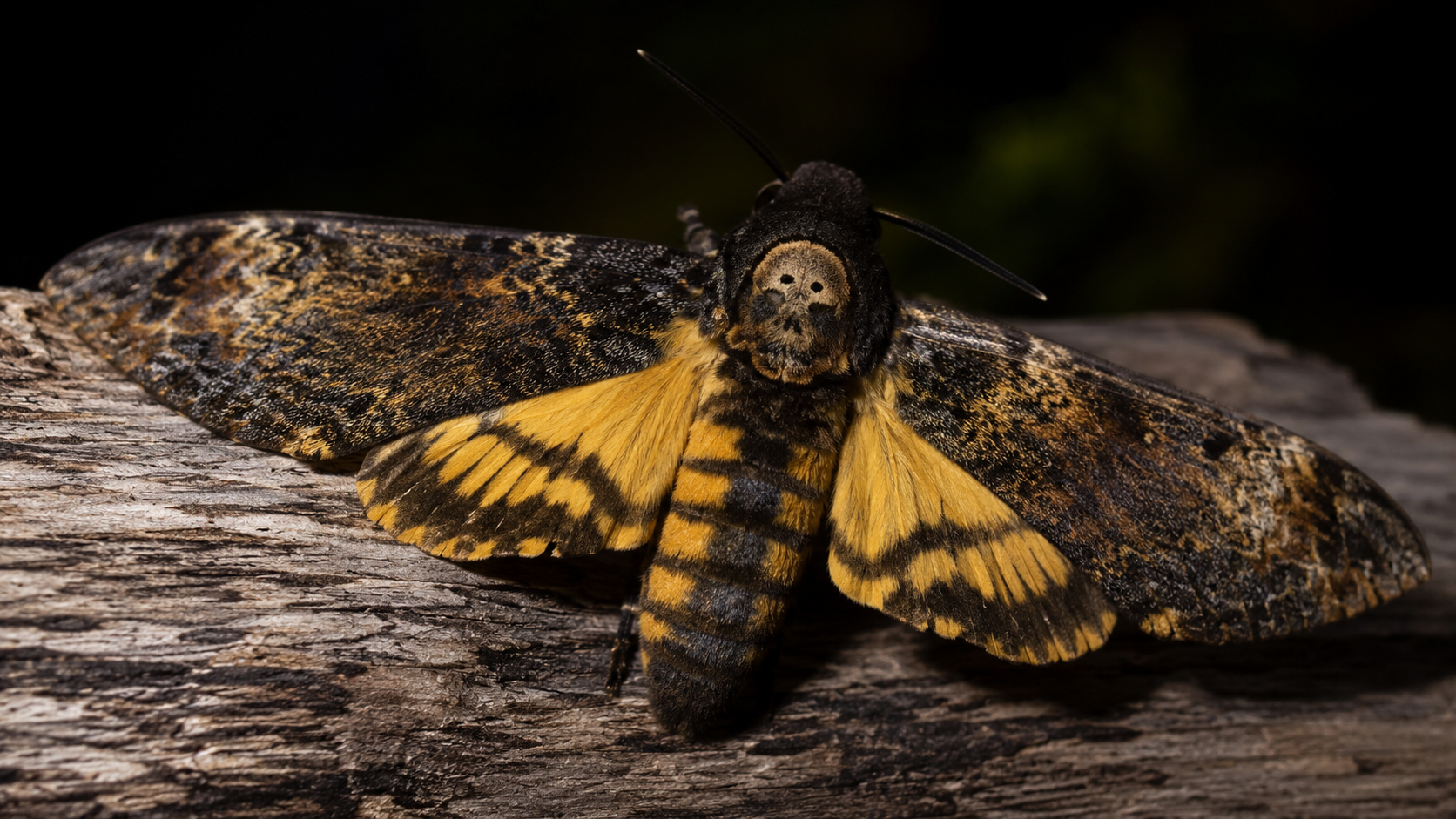
Wingspan 90–130 mm — among the largest moths regularly seen in Europe. Forewings are yellow-brown to dark brown with wavy transverse lines and a pale median band. Hindwings are yellow-orange with a broad black border and a blue eyespot at the anal angle.
The skull marking sits on the dorsal thorax between the wing bases: a pale patch with dark “eye sockets” and “nasal cavity” on a black or dark brown background. The pattern is visible when the moth rests with wings folded in the typical hawkmoth posture — roof-like over the body.
Antennae are club-tipped in females and slightly thicker in males. The body is stout and furry, yellow-brown below.
Caterpillar
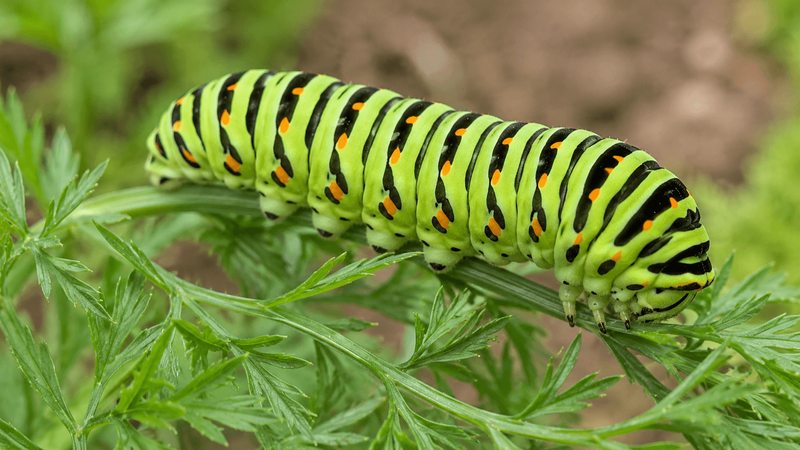
One of the largest caterpillars in Europe — up to 120 mm at the final instar. Colour varies from yellow-green to brown with oblique violet or blue-white lateral stripes and a dark hooked horn on the eighth abdominal segment. A row of small white dots runs along each side.
The larva feeds openly on host-plant leaves and is often found on potato, nightshade, lilac, and privet in gardens and farmland.
Distribution and migration
Acherontia atropos is native to Africa, the Mediterranean, the Middle East, and warm parts of Asia. It is resident and breeds year-round in climates without frost.
Each summer, adults migrate north into central and northern Europe and western Russia. Migration intensity depends on weather: warm, dry summers with southerly winds produce the largest influxes. In Russia, records extend from the North Caucasus and Krasnodar Krai northward; exceptional individuals reach the Baltic region and beyond.
The species does not overwinter in temperate latitudes. All northern populations die with the first frosts; the next year's moths arrive again from the south.
Lifecycle
Eggs and larvae
Females lay single green eggs on the underside of host-plant leaves, preferring Solanaceae (potato, nightshade) but also using Oleaceae (lilac, privet, ash). In the Mediterranean, development is continuous; in migrant populations, eggs laid in June–July produce caterpillars that pupate in late summer.
The caterpillar passes through five instars over three to four weeks. Before pupation it turns brown, wanders away from the food plant, and burrows into loose soil to form a smooth, dark brown pupa.
Pupa and adult
The pupal stage lasts two to three weeks in summer warmth, or several months if overwintering in the south. Adults emerge at night, expand the wings, and fly strongly — often attracted to light.
In resident southern populations, two or more generations per year are possible. In migrant zones, usually one generation from summer arrivals.
Behaviour
Flight and feeding
The death's-head hawkmoth is a powerful, fast flier — among the fastest Lepidoptera, capable of sustained flight over long distances during migration. Like other sphingids, it can hover in front of flowers while extending its long proboscis to drink nectar.
Unusually for a hawkmoth, adults also enter beehives to steal honey. They are covered in a chemical that reduces bee aggression, allowing them to feed inside the colony. This behaviour — documented since antiquity — contributed to the species' sinister reputation among beekeepers.
The squeak
When alarmed, the moth forces air through its proboscis, producing a sharp squeak or click. The sound is audible to humans at close range and may deter birds or mammals. Caterpillars produce a similar defensive click with their mandibles.
Attraction to light
Migrants are strongly attracted to artificial light — street lamps, windows, and UV traps. Many records from northern latitudes come from moths found at lighted buildings in late summer evenings.
Cultural history
The death's-head hawkmoth appears in European folklore as an omen of death or misfortune — partly because of the skull marking, partly because of its habit of appearing suddenly at night and entering homes.
It gained modern fame through popular culture: the species appears on the poster of the film The Silence of the Lambs (though the prop moth was altered for dramatic effect), and it is referenced in works by Thomas Hardy, Edgar Allan Poe, and others. Entomologists often note that the moth's actual biology — a harmless migrant pollinator — is far less sinister than its legend.
Conservation
Globally, Acherontia atropos is Least Concern (IUCN). It remains widespread and common in its resident range. In northern Europe it is not a breeding species and requires no local conservation measures.
Garden pesticides and loss of larval host plants (particularly potato and nightshade in small holdings) may reduce local caterpillar numbers in migrant zones, but the species' mobility and large southern source populations make it resilient.
Interesting facts
- Three species exist in the genus Acherontia: atropos (Europe, Africa, Middle East), styx (Asia), and lachesis (Southeast Asia). Only atropos regularly reaches Europe and Russia
- The skull pattern is not identical in every individual — the pale area varies in shape and intensity, but the overall effect is consistently skull-like
- In the 19th century, beekeepers in southern Europe sometimes placed traps near hives specifically to catch death's-head hawkmoths before they entered colonies
- The caterpillar's horn is not venomous — unlike some saturniid caterpillars, sphingid horns are harmless sensory structures
- Migrants can cover hundreds of kilometres in a few nights; radar studies in Europe have detected hawkmoth movements at altitude, similar to noctuid migration