Mimicry and Camouflage in Butterflies
How butterflies use Batesian and Müllerian mimicry, warning colours, and camouflage to survive — from mocker swallowtails to dead-leaf butterflies.
Two strategies, one goal: not getting eaten
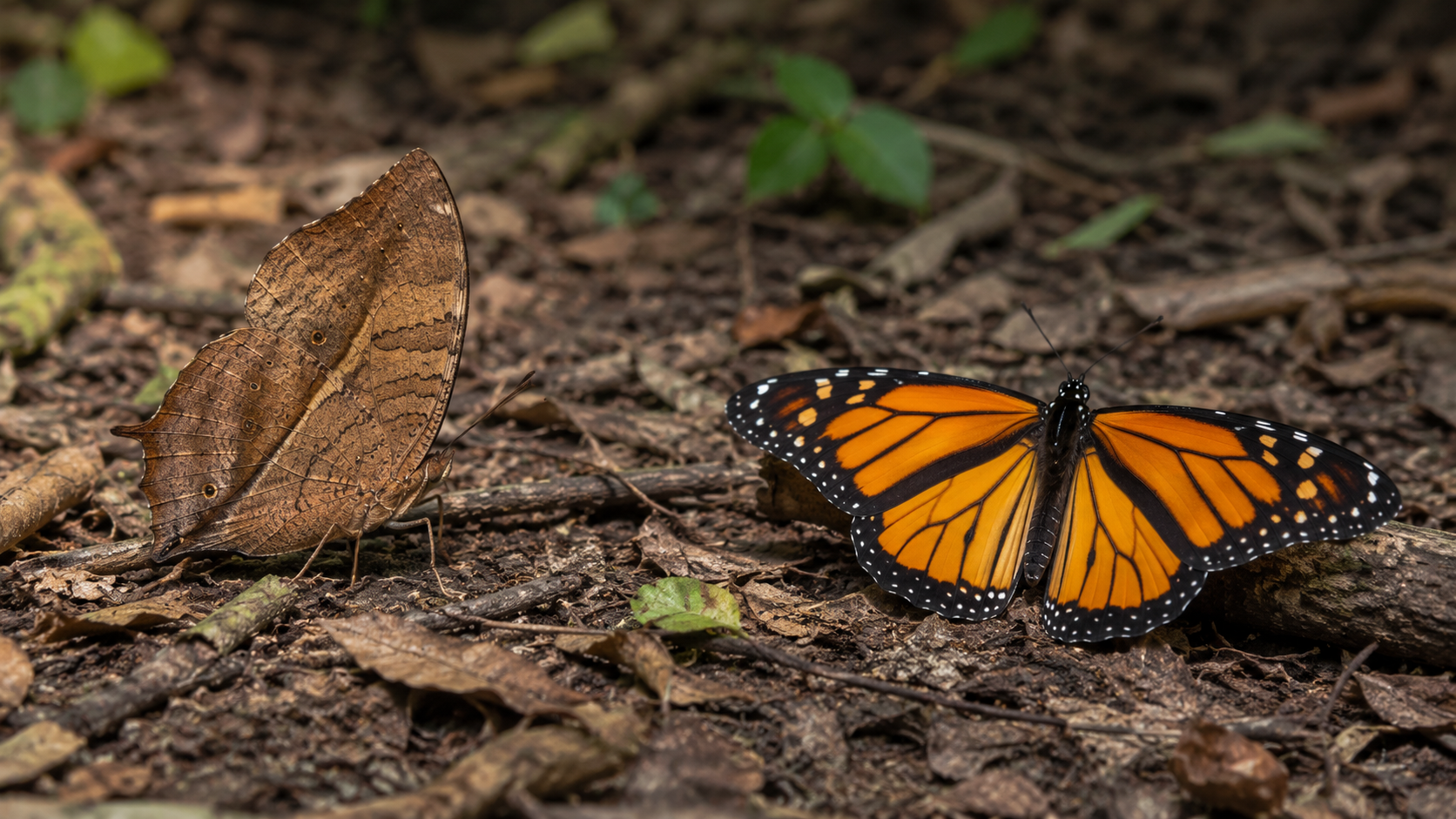
Butterflies sit near the bottom of a long food chain, and a huge share of their visible diversity in colour and pattern exists for one reason: avoiding being eaten, chiefly by birds. Two broad strategies have evolved repeatedly and independently across the group — camouflage, which aims to avoid detection altogether, and mimicry, which does not hide the butterfly but changes what a predator concludes about it once spotted. Both are widespread across butterfly families, and several species combine elements of both across different life stages or wing surfaces.
Camouflage: disappearing in plain sight
The most celebrated camouflage specialist among butterflies is the Indian oakleaf butterfly (Kallima inachus), whose closed wings are patterned to resemble a dried leaf in astonishing detail — a fake central midrib runs the length of the wing, the outline tapers into leaf-like points at both ends, and mottled brown patches mimic the blotching of fungal decay. In flight the species displays vivid blue-and-orange upper wing surfaces, but the instant it lands and folds its wings, it vanishes against leaf litter or a twig, becoming essentially invisible to a searching predator.
Camouflage in butterflies is not limited to leaf mimicry. Many moths and some day-flying species instead match bark texture and colouring — the pine hawkmoth (Sphinx pinastri), for instance, rests flat against pine trunks with a streaky grey pattern that breaks up its outline against the bark. Disruptive patterning of this kind works by breaking an insect's silhouette into shapes that no longer read as "insect" to a predator's visual search image, rather than by exactly reproducing a specific background in the way leaf mimicry does.
Batesian mimicry: borrowing someone else's bad reputation
Batesian mimicry, named for the nineteenth-century naturalist Henry Walter Bates, describes a harmless or palatable species evolving to resemble a different, chemically defended species that predators have already learned to avoid. The mimic gains protection without needing to manufacture its own toxins — a considerable metabolic saving — but the strategy depends entirely on the model remaining common enough, and sufficiently unpleasant, that predators reliably associate its pattern with a bad experience.
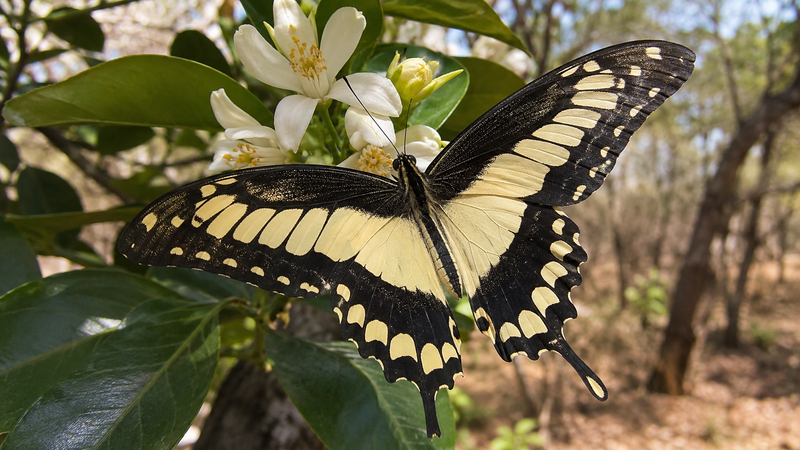
The single best-studied Batesian mimic among butterflies is the African mocker swallowtail (Papilio dardanus), whose females abandon the male's plain yellow-and-black pattern in favour of one of dozens of regional forms, each closely copying a different local species of toxic Danaus or Amauris butterfly. Because the model species differs across the mocker swallowtail's huge African range, so does the "correct" mimetic pattern, and the whole system is controlled by a single genetic supergene inherited as one unit — one of the clearest known illustrations of how natural selection can assemble and lock in a complex, multi-part disguise.
Müllerian mimicry: safety in shared signals
Müllerian mimicry, described by the naturalist Fritz Müller shortly after Bates's work on Batesian mimicry, involves two or more species that are all genuinely toxic or distasteful converging on a similar warning pattern. Rather than one species exploiting another's reputation, all the co-mimics share the cost of "teaching" predators to avoid the pattern, since a predator's single bad experience with any one of the mimicking species reinforces avoidance of all the others as well. The Heliconius longwings of the American tropics are the textbook case: numerous distantly related Heliconius species have converged on a handful of shared warning patterns across their range, each toxic in its own right from sequestering passionflower-derived compounds as caterpillars, so that a young bird that samples one unpalatable Heliconius and gets sick learns to avoid the entire co-mimicking group.
When mimicry breaks down
Mimicry is a statistical strategy, not a guarantee, and its effectiveness depends on relative abundance: a Batesian mimic remains well protected only as long as it stays considerably rarer than its toxic model within a predator's actual experience. If mimics become too numerous relative to the model, predators start encountering the harmless pattern more often than the genuinely dangerous one, and the association between pattern and unpleasant outcome weakens for everyone sharing it. This frequency-dependent selection is thought to be one of the main forces maintaining the many distinct regional mimicry forms seen in species like the mocker swallowtail, since a single fixed pattern would eventually become too common, and too safe to fake, everywhere at once.