Mocker Swallowtail
The Mocker Swallowtail is an African swallowtail famous for females with dozens of forms, each mimicking a different distasteful butterfly.
Key facts
- Latin name
- Papilio dardanus
- Family
- Papilionidae
- Wingspan
- 80-110 mm
- Flight season
- Year-round in the tropics (multiple overlapping generations)
- Host plants
- Citrus spp. (Rutaceae), Toddalia asiatica, Vepris and Teclea spp. (Rutaceae)
- Conservation status
- LCLeast Concern
Appearance
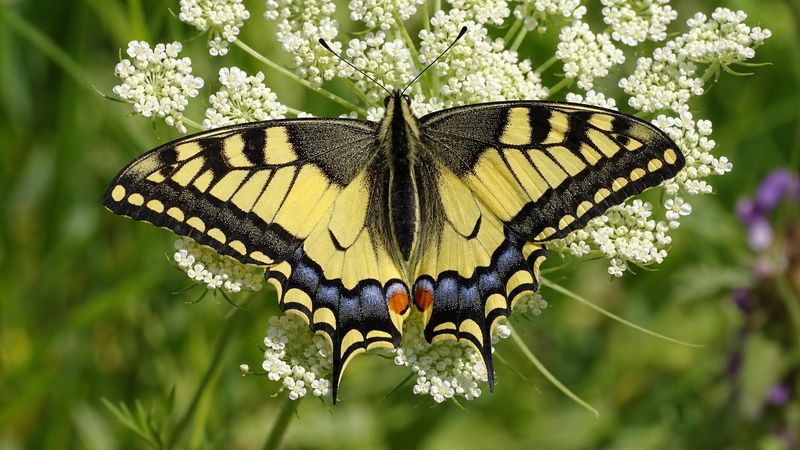
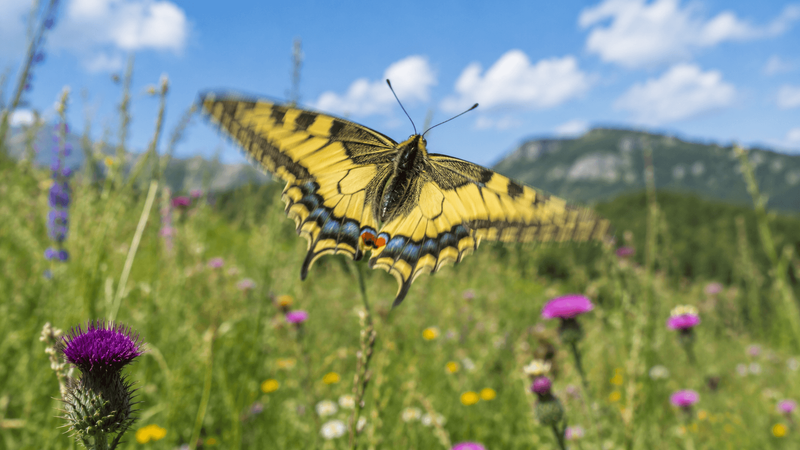
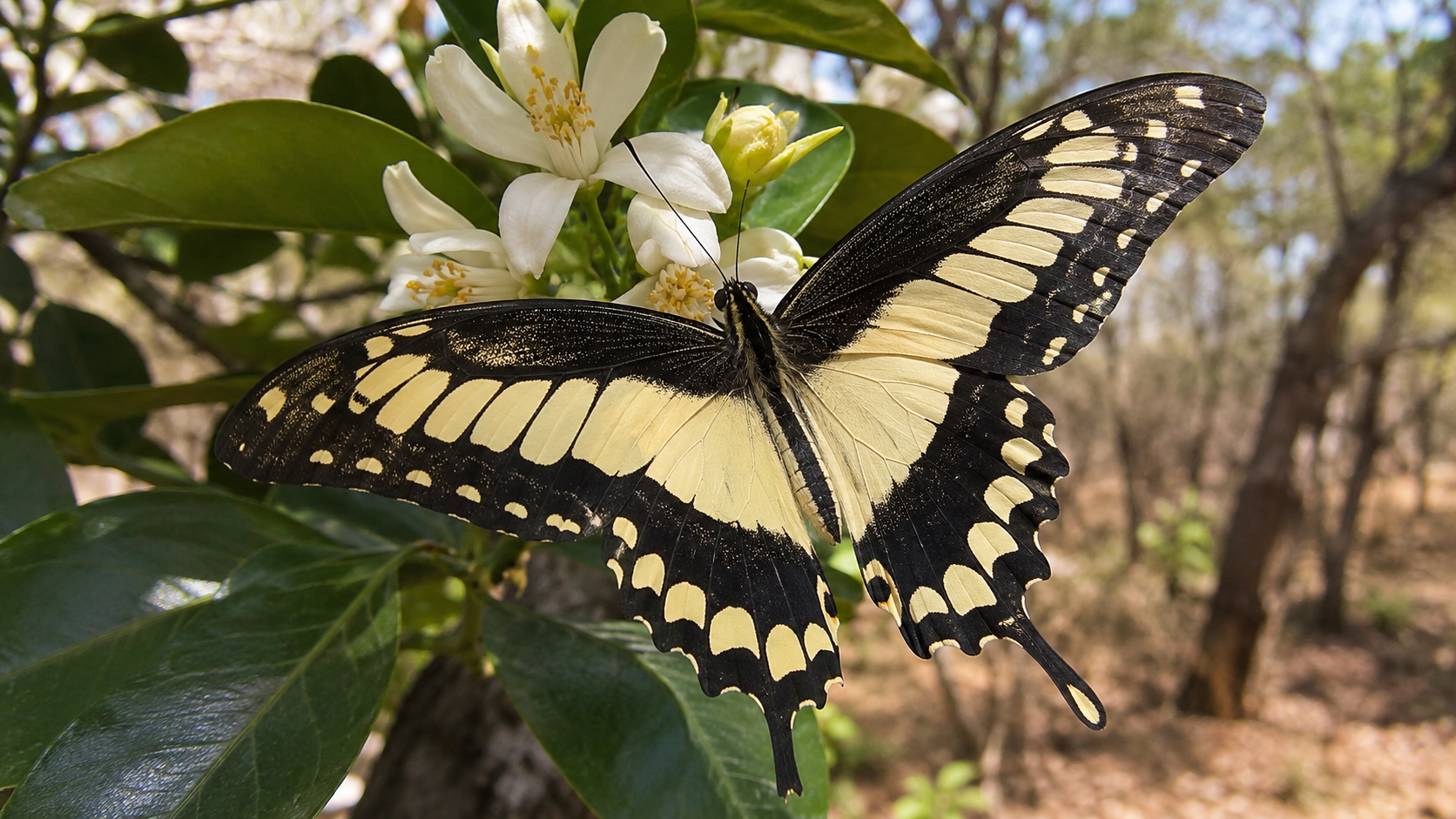
The mocker swallowtail (Papilio dardanus) is a medium-to-large African swallowtail with a wingspan of roughly 80–110 mm. Males are relatively uniform across the species' vast range: pale yellow or cream wings crossed by black veins and borders, with the hindwing drawn out into a slender tail, a conventional swallowtail pattern shared with many relatives. Females are the species' real distinction — across most of mainland Africa they abandon the male's pattern entirely in favour of one of a large number of mimetic forms, each closely copying the wing colour, pattern, and even flight style of a different, chemically protected model butterfly, most often a species of Danaus (tiger or monarch relatives) or Amauris (African crow butterflies). A minority of females, especially in island populations such as Madagascar, instead retain a non-mimetic form resembling the male, tails and all.
Range and habitat
Papilio dardanus is one of the most widely distributed swallowtails in Africa, occurring from the savanna woodlands and forest margins of West and Central Africa through East Africa to southern Africa, and on Madagascar and several other Indian Ocean islands. It favours open woodland, forest edges, and cultivated land with citrus trees, and adapts readily to gardens and orchards wherever its Rutaceae host plants are available, making it one of the more frequently encountered large swallowtails across much of the continent.
Feeding and behaviour
Adults are strong, fairly fast fliers, visiting a wide range of flowering plants for nectar, including cultivated citrus blossom, and males in particular patrol open ground and forest edges in search of females. Mimetic females typically also adopt a slower, more leisurely flight style closer to that of their unpalatable model species, reinforcing the visual deception with behavioural mimicry — predators that have learned to avoid the model's characteristic unhurried flight are less likely to attack a female mocker swallowtail flying in the same manner.
Reproduction
Females lay eggs singly on the leaves of citrus and related Rutaceae host plants. The species' famous polymorphism is controlled by a single genetic supergene — a tightly linked cluster of genes inherited as one unit — that determines which complete mimetic wing pattern, rather than any single trait in isolation, a given female will develop. Decades of breeding experiments through the twentieth century used this system to work out how such a complex, multi-part pattern can be inherited and maintained intact across generations despite ongoing recombination, making the species a foundational case study in the genetics of mimicry.
Interesting facts
- Some populations carry more than a dozen distinct named female forms, each restricted to the geographic range where its particular model species occurs, so that the "typical" female pattern changes markedly from one region of Africa to another.
- The species was studied intensively by the geneticist Cyril Clarke and others from the 1950s onward, whose large-scale breeding programmes helped establish the modern understanding of supergene inheritance in butterflies.
- Madagascar's non-mimetic female form is thought to persist because the island lacks the specific unpalatable model species that drive mimicry on the African mainland, removing the selective pressure that favours mimetic females elsewhere.
- Because its males are so visually uniform across such a huge range while its females vary so dramatically, the species offers an unusually clear illustration of how the sexes within a single species can experience entirely different selective pressures.