Hercules Grayling
The Hercules grayling is a large mountain brown. It is close to the grayling but larger and lives in more rocky, mountainous landscapes.
Key facts
- Latin name
- Hipparchia hermione
- Family
- Nymphalidae
- Wingspan
- 52-65 mm
- Flight season
- July — August
- Host plants
- Sheep's fescue, Barley grass, Bluegrass
- Conservation status
- LCLeast Concern
Appearance
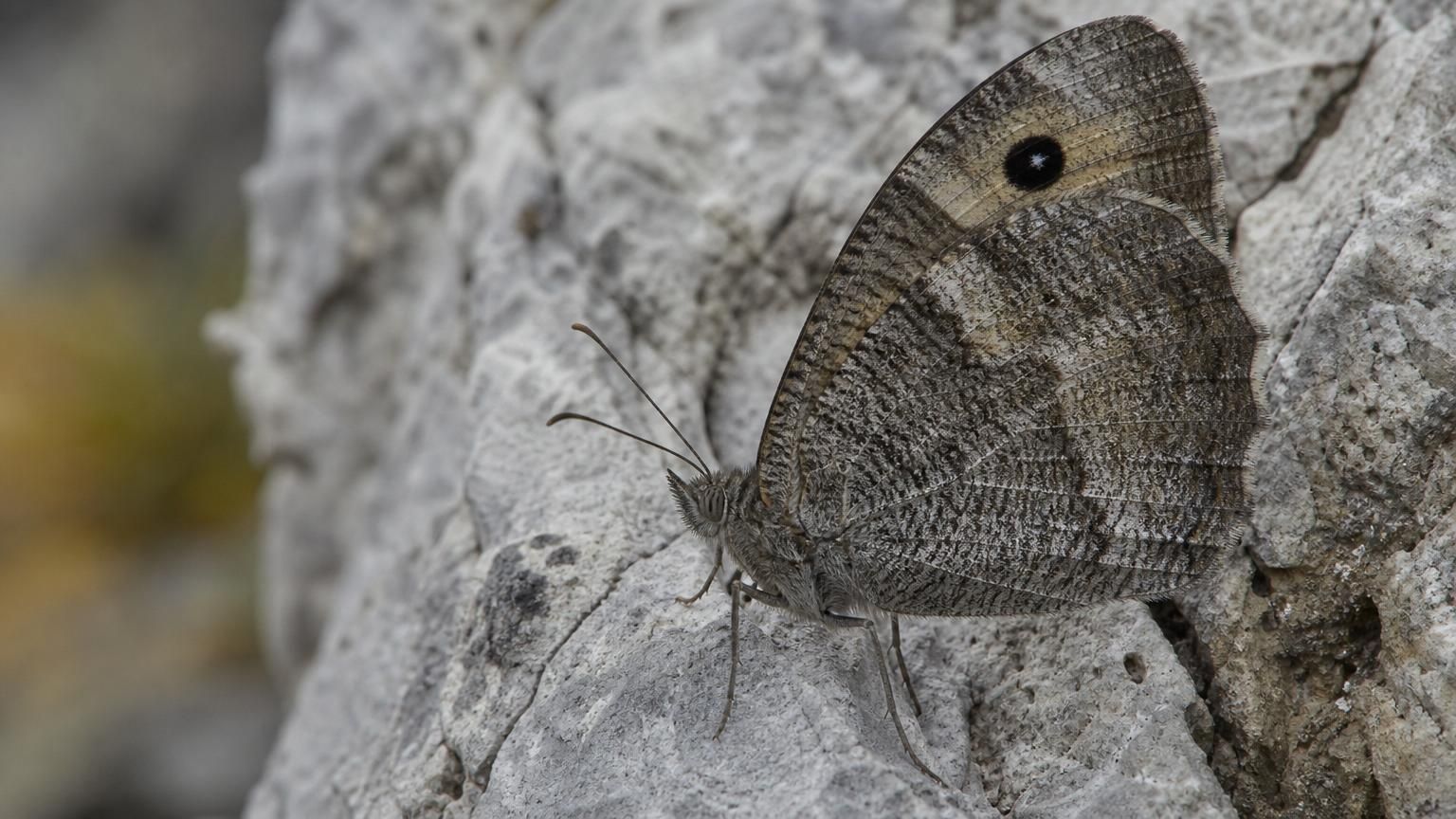
The Hercules grayling (Hipparchia hermione) is the largest Hipparchia in Russia with a wingspan of 52–65 mm. The upper side of the wings is dark brown with a pale ochre band and two eyespots on the forewing.
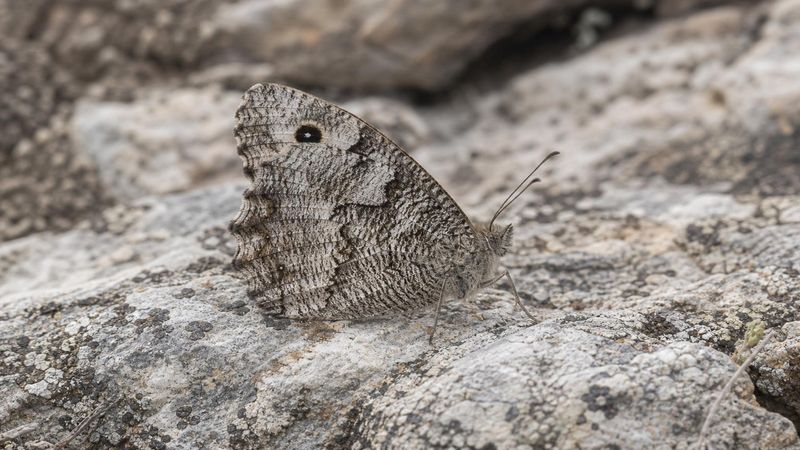
The underside of the hindwings is grey-brown, marbled — excellent camouflage on limestone. The butterfly almost always sits with closed wings.
Range and Habitat
A mountain and foothill species. Distributed in southern Europe, Asia Minor, and the Caucasus. In Russia it occurs on the North Caucasus and in the Crimean mountains.
It lives on steep rocky slopes with limestone outcrops and sparse grass. It reaches up to 2,000 m above sea level.
Life Cycle
One generation per year. Flight in July–August.
Eggs on grasses. The caterpillar overwinters. The life history is similar to the grayling: caterpillars active at night, pupa in soil.
Behaviour
Like the grayling, the Hercules grayling actively camouflages on rock: it lands on stone, tilts toward the sun, and hides the forewing behind the hindwing. Males patrol rocky summits and ledges, forming 'leks' on sunlit cliffs.
The species is named after Hercules — for its large size among Hipparchia browns.