Large White
The large white is the commonest white butterfly in gardens, whose caterpillars eat cabbage. Larger than the small white, with dark wing spots.
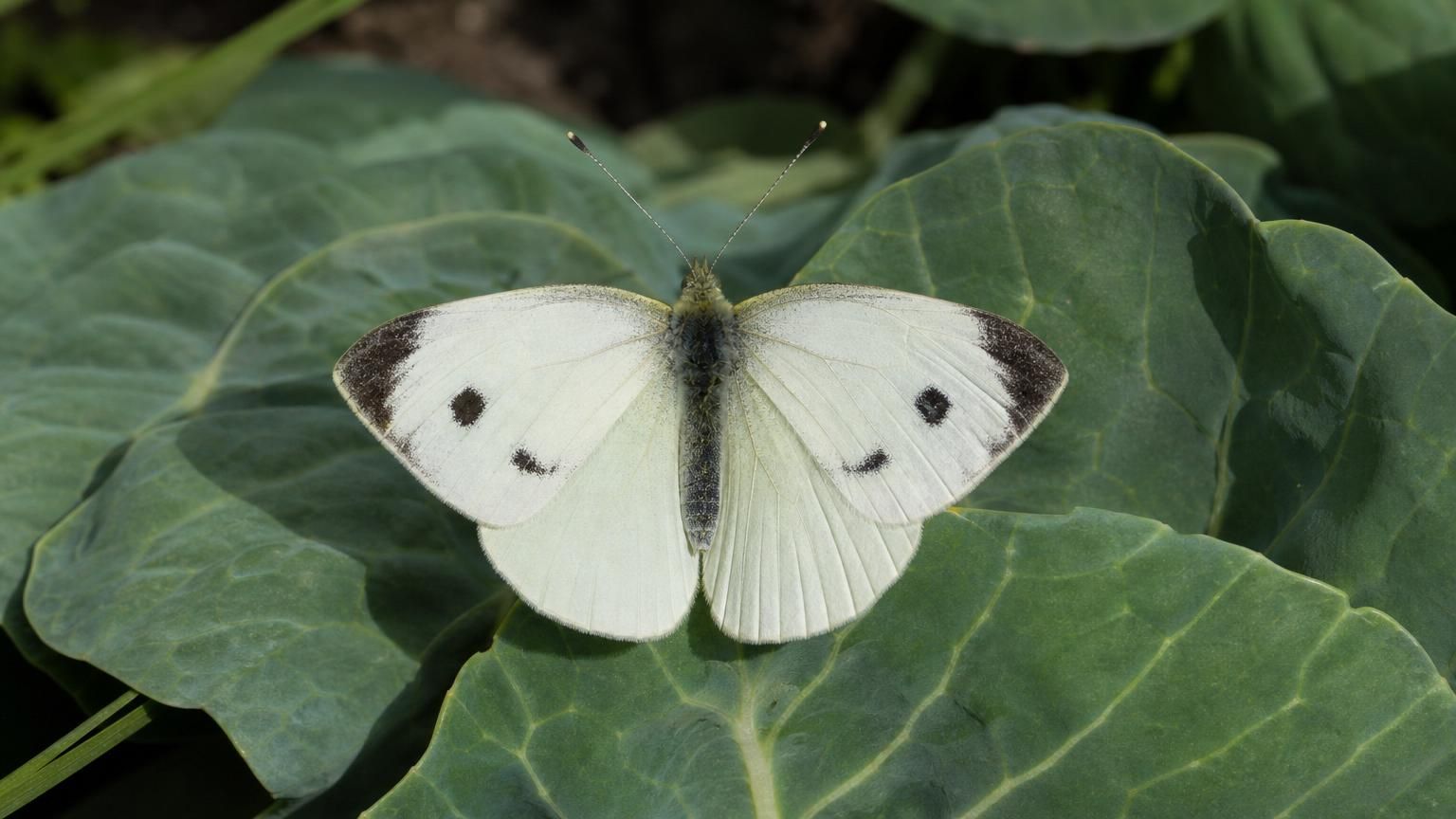
Key facts
- Latin name
- Pieris brassicae
- Family
- Pieridae
- Wingspan
- 50-70 mm
- Flight season
- April — October
- Host plants
- Cabbage, Radish, Turnip, Nasturtium, Horseradish
- Conservation status
- LCLeast Concern
Appearance
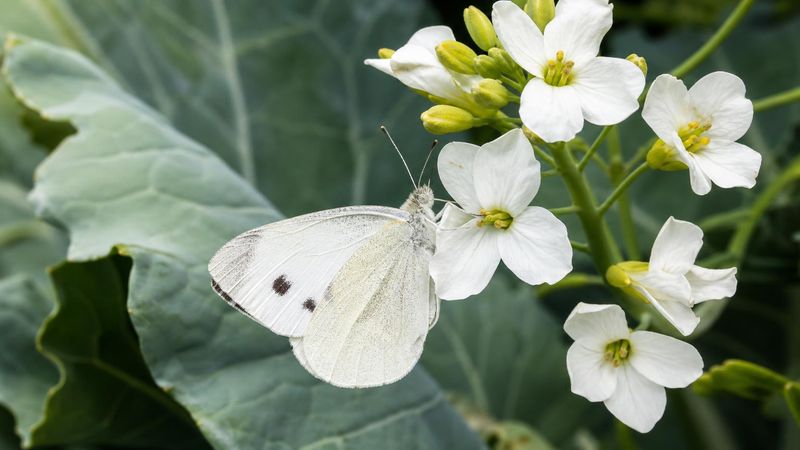
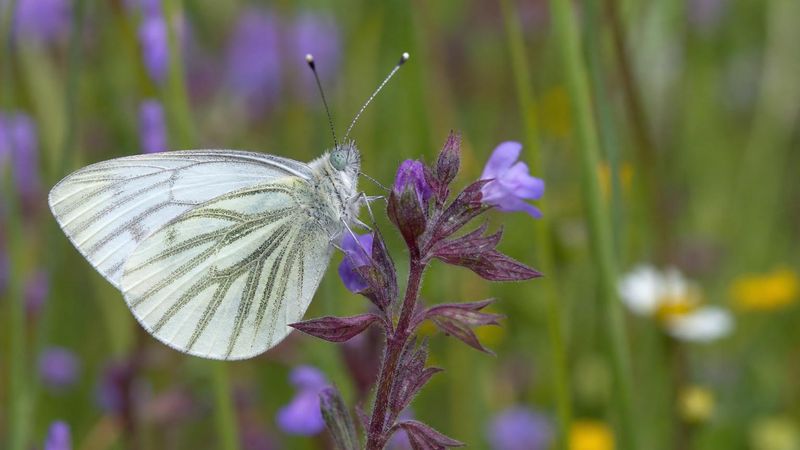
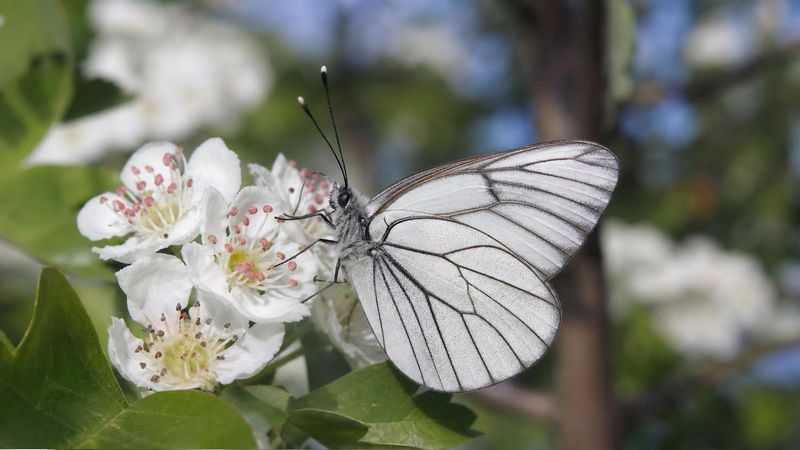
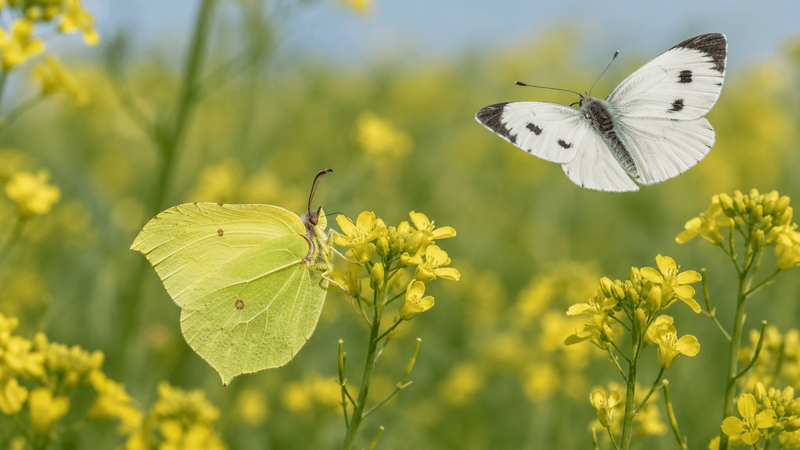
The large white (Pieris brassicae) is a large white butterfly with a wingspan of 50–70 mm. The main wing color is white. The forewing tip has a broad gray-black patch. The female has two black rounded spots in the center of the forewing and a black spot at the lower corner. In the male these spots are absent or very faint.
The underside of the hindwings is yellowish green. The first generation is paler; the second (summer) generation is more contrasted.
Range
The large white is found across Europe and Asia to the Himalayas; it has been introduced to southern Africa and South America. In Russia it is common everywhere.
It lives in gardens, allotments, fields, meadows, and along roads — wherever crucifers grow. It actively colonizes agricultural landscapes.
Life cycle
In Russia 2–3 generations per year. Pupa overwinters, attached to fences, building walls, and trees.
The female lays eggs in dense clusters (20–100) on the underside of cabbage leaves. Young caterpillars are greenish yellow and stay in a group. Older caterpillars (up to 4 cm) are blue-green with yellow side stripes and live alone. The pupa is angular, green or yellowish with black spots.
Behavior
The large white is an active day-flying species. Flight is straight and purposeful, with sharp wingbeats. Males patrol gardens and meadows for females; aerial chases sometimes involve three or four individuals. They feed on nectar of oilseed rape, mustard, burdock, dandelion, and red clover. In cloudy weather they are inactive — sitting in shelter with wings folded.
Reproduction
The female lays eggs in dense clusters of 20–100 on the underside of crucifer leaves. Eggs are bright yellow, cylindrical, and ribbed — easy to see. Young caterpillars are greenish yellow and stay in a group. Older caterpillars (up to 4 cm) are blue-green with yellow side stripes and gradually disperse. The pupa is angular, green or yellowish with black dots, attached to fences, walls, or stems.
Overwintering
The large white overwinters as a pupa. Pupae attach to fences, building walls, and tree trunks. They withstand moderate frosts. In spring, when the air warms to +12–15 °C, the first adults appear in April. In central Russia there are 2–3 generations per year; the last autumn brood enters pupal diapause for winter.
Interesting facts
- The large white is one of the first documented agricultural pests in Russia: it is mentioned in agronomic works of the 18th century.
- Introduction to South America in the 1930s caused serious damage to local agriculture.
- The caterpillar accumulates mustard oils from host plants; they are toxic to most birds but do not protect against parasitic wasps.
- Males of the first generation are noticeably paler than those of the second — spot intensity helps date emergence.
Significance for gardeners
The large white is one of the main pests of cultivated crucifers. Caterpillars eat cabbage leaves, leaving only the veins. In years with a warm early spring, mass outbreaks can destroy the entire crop.