Butterflies of Kazakhstan
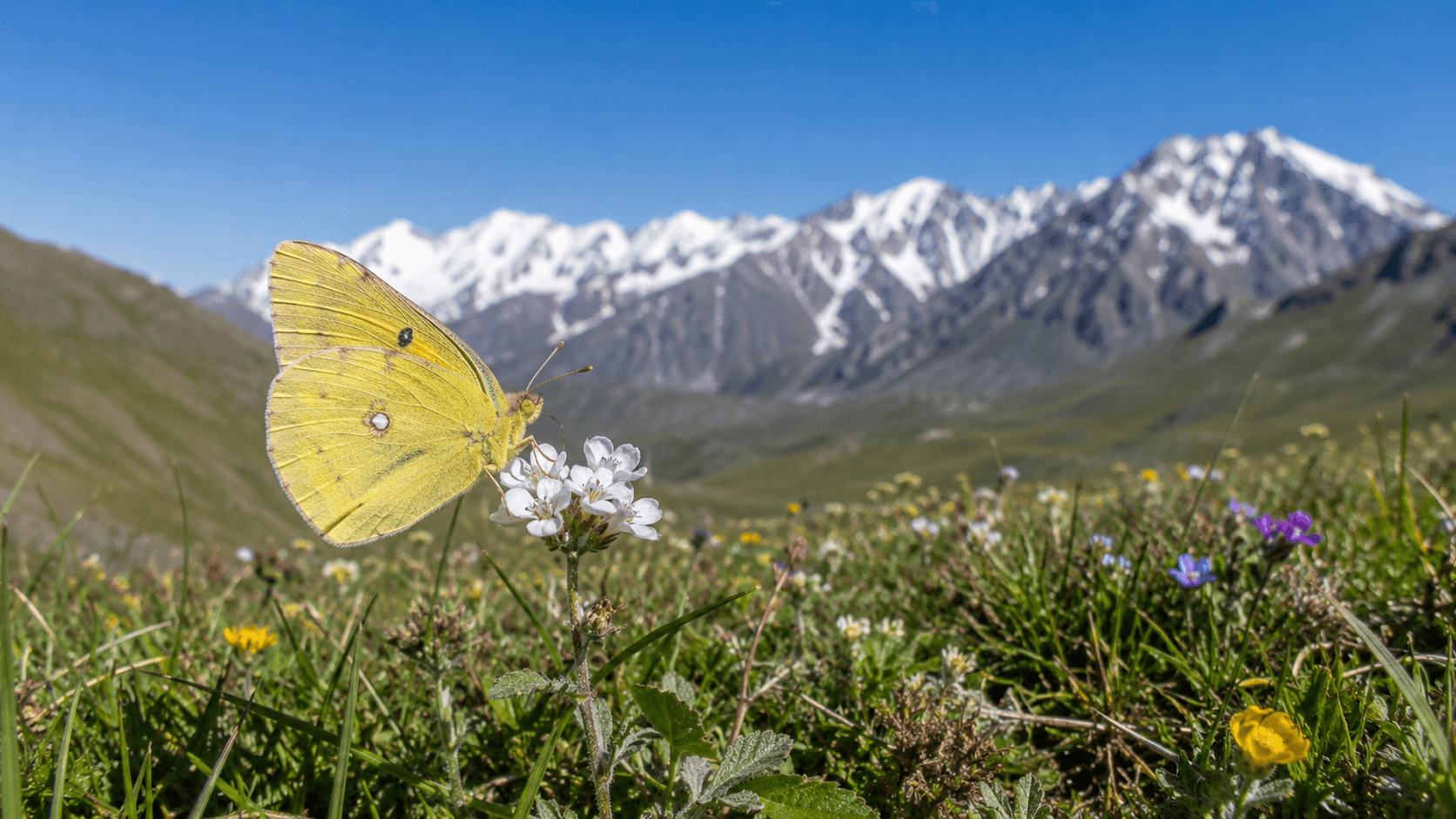
Butterflies of Kazakhstan: overview
Kazakhstan is the world's ninth-largest country (2.7 million km²). Landscape diversity is enormous: from Caspian semi-deserts in the west to the high mountains of the Tian Shan in the southeast and the Altai foothills in the northeast. This supports a rich fauna — about 400 species of day-flying butterflies.
Key regions
Tian Shan
The mountain system in the southeast is the main center of biodiversity. Elevations from 700 to 7,010 m (Khan Tengri peak). Species found here include:
- Apollo (Parnassius apollo) and several other apollo species, including Eversmann's Apollo (Parnassius eversmanni)
- Phoebus Apollo (Parnassius phoebus) — a high-mountain species
- Mountain sulphurs of the genus Colias — several species, some rare
- Fritillaries of the genus Erebia — numerous mountain species
- Blues — rich diversity of mid- and high-mountain species
Altai
Northeastern Kazakhstan is part of the Altai mountain biome. Species shared with Russia's Altai occur here, including rare fritillaries and apollos.
Steppes and semi-deserts
Vast steppe territories support steppe species: sulphurs, numerous blues, Euphorbia zegris (Zegris eupheme) — a striking orange-tinted white of the foothills and semi-deserts of Kazakhstan and Central Asia.
Karatau
A small isolated range in southern Kazakhstan — a center of endemism with several species found only here.
Unique species
Euphorbia zegris (Zegris eupheme) — one of the most beautiful whites of Central Asia with a bright orange spot on the wing. It flies in April–May on flowering steppes.
Phoebus Apollo (Parnassius phoebus) on the Tian Shan is represented by large, colorful mountain populations.
Observation season
- April–May — steppes: zegrises, early blues
- May–June — foothills and valleys of the Tian Shan
- July–August — high mountains: apollos, phoebus, mountain fritillaries
- August–September — last mountain species