Butterflies of India
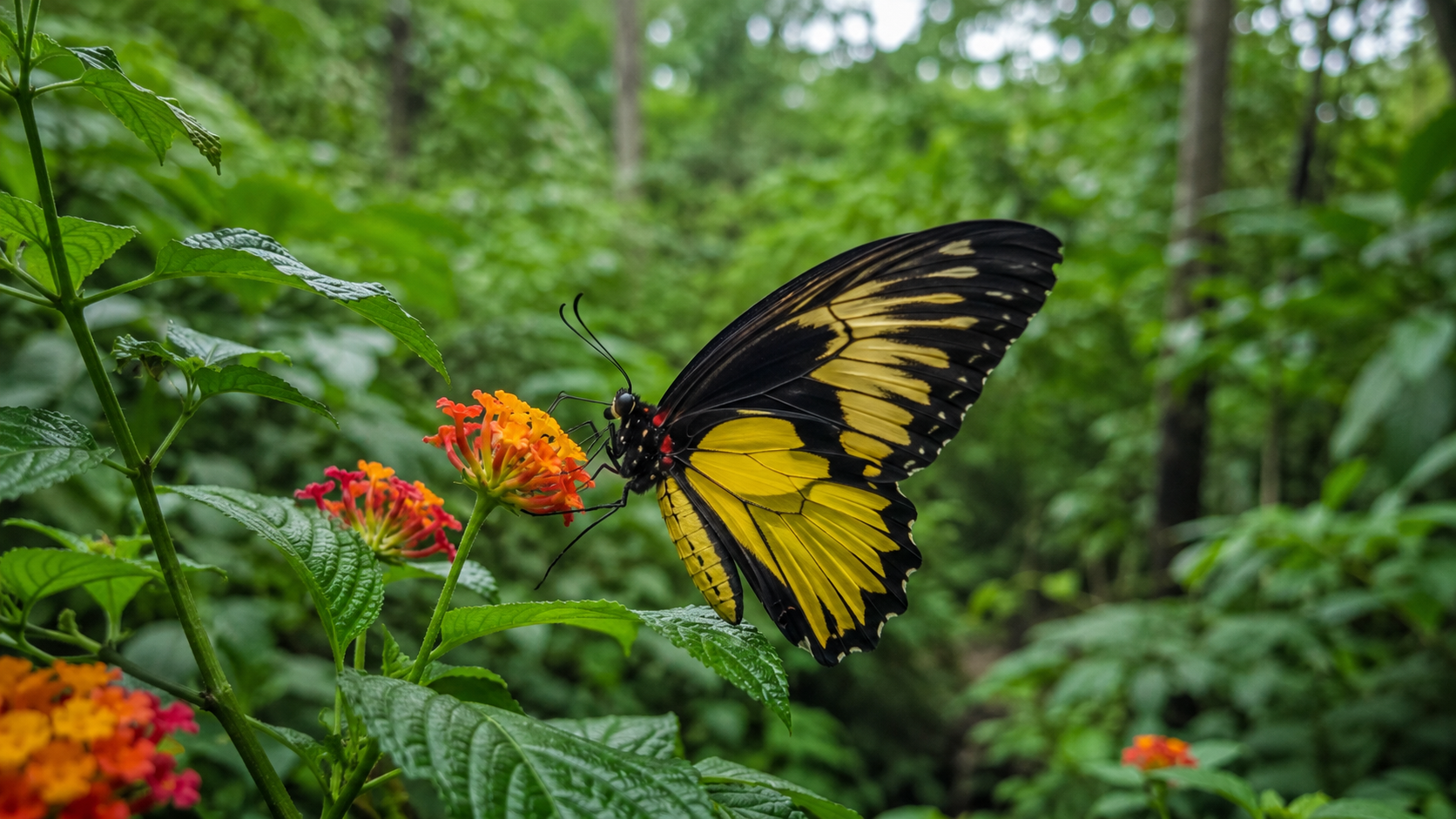
Butterflies of India: overview
India is one of the world's leaders in butterfly species diversity. About 1,500 species of day-flying butterflies are recorded here (of ~20,000 worldwide), roughly 7.5% of global fauna. The country includes two of the world's 36 biodiversity hotspots: the Western Ghats and the Himalayas.
Key regions
Western Ghats
The mountain chain along India's west coast is one of the richest butterfly regions in Asia. High endemism: dozens of species occur only here. Large birdwings (Troides minos, Troides aeacus), numerous swallowtails, and tropical nymphalids occur here.
Tropical forests of Kerala and Karnataka are the best observation sites from June through September (the monsoon creates peak diversity).
Himalayas
The long mountain barrier creates several altitudinal belts with different faunas:
- Foothills (up to 1,500 m) — tropical fauna, swallowtails, nymphalids
- Mid-montane belt (1,500–3,000 m) — temperate species, admirals, fritillaries
- Subalpine belt (3,000–5,000 m) — apollos, mountain sulphurs, arctic fritillaries
Northern Sikkim and Arunachal Pradesh are a mecca for lepidopterists: hundreds of species in a small area.
Northeast India
The states of Meghalaya, Manipur, and Nagaland are a transition zone between Indian and Indochinese faunas. Species rare even for Asia occur here, including several endemics.
Protected species
India protects butterflies by law. The Southern Birdwing (Troides minos) is a specially protected species listed on CITES (Appendix II). Trade without a permit is prohibited.
Butterflies in culture
In Indian culture, butterflies symbolize transformation and living in the moment. The Southern Birdwing (Troides minos) is the official symbol of Maharashtra state.
Observation season
- Western Ghats: June–September (peak) and February–April
- Himalayas: May–September
- South India: year-round, peak after monsoons (October–December)