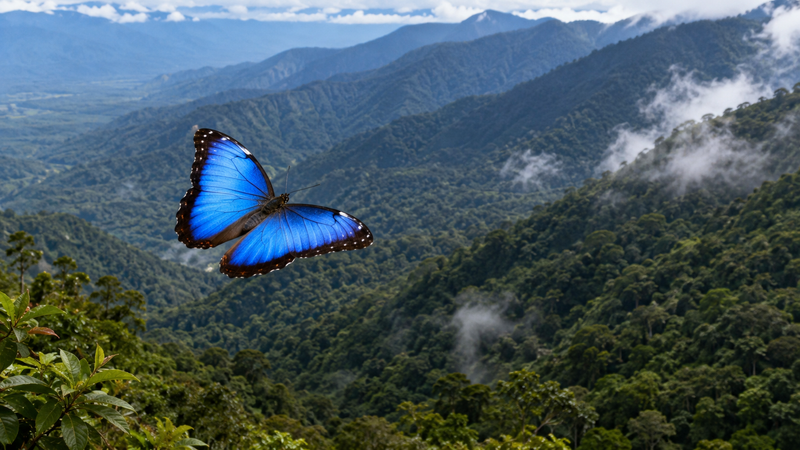
One-spotted Prepona
The one-spotted prepona (Archaeoprepona demophon): a powerful Amazonian butterfly with a blue-green band, bark-mimicking underside, aggressive flight.
Key facts
- Latin name
- Archaeoprepona demophon
- Family
- Nymphalidae
- Wingspan
- 80–115 mm
- Flight season
- Year-round (peak activity in dry season)
- Host plants
- Annona species (Annonaceae — custard apple family), Xylopia (Annonaceae), Rollinia (Annonaceae), Duguetia (Annonaceae)
- Conservation status
- LCLeast Concern
Appearance
The one-spotted prepona is a large, robust nymphalid with a wingspan of 80–115 mm — among the bigger butterflies of mainland Neotropical forests. Its two visual faces could not be more different.
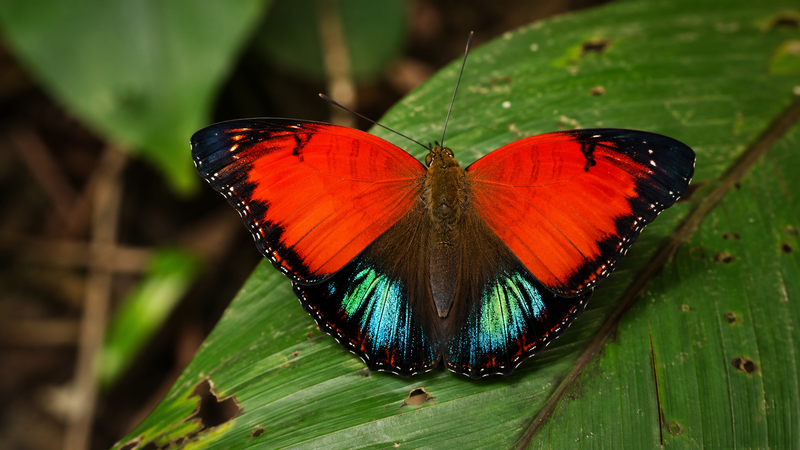
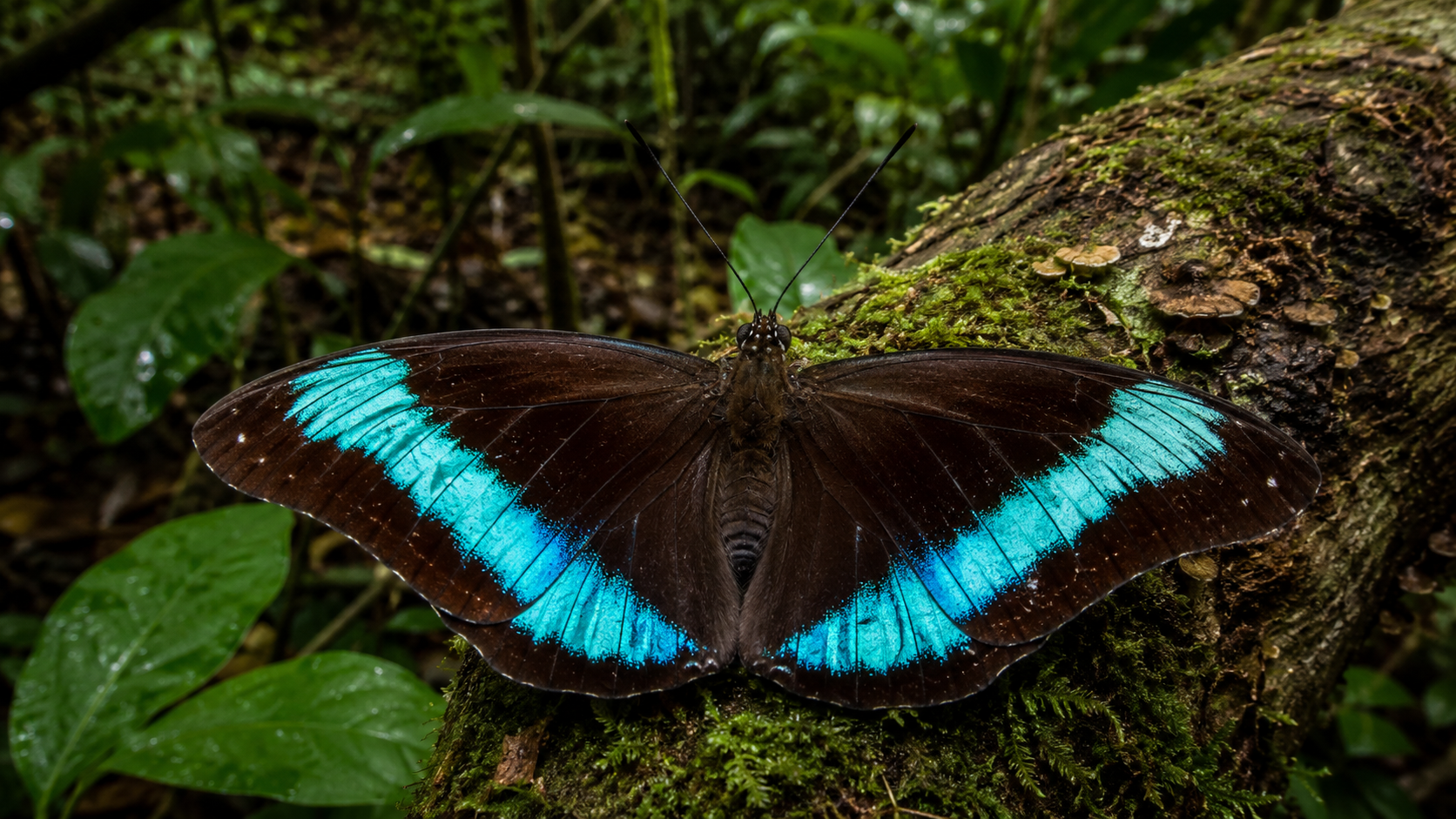
Upperwing (open): The ground colour is deep chocolate-brown to near-black. Crossing both wings diagonally is a broad band of intense iridescent blue-green, shifting toward turquoise or electric blue depending on the angle of light. This is structural colour produced by microscopic scale architecture — the same physics as Morpho wings, though producing a narrower spectral peak. In males the blue band is wider and more vivid; in females it is slightly narrower and in some individuals has a greenish-teal rather than blue cast. The forewing has an additional pale blue-white sub-apical spot (the "one spot" of the common name) just inside the dark border.
Underside (closed): The complete opposite of the upperwing — cryptic bark mimicry of the highest order. The entire wing surface is covered with a reticulated pattern of grey, buff, cream, and dark brown, precisely imitating the surface of weathered, lichen-crusted bark. On the hindwing underside is the "shoe" mark: a dark, kidney-shaped patch enclosed by pale lines, characteristic of the Prepona group and the origin of the common name "King Shoemaker." When a prepona closes its wings on a bark surface, it becomes nearly impossible to spot even at close range.
Range and habitat
Archaeoprepona demophon is one of the most widespread Charaxinae in the Americas, ranging from southern Mexico (Oaxaca, Chiapas) south through all of Central America and into South America as far as Peru, Bolivia, and central Brazil. It occurs at elevations from sea level to approximately 1,500 m, favouring lowland and premontane rainforest.
It is a species of intact or lightly disturbed primary and secondary forest — more tolerant of some disturbance than Agrias claudina, but still absent from heavily fragmented or agricultural landscapes. It requires large Annonaceae trees as larval host plants and areas of exposed, mineralised soil or sandy stream banks for adult mud-puddling.
Life cycle
Females oviposit on the young leaves of Annonaceae — custard apple relatives including Annona, Xylopia, and Rollinia. These are common forest-understorey trees throughout the Neotropical range.
The caterpillar is typical Charaxinae: large, smooth, green, with a pair of curved "horns" on the head capsule and a tapered rear end — a silhouette that breaks up the larval outline when resting along a midrib. It feeds on young leaves, primarily at night. Final-instar larvae can reach 60–70 mm.
The pupa is angular and laterally compressed, green with pale-gold metallic patches. It hangs from the underside of a leaf or twig by its cremaster. Adults are present year-round in the equatorial part of the range, with peaks of mud-puddling activity coinciding with the dry season when exposed stream banks are available.
Behaviour
Flight and territory
Prepona flight is the fastest and most powerful of any Charaxinae — explosive bursts of speed combined with rapid direction changes make the butterfly nearly impossible to follow with the eye or a net once it is disturbed. Males patrol defined ridgetop territories and forest path corridors, making extended steep dives and climbs when pursuing rivals. Both sexes spend most of the day in the forest canopy feeding on fermenting fruit.
Mud-puddling and baited traps
The most reliable observation opportunity is at mineralised mud-puddle sites: exposed sandy stream banks, urine-soaked soil at mammal wallows, or carcass seeps where males come to extract sodium and amino acids. Groups of 3–8 individuals sometimes assemble at productive sites, occasionally alongside other Charaxinae, large Papilio, and Morpho species.
Researchers and photographers regularly use baited traps — a mesh or wooden frame with a fermenting fruit-and-fish-paste bait suspended above a collection funnel. Archaeoprepona demophon is attracted reliably by fermented banana mixed with shrimp paste or aged fish, descending from the canopy to investigate. Baited traps provide one of the few opportunities to photograph the species at close range.
Aggression
Prepona males are notably aggressive toward other large butterflies in their territory. They make rapid, stabbing dives at intruding morphos, Agrias, and Charaxes, sometimes making physical contact, before returning to their perch. This territorial aggression has been used to attract males for observation — a large bright object (a blue cloth or even a phone screen with an iridescent display) waved at a forest ridgetop can trigger investigative dives.
Conservation
Archaeoprepona demophon is listed Least Concern (LC) and is locally common throughout its range wherever intact forest remains. Its greater tolerance of forest disturbance compared to Agrias makes it a less sensitive indicator of pristine habitat — it can persist in secondary forest and around forest edges where Agrias cannot. However, wholesale forest clearance eliminates it, and fragmented forest patches too small to support the Annonaceae host trees and open stream margins the species requires do not hold viable populations.