Claudina Agrias
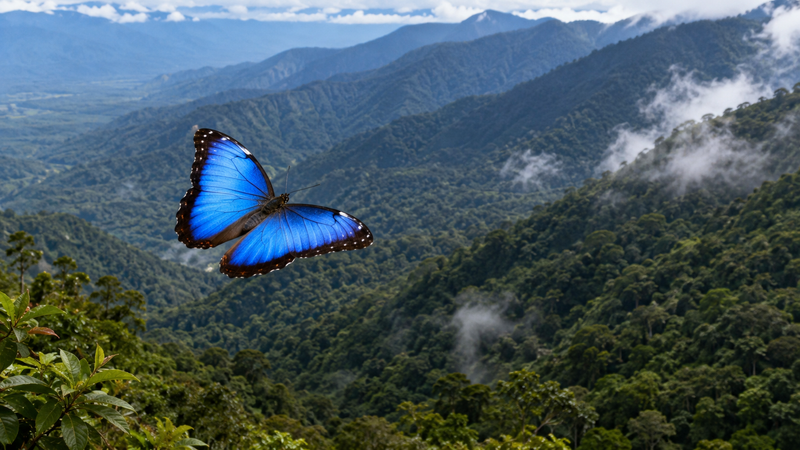
The Claudina agrias (Agrias claudina) is among the most spectacular Amazon butterflies — scarlet-and-blue wings flash in the canopy, camouflaged below.
Key facts
- Latin name
- Agrias claudina
- Family
- Nymphalidae
- Wingspan
- 70–95 mm
- Flight season
- Year-round (adults present all months, peak in dry season)
- Host plants
- Erythroxylum (Erythroxylaceae)
- Conservation status
- NENot Evaluated
Appearance
Agrias claudina is a large, powerful nymphalid of the Charaxinae subfamily — the "leafwings and emperors" — with a wingspan of 70–95 mm. The contrast between its two faces is extraordinary:
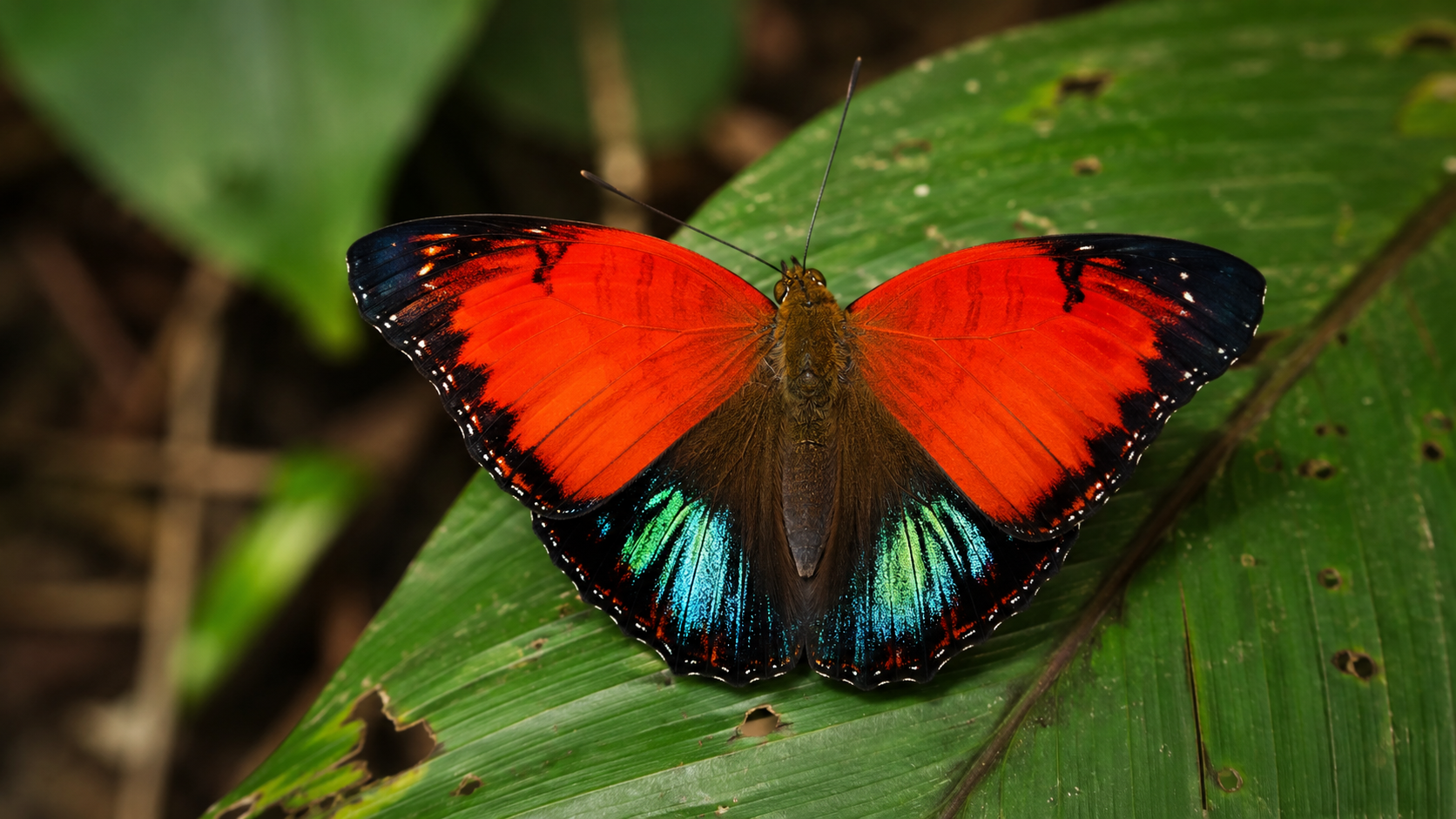
Upperwing (open): The male's forewing is vivid scarlet-red, sharply defined against dark brown wing margins. The hindwing bears a broad band of brilliant iridescent blue-green that shifts toward turquoise and violet as the viewing angle changes — a structural colour produced by microscopic scale architecture similar to that of Morpho butterflies. The outer hindwing margin is dark. The total effect in sunlight is incandescent; binocular views of a male at a mud-puddle, wings outstretched, constitute one of the great sights of Neotropical entomology.
Underwing (closed): The underside is the opposite — a masterpiece of cryptic camouflage. The hindwing underside is covered in a reticulated pattern of ochre, cream, grey, and dark brown, accurately mimicking lichen and fungi on bark or a dry fallen leaf. When a resting individual closes its wings, it vanishes against any rough bark or dead leaf substrate within a second. The forewing underside shows a reduced version of the red upperwing colour, partially concealed beneath the hindwing at rest.
Female: Dramatically different — dark brown above with orange submarginal patches on forewing and hindwing, lacking the male's red and blue. Females were initially described as a separate species (A. aedon) before the connection was made.
Range and habitat
Agrias claudina is distributed across the western Amazon basin: eastern Peru, northern Bolivia, southeastern Ecuador, and western Brazil (Acre, Amazonas). It inhabits primary lowland and submontane rainforest from near sea level up to approximately 1,200 m elevation, with peak diversity in the foothills of the eastern Andes — the Yungas transition zone where the Amazon meets the Andean slopes.
Several named subspecies occur across this range, reflecting geographical isolation by Andean ridges and river barriers:
- A. claudina claudina — eastern Peru (type subspecies)
- A. claudina lugens — Bolivia (darker blue band)
- A. claudina sardanapalus — northern Peru to Ecuador (wider blue)
The species requires intact primary forest — it does not persist in logged, secondary, or fragmented forest. Larval hosts are Erythroxylum trees (Erythroxylaceae), not Clusiaceae (Casagrande & Mielke, 1997).
Life cycle
Females lay eggs on the young leaves of Erythroxylum in the forest canopy — a fact established only through careful observation in semi-natural conditions, as accessing canopy-level oviposition in primary Amazon forest is extremely difficult.
The caterpillar is reportedly pale green with lateral pale stripes and small fleshy projections (tubercles) along the body — typical Charaxinae larval form. It feeds on young leaves and rests along the midrib, where its outline blends with the leaf vein. Like other Charaxinae, the caterpillar almost certainly drops to the forest floor when disturbed and lies motionless, relying on cryptic coloration.
The pupa is angular, green or brown, suspended by the cremaster from a leaf stem. Little is documented about the precise duration of the larval and pupal stages under wild conditions.
Adults are present throughout the year, reflecting the non-seasonal environment of Amazonian lowland forest. Activity is most pronounced in the dry season (May–October in Bolivian Yungas), when mud-puddling at exposed river banks becomes concentrated and predictable.
Behaviour
Canopy life and mud-puddling
For most of its life, A. claudina is essentially invisible — high in the forest canopy, feeding on fermented fruit pulp from damaged or fallen canopy fruits. It does not visit flowers. The principal opportunity to observe the species is at forest-floor mud-puddle sites: males descend to probe moist, mineral-rich soil or sand along small forest streams and Amazonian flood beaches, extending their proboscis to extract sodium and other ions from the water.
At these sites, multiple Agrias individuals sometimes congregate alongside other Charaxinae (Prepona, Archaeoprepona), large Papilio, and Morpho species — creating the most spectacular mud-puddling assemblages in the Americas.
Flight
The flight of A. claudina is fast, direct, and powerful, low to the ground when mud-puddling but characteristically erratic and difficult to follow. At the slightest disturbance, individuals launch into the air and disappear into the canopy within seconds. Patience and stillness at a known puddling site are essential for extended observation.
Conservation
Agrias claudina is listed Least Concern (LC) globally. It remains locally common wherever primary lowland forest is intact across its Amazonian range. However, it is acutely sensitive to forest fragmentation — it does not cross open ground or persist in degraded areas — making it a useful indicator species for primary forest integrity.
The species has historically attracted intense collector pressure: its beauty and rarity in collections drove a period of aggressive commercial collecting in Peru and Bolivia from the 1960s to 1990s, with individual specimens selling for hundreds of dollars. Agrias claudina is not listed on CITES (Appendix III Bolivia covers the subspecies Agrias amydon boliviensis). Range states regulate collecting under national law; farms in Peru supply legal material for collectors and research.