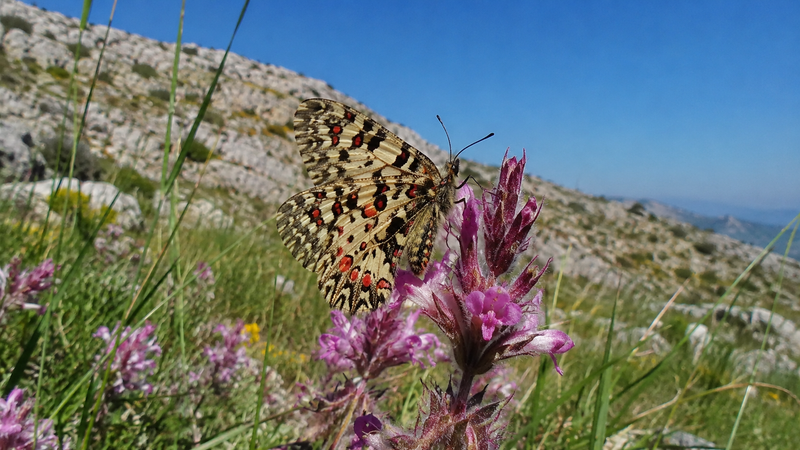
Cardinal
The cardinal (Argynnis pandora) is the largest Mediterranean fritillary — its hindwing underside suffused with crimson, giving the species its English name.
Key facts
- Latin name
- Argynnis pandora
- Family
- Nymphalidae
- Wingspan
- 60–76 mm
- Flight season
- June — August
- Host plants
- White violet (Viola alba), Hairy violet (Viola hirta), Sweet violet (Viola odorata), Wild pansy (Viola tricolor)
- Conservation status
- LCLeast Concern
Appearance
The cardinal is a large, powerfully built fritillary with a wingspan of 60–76 mm — comparable to or slightly larger than the silver-washed fritillary, and among the biggest fritillaries of the Western Palearctic.
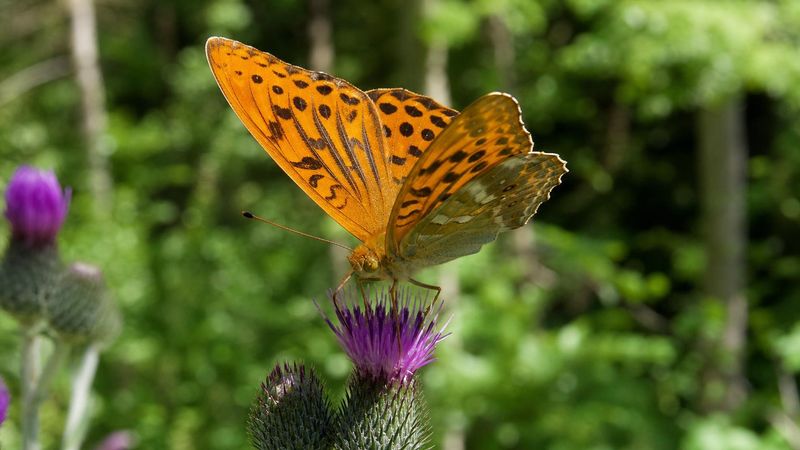
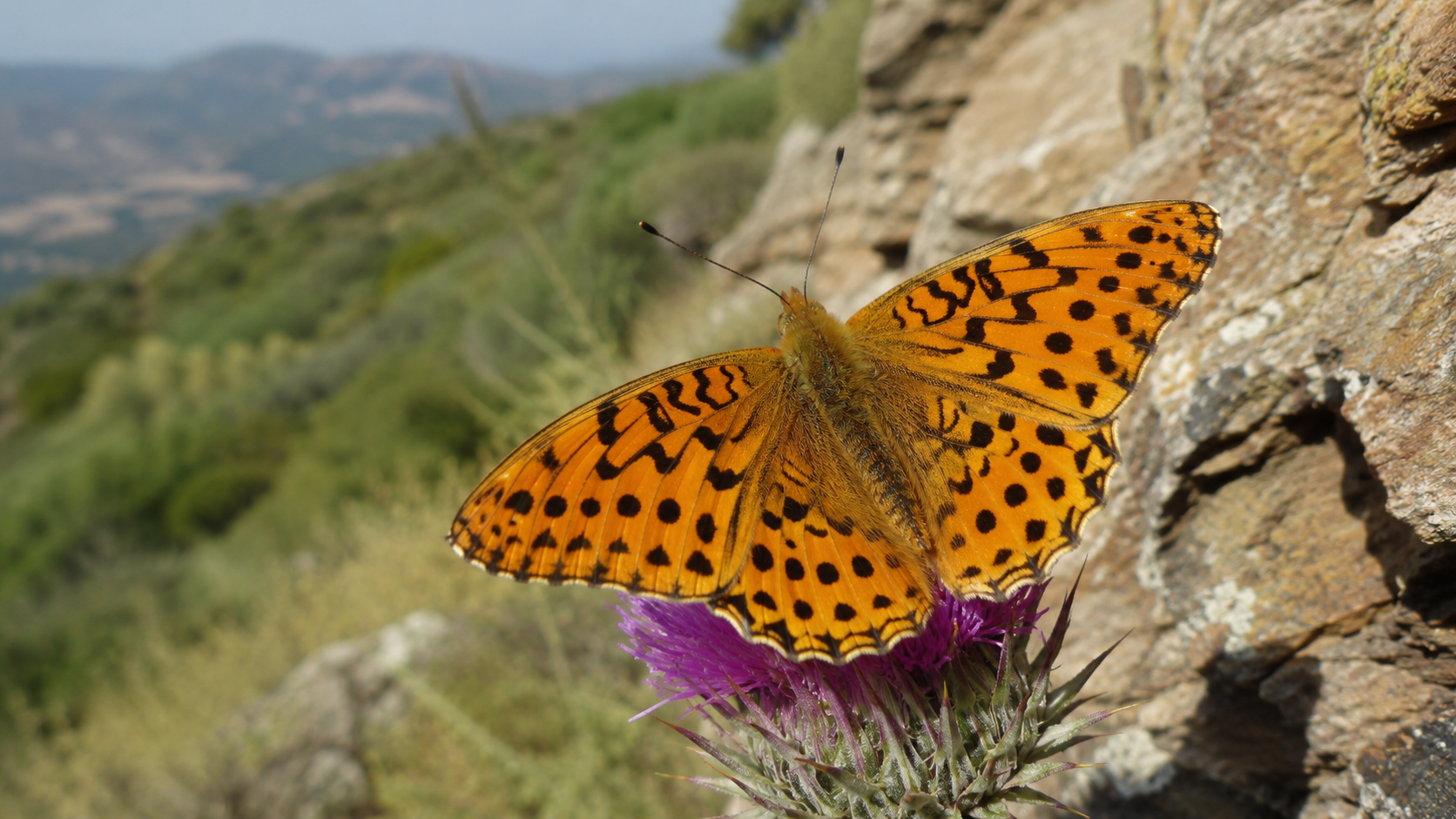
Upperwing: Orange-tawny with the characteristic fritillary pattern of black spots, lines, and chevrons, broadly similar to the silver-washed fritillary. Fresh males often show a subtle olive-green or sage-green flush on the hindwing base — a feature unique among large fritillaries. Females are larger and paler, with a more obviously greenish-tinged hindwing and a heavier black pattern on the forewing.
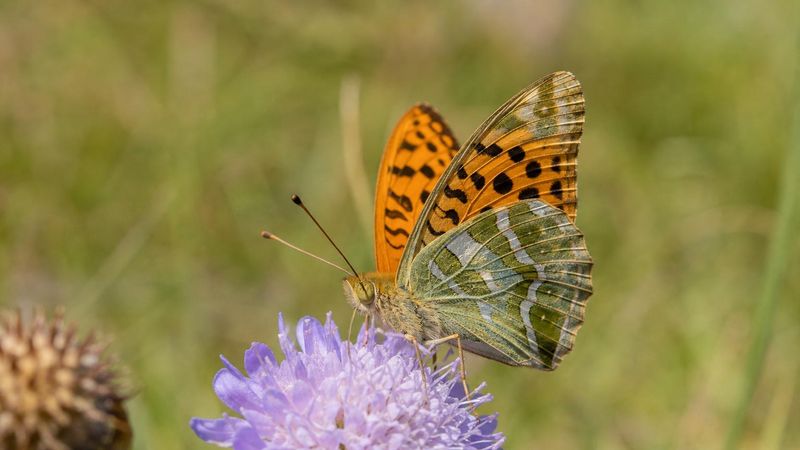
Hindwing underside: The definitive field mark. The basal two-thirds of the hindwing are covered in a distinctive pinkish-crimson or carmine suffusion — the "cardinal red" that gives the butterfly its English name — overlaid with a mosaic of irregular pale markings and a row of small silver spots along the outer band. The forewing underside is plain orange with a few dark spots. No other Western Palearctic fritillary shows this rosy-red underside coloration.
Males have a distinct sex brand (androconia) on the upper forewing, visible at close range as a band of thickened, dark-centred veins.
Range and habitat
The cardinal is a Mediterranean and continental steppe species with one of the widest ranges of any Argynnis fritillary. Its distribution extends from the Canary Islands and Madeira east across North Africa and the entire Mediterranean coast, through the Middle East, Turkey, Transcaucasia, Iran, Afghanistan, and Central Asia to the Tian Shan mountains and Kazakhstan — a range of over 9,000 km.
In Europe it occurs in:
- Southern France (Provence, Languedoc, Corsica)
- Iberian Peninsula (eastern and southern Spain, Portugal)
- Italy (south, Sicily, Sardinia)
- Balkans and Greece (widespread and locally common)
- Crimea and Caucasus (local)
Preferred habitats are dry, warm, rocky hillsides and limestone slopes with a mosaic of open grassland, scrub (garrigue, maquis), and light woodland. The key requirement is the presence of violets in rocky or shaded microhabitats, combined with large thistles and knapweeds for adult feeding. The species tolerates surprisingly hot and arid conditions and regularly flies in temperatures exceeding 35 °C.
Life cycle
The cardinal is single-brooded, with adults flying from late May to August (the peak typically in late June and July). At higher elevations in Turkey and the Caucasus the flight period may extend to September.
Eggs are laid singly in the immediate vicinity of violet plants, often directly on the soil, dry leaf litter, or stones rather than on the plant itself. This is typical of large Argynnis fritillaries — the female selects a microhabitat where violet leaves are accessible but does not always oviposit directly on the foodplant.
The caterpillar hatches in late summer, feeds briefly, then enters larval diapause over winter, typically sheltered among leaf litter or in crevices in the soil. Development resumes in spring; the larva feeds nocturnally on violets and is fully grown by May. The pupa hangs freely from low vegetation.
Behaviour
Males are conspicuous and relatively approachable. They spend extended periods nectaring on tall flowers — thistles (Cirsium, Carduus), knapweeds (Centaurea), and scabious are strongly preferred — returning repeatedly to the same patch. Between feeding bouts they perch on prominent stems or rocks in sunshine, making short sorties to investigate passing individuals.
The cardinal's flight is powerful and direct, with the characteristic large-fritillary style of fast, shallow wingbeats interspersed with glides. When alarmed, it flies strongly uphill and disappears over a ridge with speed that makes pursuit difficult.
Females are considerably less visible: they spend much of their time walking in low scrub and among rock crevices, probing for suitable egg-laying sites near violet plants, and nectar only occasionally.
Conservation
The cardinal is listed Least Concern (LC) globally and is not considered threatened across most of its broad range. In parts of the Mediterranean it is a common and regularly encountered species. Populations in Crimea and at the northern edge of its European range are small and more sensitive to habitat change; several regional lists in southeastern Europe classify it as Near Threatened.
The main local threats are the conversion of dry hillside garrigue to vineyard and olive cultivation, urban and tourist development of coastal slopes, and the loss of traditionally grazed rough grassland that supports the violet populations on which the larvae depend. Conservation benefit comes primarily from protecting rocky limestone hillsides from intensive land use — the same habitats that support important plant and reptile communities.