Butterflies of Bolivia
Bolivia records an estimated 3,000–3,500 butterfly species — among the highest totals on Earth. Geography compresses Andean altiplano to Amazon lowlands.
Overview
Bolivia is landlocked in the heart of South America, straddling the Andes and the Amazon basin. Its territory descends from the high altiplano at 3,500–4,000 m — one of the world's highest inhabited plateaus — down the steep eastern Andean escarpment through cloud forest and subtropical valleys, and spreads across the vast lowlands of the Amazon and Pantanal to the east and south.
This single country therefore contains a complete cross-section of South American ecosystems, and its butterfly fauna reflects this: an estimated 3,000–3,500 species, distributed across habitats as different as sparse puna grassland at 4,000 m and flooded igapó forest at 200 m. Bolivia is consistently cited as one of the world's five most butterfly-rich countries.
The Yungas — Bolivia's butterfly jewel
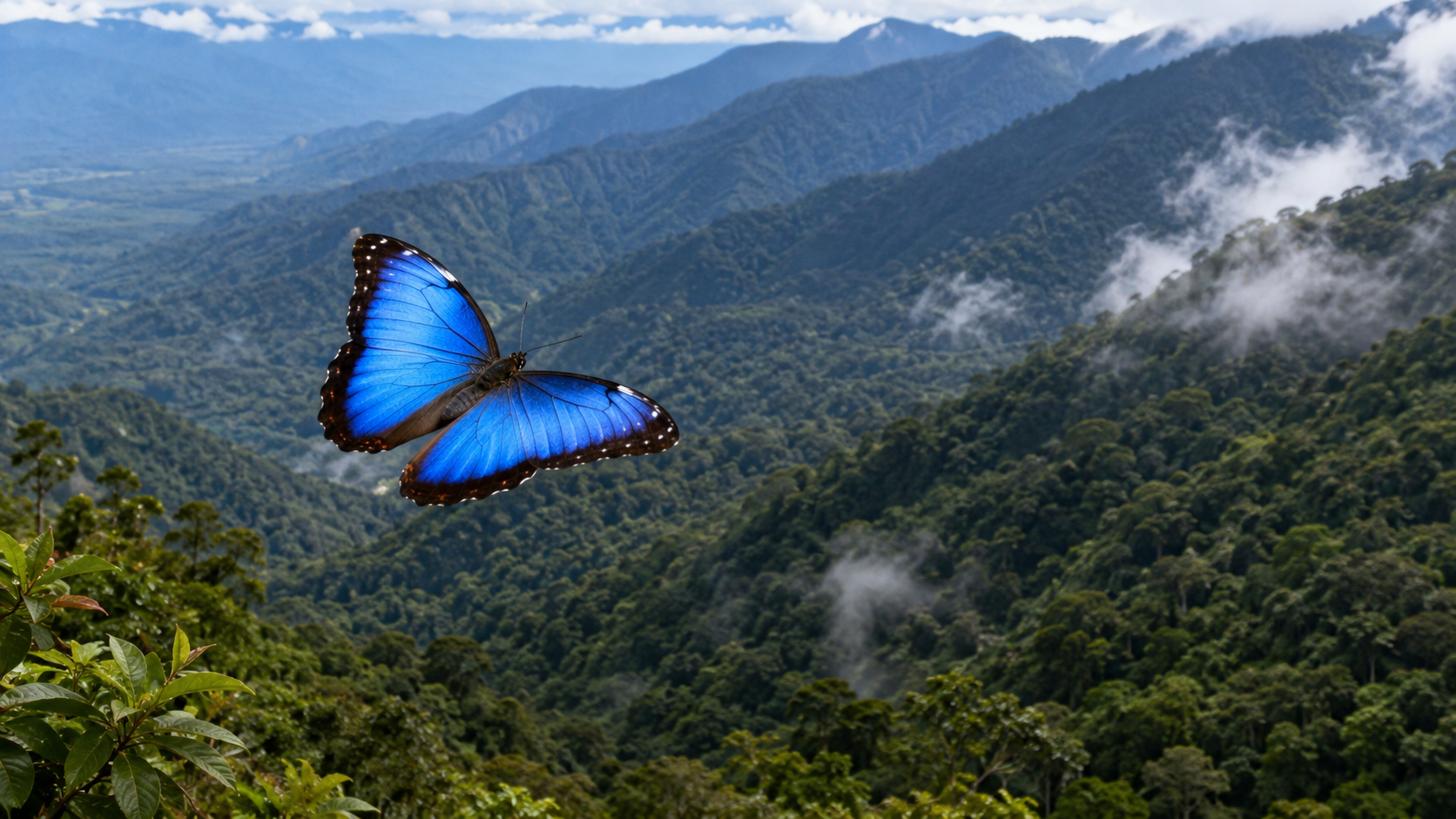
The Yungas — the humid subtropical and cloud forest belt on the eastern Andean slopes — is the heart of Bolivia's butterfly diversity. Occupying elevations roughly between 800 and 2,800 m, it forms a band along the entire eastern face of the Bolivian Andes, characterised by persistent cloud cover, high rainfall, and extraordinary botanical richness.
The key features that drive Yungas butterfly diversity:
- Altitudinal compression: species typical of lowland Amazon and species typical of Andean cloud forest meet and overlap, producing both communities simultaneously within a small area
- Habitat heterogeneity: each ridge and valley has slightly different exposure, soil, and microclimate, promoting local endemism
- Seasonal stability: the cloud forest maintains relatively constant temperature and humidity year-round, supporting more species than seasonally extreme habitats
Notable Yungas species include:
- Agrias claudina — scarlet-and-blue canopy nymphalid (see species page)
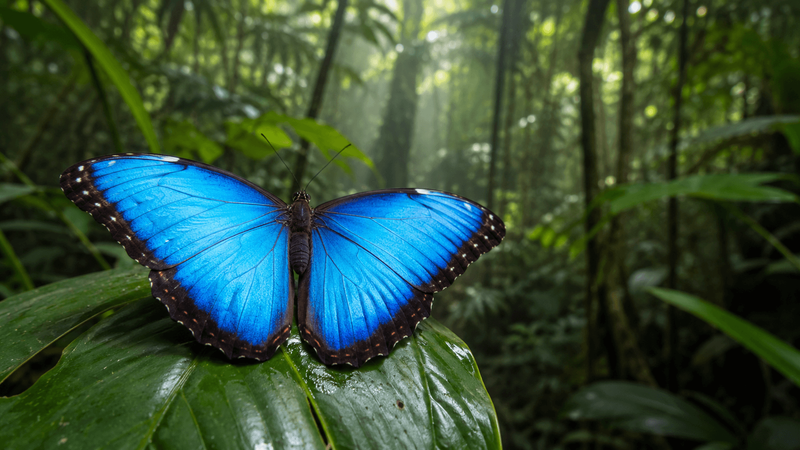
- Morpho menelaus and M. achilles — brilliant blue morphos of forest edges and rivers
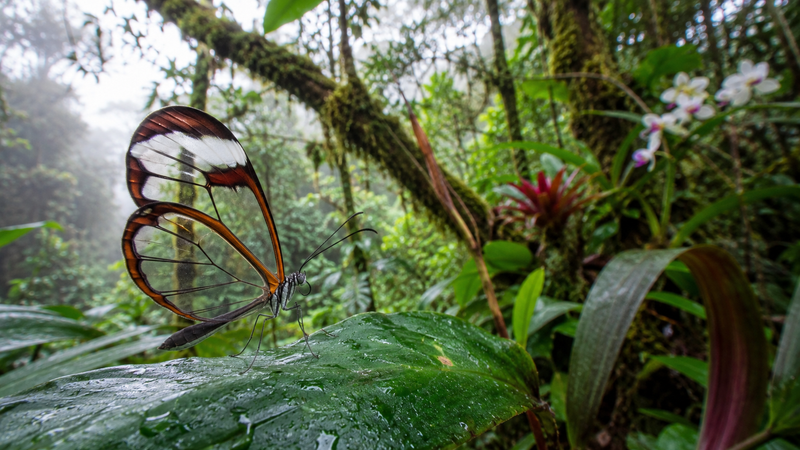
- Ithomia and Napeogenes glasswings — transparent-winged nymphalids that drift through forest understory in toxic mimicry rings
- Multiple Heliconius species, including H. melpomene and H. erato — Müllerian co-mimics with bold red and yellow patterns
- Papilio zagreus and P. thoas — large swallowtails of forest clearings
Coroico and the "Death Road"
The North Yungas Road descending from La Paz to Coroico passes through one of the most concentrated altitudinal gradients in South America — dropping nearly 3,600 m in 60 km. The former road (now a mountain bike and hiking route) passes through continuous Yungas cloud forest and is among the most accessible butterfly-watching transects in Bolivia. Species composition changes dramatically every few hundred metres of altitude.
Amazon lowlands
East of the Yungas escarpment, the Bolivian Amazon spreads across Beni and Pando departments — flat, seasonally flooded forest and savanna, geologically and climatically part of the greater Amazon basin.
This zone adds purely Amazonian species absent from the mountains:
- Prepona and Archaeoprepona — powerful, canopy-level Charaxinae with iridescent blue-green upperwings
- Caligo owl butterflies — huge brown nymphalids with massive eyespots on the underside; crepuscular
- Morpho deidamia and other lowland Morpho species
- Urania leilus — a day-flying moth frequently mistaken for a butterfly, with iridescent green and black wings, sometimes seen in massive migration events
The Madidi National Park (1.9 million ha, Beni department) is one of the world's most biodiverse protected areas; surveys have documented over 2,000 butterfly species within the park, and experts estimate the true total could approach 3,000 for this single site.
Andean high zones
Above the Yungas, the Bolivian Andes support a progressively specialised high-altitude fauna. The puna grassland and altiplano above 3,800 m have far fewer species but include genuine high-altitude endemics:
- Colias species adapted to Andean conditions — including C. dimera and C. euxanthe on high grassland
- Tatochila whites — genus endemic to the Andes
- Phulia whites — snowfield and rocky slope specialists above 4,000 m
- Several high-altitude Lycaenidae restricted to individual mountain ranges
The Salar de Uyuni region, despite its extreme aridity and altitude, supports a small but distinctive community of open-country whites and blues.
Chiquitano dry forest and Pantanal
In eastern Bolivia, the Chiquitano dry forest of Santa Cruz department and the margins of the Pantanal wetland add seasonal subtropical species distinct from both Yungas and Amazon:
- Dione juno — orange and black heliconiid
- Various Eurema and Phoebis yellows and sulphurs
- Anartia jatrophae — white peacock, a common open-country nymphalid
Seasonality
Bolivia spans several climate zones with different seasonal patterns:
| Region | Best period | Notes |
|---|---|---|
| Yungas | May–October (dry) | Cloud forest accessible, most species in flight |
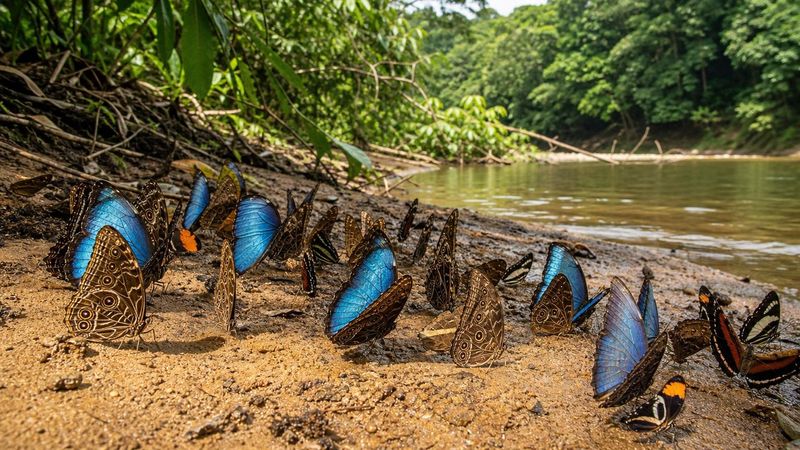
| Amazon lowland | July–September | Peak dry season; mud-puddling concentrations on river beaches |
| Altiplano | October–March | Warm season; Colias and whites most active |
| Chiquitano | September–November | Transition season with maximum wildflower diversity |
Conservation
Bolivia retains approximately 57% forest cover, among the highest in South America, and its network of protected areas — including Madidi, Amboró, Noel Kempff Mercado, and Pilón Lajas — covers extensive areas of the most biodiverse habitats. However, agricultural expansion (particularly soybean cultivation and cattle ranching in Santa Cruz department), road construction into the Amazon, and coca cultivation in the Yungas all create deforestation pressure. The pace of documented change accelerated sharply in the 2010s.
Bolivia's butterfly fauna is dramatically under-documented by international standards — many Yungas ridge systems have never been surveyed, and new species are described every year from existing museum collections. The country represents one of the great frontiers of remaining butterfly discovery.